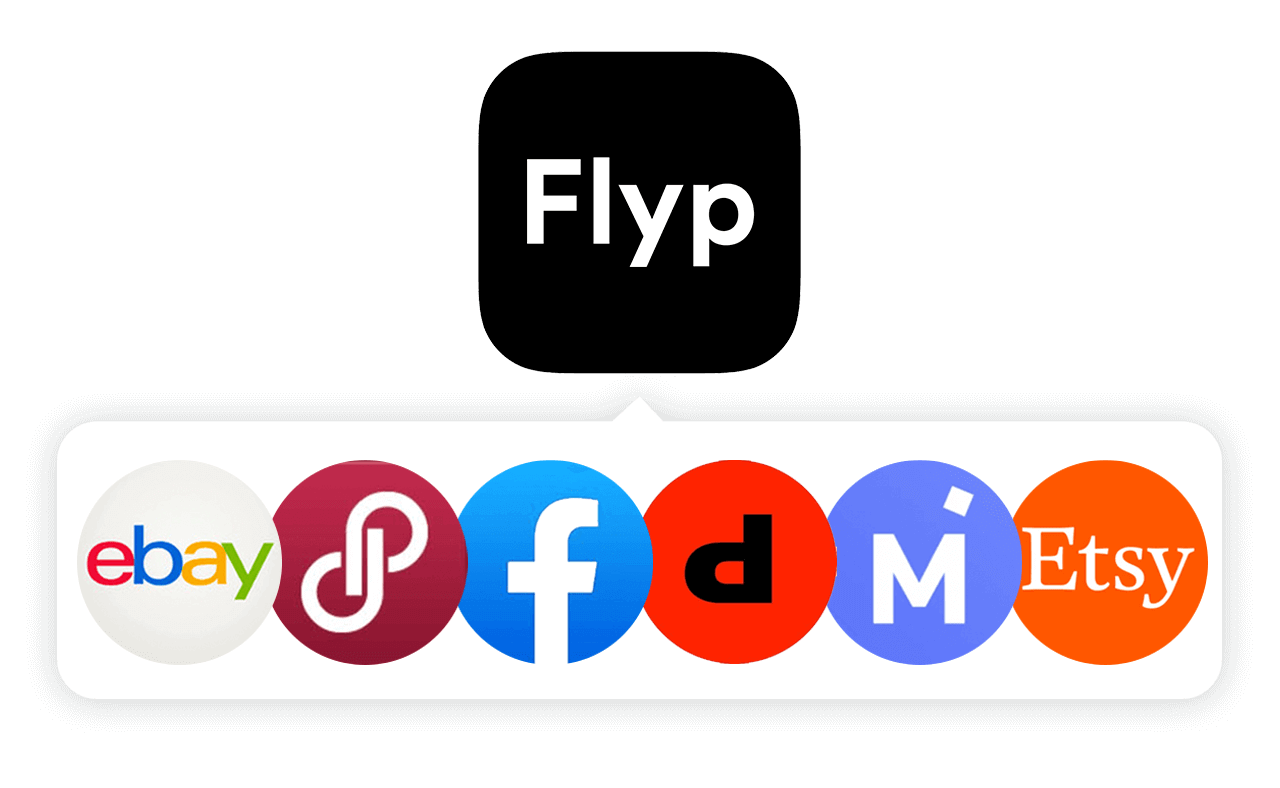
Here is a problem that sounds too small to build a company around, which is usually a sign that it is exactly the right size. You have a closet full of clothes you no longer wear. You could sell them. The catch is that "sell them" is not one action - it is the same action performed over and over, once per marketplace, because a buyer on Poshmark is a different person than a buyer on eBay, who is a different person than a buyer on Mercari or Depop or Etsy or Facebook. Each platform wants its own photos, its own title, its own description, its own price. Do the math on a few hundred items and you have invented yourself a part-time job that mostly consists of copying and pasting.
Flyp's whole existence is a bet that this copying-and-pasting is worth automating. The company, founded in San Francisco in 2018 by James Kawas and Dani Arnaout, makes a tool called the Crosslister that takes one listing and re-posts it across all six of those marketplaces. It reads the item you already listed, copies the photos and the text and the price, and fills in the forms on the other platforms for you. When something sells on one marketplace, it can auto-delist the item from the rest, so you don't accidentally sell the same jacket twice.
That is the boring, useful core. Around it Flyp has built the rest of the reseller's toolkit: a Poshmark "Sharer" bot that shares your closet on a schedule, sends offers to people who liked your items, follows and unfollows to juice your reach, applies automatic discounts, and - in the detail that most delights and unsettles - solves the CAPTCHAs that would otherwise interrupt the automation. There is an orders dashboard, inventory tracking, analytics, and a background remover for cleaning up product photos. The pitch is that everything a small resale operation needs sits in one place.
The number that makes Flyp interesting is the price: nine dollars a month, flat, after a 100-day free trial, with no tiers and no add-ons. Competing crosslisters have historically charged upward of a hundred dollars a month. When your product does roughly the same job as the incumbents, pricing it at a tenth of theirs is not a feature - it is the strategy. It is also the kind of move that only works if you have some other way to make money, which Flyp does.
That other way is the part the founders actually get excited about. Kawas describes Flyp's revenue engine as an algorithmic matching platform: it pairs a regular consumer, or a liquidation company, or a donation center - anyone sitting on a pile of used goods they don't want to sell themselves - with a "power reseller" who will. Flyp handles the logistics of moving the inventory and takes roughly a 5% commission on the transfer. The free-ish software gets resellers onto the platform; the matching business is where the money is supposed to come from.
This reframes what Flyp is. It is not really a browser extension company. It is a company that has decided the resale economy has a supply problem, not a demand problem. There is a nearly infinite amount of used stuff in the world. What's scarce is people willing to photograph it, list it, answer buyer questions, and ship it. Kawas pegs the U.S. count of these power resellers at around 350,000, most of them part-timers. Flyp's thesis is that if you give those people enterprise-grade tools and a steady feed of inventory, they become the processing layer for the entire secondhand market.
Investors bought the pitch. In May 2022 Flyp announced a $10 million Series A led by Asymmetric Capital Partners, with a long tail of participants - NextView, Afore, Interlace Ventures, Alante Capital, BAM Ventures, 1517, GroundUp, Gaingels, Tectonic Ventures - and, notably, Ryo Ishizuka, a co-founder of Mercari. That last one is worth pausing on. Mercari is one of the marketplaces Flyp helps sellers list on. A marketplace insider writing a check to a company that helps sellers be everywhere at once suggests the marketplaces themselves don't see cross-listing as a threat so much as plumbing. Reported total funding across sources sits somewhere between $14.3 million and $24.5 million, and by 2024 Flyp was said to be around $3 million in annual recurring revenue.
Kawas is not new to secondhand commerce. Before Flyp - which spent its early life under the name Brisk - he built Saily, which became one of the top-ranked secondhand shopping apps in the U.S. with millions of downloads. The lesson he seems to have carried into Flyp is that the buyer side of resale is crowded and well-served, while the seller side is starved for tools. So he built for the sellers.
There is an honest wrinkle, and to Flyp's credit its own users are loud about it. Because the tool runs largely as a Chrome extension that watches your active browser tab, it needs your computer awake to work. Close your laptop and the auto-delist feature can quietly stop monitoring your sales, which means an item that sold on Poshmark might linger on eBay until you open the lid again. Veteran sellers also grumble when Poshmark tweaks its sharing algorithm and the bot has to catch up. These are real constraints, and the interesting thing is that they are the kind of constraints that come from building a genuinely cheap, browser-native product rather than a heavier server-side one. The $9 price and the "keep your laptop open" caveat are two sides of the same architectural coin.
Underneath the tooling sits a tidier story that Flyp likes to tell: every hoodie that gets resold is a hoodie that didn't go to a landfill. The company frames its mission around keeping goods in circulation, which makes reseller income and waste reduction the same problem viewed from two angles. Whether or not you find that framing convincing, it does explain why a company selling a copy-paste utility talks about a "reseller revolution." The utility is the wedge. The circular, distributed, always-on resale supply chain is the ambition. For now, though, it mostly does the humble, valuable thing: it lets one person sell one item six times without losing an afternoon to forms.