I · Right now, in a browser somewhere
The browser tab that ships hardware
A mechanical engineer in Berlin opens a tab. She types a sentence about the device she wants. Twenty minutes later, Flux is ordering parts.
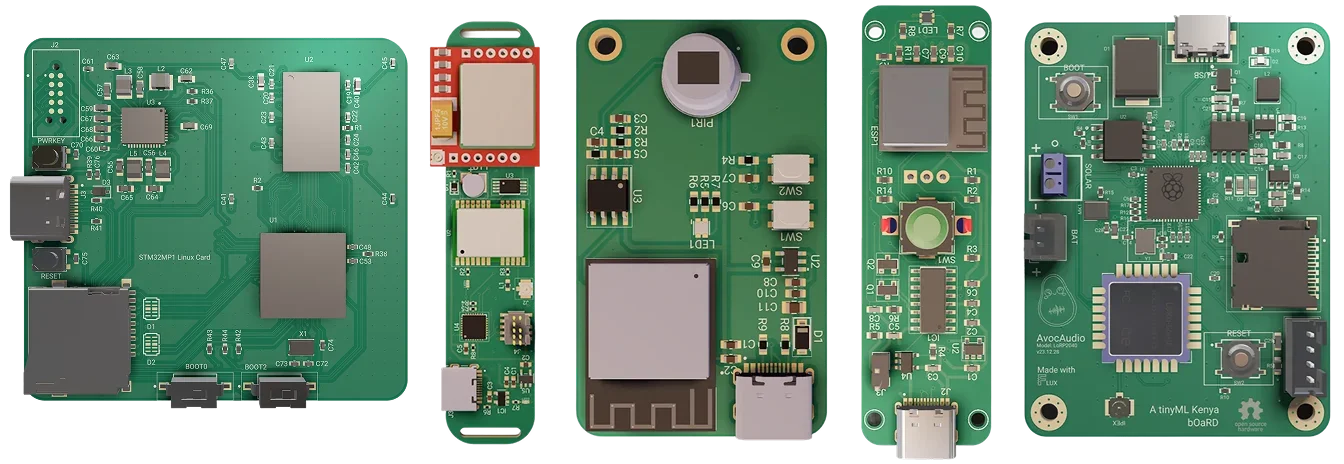
That is the scene Flux has spent six years engineering toward, and as of late 2025 it is, more or less, real. The San Francisco company runs an electronic design automation platform that lives entirely in a web browser, on top of an AI agent it calls the AI Hardware Engineer. Schematics, footprints, layout, design rule checks, the bill of materials, the handoff to a fabricator - the whole grim parade of tasks that traditionally devoured a hardware engineer's week now happens, increasingly, on prompts.
Flux is what happens when the people who built modern consumer software get bored and decide the electronics industry deserves the same favor. It is a small company of about 110 people backed by 8VC, Bain Capital Ventures, the GitHub founder, and a Figma board member. It is used by more than 300,000 engineers and at least one team that flew a satellite with a board drawn inside it. And it is the rare AI startup whose output is not a chatbot transcript but a chunk of fiberglass with copper on it.
"This is Figma for circuit design - ridiculously slick software in a space where everyone else's UX is stuck in 2005."
A Flux user, reviewing the platform
Translation: the compliment hardware tools rarely get.
II · The problem they saw
Hardware was stuck in a desktop circa 2005
Anyone who has tried to design a printed circuit board in the last twenty years has met the same villains. The leading tools - Altium, OrCAD, Eagle - are powerful, expensive, and shaped like CAD software was shaped when George W. Bush was still in office. They install locally. They guard files behind license dongles. They do not collaborate, not really, not the way Google Docs collaborates. Reviewing a colleague's schematic typically involves a PDF and a prayer.
Meanwhile, software engineering has spent the same two decades being rebuilt around the browser, around Git, around chat-based copilots that complete a thought before it's typed. The gap between these two worlds - one fluid, one fossilized - is the gap Flux exists to close.
Hardware founders feel it acutely. A startup that wants to ship a smart sensor, a robot, or a piece of medical equipment needs an electrical engineer who knows the old toolchain, and that engineer is expensive, scarce, and unable to iterate at the pace the rest of the team takes for granted. The PCB is almost always the bottleneck. The PCB is almost always the reason the demo slips.
"We want to take the hard out of hardware."
Matthias Wagner, Co-founder & CEO
A slogan and a thesis statement. Which is which depends on the day.
III · The founders' bet
A product manager, a maker, and a Burning Man problem
Matthias Wagner spent his pre-Flux years at Facebook, where he shipped pieces of the Moments app, augmented-reality ads, and the early Oculus stack. He is, by training and inclination, a software person. He is also a builder of off-grid power systems for desert encampments, and somewhere along the way the two parts of his life collided. Designing the electronics for a Burning Man camp turned out to be harder than designing software for a billion people. The tooling, he decided, was the problem.
In 2019 he co-founded Flux with Lance Cassidy and Christian Blank. The bet was not subtle: rebuild electronic CAD from scratch, in the browser, multiplayer by default. Make it look like a tool an engineer in 2025 would actually want to open. Then, when the AI wave arrived, push it harder than anyone else in the category was willing to.
It was a bet on two things at once - that PCB designers would tolerate switching tools, which is famously the hardest switch in engineering, and that AI could meaningfully participate in a domain where being almost right means burning a $200 prototype.
"A space startup used Flux to design and produce a board for a satellite mission that successfully went to space. That was a very cool moment for us."
Matthias Wagner
When the failure mode of your tool involves orbit, you tend to test carefully.
IV · The product
From assistant, to co-designer, to engineer
Flux has shipped its AI strategy in three escalating chapters. The first, in 2023, was Flux Copilot - a chat panel beside the editor that could answer questions about parts, suggest components, and review schematics. It was the industry's first AI design assistant baked into a PCB tool, and it was useful in the way an opinionated intern is useful.
The second chapter graduated Copilot into a co-designer. It could now do real work: place components, draw connections, sanity-check a power rail. The third chapter, announced in October 2025 alongside the Series B, is the one that turns the screw. The AI Hardware Engineer is an agentic system that takes a natural-language brief, researches part availability and pricing through live distributor data, generates the schematic, lays out the board, and prepares the manufacturing files. It is not a toy. It is the platform's most aggressive attempt yet to compress weeks of work into hours.
What you can actually do with it
Describe
"A USB-C battery monitor"
Plain English in, schematic out.
Source
Live BOM
Real parts, real prices, real stock.
Layout
Auto-route
Copilot handles the tedium.
Collaborate
Multiplayer
Your colleague's cursor, on your board.
Manufacture
Gerbers out
One click to a fab.
No install
Browser-only
Goodbye license dongle.
A Flux Timeline
Six years, three AI chapters, one satellite
- 2019Matthias Wagner, Lance Cassidy, and Christian Blank found Flux in San Francisco.
- 2021$2M seed. Early backers include GitHub co-founder Tom Preston-Werner and Figma board member John Lilly.
- 2022$10M Series A led by Bain Capital Ventures and 8VC. Browser-based eCAD goes public.
- 2023Flux Copilot launches - the first AI assistant inside a PCB editor.
- 2024Copilot is upgraded from assistant to co-designer. A satellite ships with a Flux-designed board.
- 2025$27M Series B led by 8VC. The AI Hardware Engineer agent ships. Platform crosses 300,000 engineers.
V · The proof
The numbers, the customers, the orbit
It is one thing to claim a category. It is another to land it. Flux's evidence stack is, by hardware-tool standards, unusually concrete. A user base north of 300,000 engineers, spanning hobbyists tinkering with vending machines and Fortune 500 teams working on real product lines. A satellite that flew on a board the platform helped design. Investors who have seen this movie before: 8VC and Bain Capital Ventures led the Series B, with John Lilly and Tom Preston-Werner on the cap table from earlier rounds.
Where the dollars sit
Flux funding by round · USD millions
Source: Flux disclosures and reporting. Bars are scaled to total raised, not to ambition.
Numbers can be flattered; switching costs cannot. The brutal truth about PCB software is that no engineer changes tools for fun. Flux's growth implies a different calculation: that the productivity gain from a browser-native, AI-native workflow outweighs the pain of leaving a known toolchain. That is the metric the round is really betting on.
"With almost no electronics background, I used Flux to design boards and launch a vending machine business fast. Hardware became possible."
A Flux user testimonial
If the line between hobbyist and founder gets thinner, this is the kind of tool that does it.
VI · The mission
Take the hard out of hardware
Wagner's tagline gets quoted because it is short and because it survives translation. Flux's mission is not to add AI to a PCB tool. It is to redraw the line between people who can build physical things and people who cannot. Today that line cuts cleanly through the population. A handful of trained electrical engineers can summon working hardware. Everyone else commissions it, slowly and expensively.
An AI Hardware Engineer in a browser tab does not erase electrical engineering as a discipline. It does, however, raise the floor of what a non-specialist can attempt. A mechanical engineer can prototype the sensor board they need without waiting six weeks for a contractor. A founder can validate a hardware idea on the same day they have it. The total amount of physical product the world is capable of inventing goes up.
"PCB design is the bottleneck of the physical world. The bottleneck is finally moving."
Editor's note
VII · Why it matters tomorrow
Robots, drones, satellites - everything needs a board
The category Flux is reaching for is much larger than CAD. The next decade of useful things - humanoid robots, climate sensors, off-grid power, defense tech, medical wearables, the second wave of consumer hardware - all require somebody to draw a printed circuit board. The electronic design automation market sits at roughly $15.9B and is forecast to roughly double over the next decade. PCB design software is its own multi-billion subsegment growing in the mid-teens.
Flux's wager is that the firm holding the AI-native, browser-native workflow will eat a disproportionate piece of that growth, because the new generation of hardware builders will never have learned the old tools and will not be inclined to. There is precedent. Figma did not displace Adobe by being slightly better at vectors. It displaced Adobe by being a different shape entirely.
Whether Flux can pull off the same trick against Altium and Cadence is the question the next two years answer. The Series B suggests a number of serious people think the answer is yes.
VIII · Closing scene
Back to the tab
Return to the engineer in Berlin. The schematic Flux drafted is on her screen. She edits two components, adjusts a trace, signs off on the bill of materials, and exports. Somewhere in Shenzhen a fab queue ingests her Gerbers. In nine days she will hold a working prototype.
She is not an electrical engineer. She is a mechanical one who decided, today, to be both. That is what Flux is for. That is the line moving.