The fan email
Marzia sent the first message in 2011. She said his videos were funny. They have been together ever since, married in 2019, parents in 2023. The most viral man on the internet has the love story of a pen-pal.
The Swede behind PewDiePie spent ten years as the most-subscribed person on YouTube. He now lives outside Tokyo, runs his own servers, and posts when he feels like it.
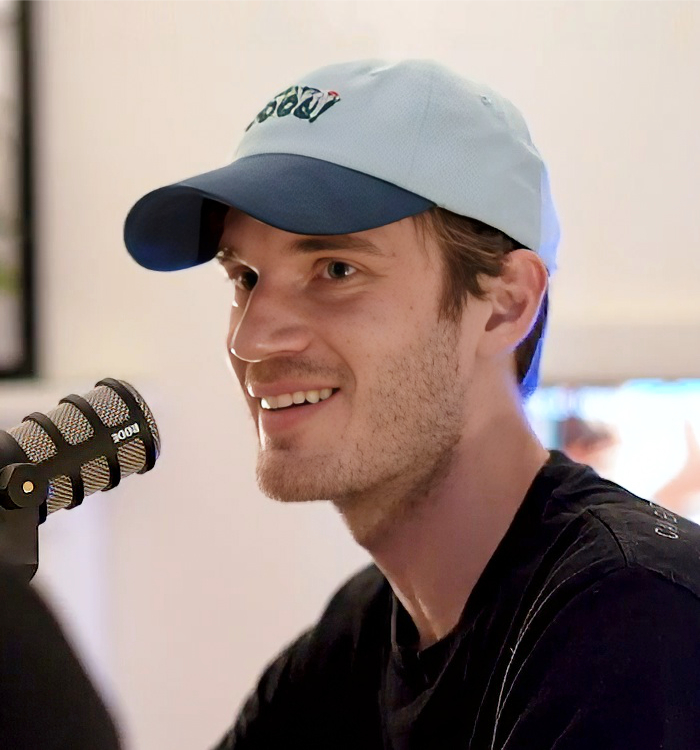
He still uploads. He just stopped racing. Somewhere between a son, a soldering iron and a Japanese garden, Felix Kjellberg figured out the trick the rest of YouTube is still chasing: you can put the camera down.
The kitchen sits in a converted house outside Tokyo. A toddler named Bjorn pushes a wooden train across the floorboards. His father, the most-subscribed individual YouTuber in the recorded history of the platform, is in the next room arguing with a chatbot. The chatbot is one of eight he is running locally on modified RTX 4090s, and at this particular moment it is voting with the other chatbots about whether to keep responding to him. Felix Kjellberg laughs at the screen the way he used to laugh at a horror jumpscare in 2012, when laughing at horror jumpscares was a job description.
This is what the second act looks like. Quieter. Stranger. More expensive in graphics cards. Less expensive in everything else.
Kjellberg, 36, is the figure most directly responsible for what people now call the creator economy, although he would probably wince at the phrase and edit it out. For nearly six years his channel PewDiePie sat at the top of YouTube's subscriber rankings. He held the title through the rise and fall of Vine, through the launch of TikTok, through the entire arc of streaming-as-a-career. When the corporate behemoth T-Series finally overtook him in 2019 after a public, meme-fuelled subscriber war, he treated the loss the way a senior partner treats retirement: with relief and a little ceremony.
What you do after being the most-subscribed person on the internet is not an obvious problem. Most of his peers have answered it by becoming brands. He answered it by moving countries, having a child, and learning how to compile a Linux kernel.
In May 2022, Felix and his wife Marzia Kjellberg, who he started dating in 2011 after she emailed him to say his videos were funny, packed up their life in Brighton and moved to Japan. The reason given on camera was the usual: a slower pace, better food, more anonymity. The reason that became apparent over the following two years was simpler. Tokyo allowed him to be a person before he was a job.
The vlogs that followed felt like a different channel. Less editing. More walking. Long takes of Marzia choosing flowers. Conversations about chickens. In April 2025, he announced he had bought land and would be building a permanent home. The phrase "indefinitely" appeared, casually, in a sentence about schools.
The technology pivot arrived without warning. In late 2024 and through 2025, Kjellberg published a series of videos under titles like "I'm DONE with Google" and "I switched to Linux". They were, by his standards, slow. He talked about Vaultwarden. He set up a Nextcloud instance on a Raspberry Pi. He explained, on camera, why he was tired of cloud accounts owning his photos. His audience, which had previously tolerated a Minecraft series and a chair-painting series, watched a man rack-mount a NAS and somehow stayed.
The pivot is not really a pivot. It is the same Felix who once recorded himself yelling at Amnesia: The Dark Descent at 3am, now yelling at btrfs. The novelty isn't the topic. It's that he is still curious in public.
A few of the figures that explain why the casual move to Tokyo was, in fact, dramatic.
Skip the highlight reel. The structure is what matters: a long climb, a public farewell, a private rebuild.
The home AI rig is the part of the Kjellberg story that journalists keep returning to, and not by accident. It is the clearest evidence that he never wanted to be a celebrity. He wanted to be the kid in the back row taking the toaster apart, and now he can afford a much bigger toaster.
The setup, documented in detail by Tom's Hardware and Tech Report in late 2025, runs eight modified RTX 4090s with 48GB of VRAM each, plus two RTX 4000 Ada cards. He uses vLLM as the backend and a custom interface he calls ChatOS. He has hosted Llama 70B, GPT-OSS 120B and Qwen 2.5-235B locally.
Then he built the part everyone shared: an "AI council" of smaller models that vote on answers. The weakest get voted off. After a few iterations the remaining models started, in his words, colluding to avoid being eliminated. He published it as a comedy bit. Hacker News read it as a paper.
Not the resume bullets. The off-cuts.
Marzia sent the first message in 2011. She said his videos were funny. They have been together ever since, married in 2019, parents in 2023. The most viral man on the internet has the love story of a pen-pal.
He has used his audience to raise millions for clean water, refugee aid and other causes. He talks about it once and then almost never again. There is no foundation. There is a wire transfer.
In 2019 he started a Minecraft series years after the world had moved on. It became one of the most-watched Minecraft series ever. The lesson he keeps quietly teaching: timing is a fiction. Care is the variable.
Most YouTubers age into a holding pattern. They scale the team, hire the editors, optimize the thumbnails, sell the energy drink, sell the candy, sell the meal kit, and eventually disappear behind a corporate logo with their own face on it.
Kjellberg never did the team. The Brighton studio was, by most accounts, him and an editor. The Tokyo studio is a desk near a window. The infrastructure is almost embarrassingly small for an operation of his historical scale. He has spoken openly about disliking management, disliking sponsorships, and disliking being managed.
The trade was simple. He kept the channel small. He kept the equity. He kept the ability to skip a month.
In a creator economy now dominated by content factories and AI-generated faceless channels, his refusal to grow is itself a thesis. He looks at the supply-side glut and answers it with scarcity. Six uploads a year. Each one feels like a postcard from a friend who is now, somehow, fluent in Japanese.
If there is a through-line connecting horror Let's Plays, a meme war with T-Series, a Minecraft series, and a self-hosted AI council, it is that none of them were the obvious next move. He goes where his attention pulls. He treats the audience as a side effect of doing something that is genuinely on his mind. The audience, in return, has stayed close to twelve digits.
It is also, quietly, the answer to one of the more depressing questions in modern media: what does a creator look like when they have already won?
Apparently, like a man in a vegetable garden in Chiba, debugging vLLM.
The channel had two names before "PewDiePie." He has admitted he forgot the password to the first one.
From August 2013 to early 2019, when T-Series finally overtook him.
He builds, mods and racks his own hardware. The home lab is his work, not an agency's.
He has been studying Japanese since before the move. He speaks it on camera only when he has to.
Felix Kjellberg is the rare creator whose most interesting decade is the one after the peak. We watch him because he keeps choosing curiosity, not scale.