YesPress Profile / Company
FeedbackNow
"The survey asked you how it went next week. We asked while you were still standing there."
"The survey asked you how it went next week. We asked while you were still standing there."
Walk through almost any major airport, and just past security you will find a small box with smiley faces on it. You have pressed one without thinking. That press is FeedbackNow's entire business - and it is a much bigger business than a button has any right to be.
The company sits on West 14th Street in New York with about 35 people. It does not look like an empire. But its little terminals stand in hospitals, train stations, retail aisles, and airport corridors across the world, quietly turning a smile or a frown into a number that someone in operations actually reads. That is the whole trick: making the smallest possible act of feedback count for something.
A survey is a conversation you have after the moment is gone. A button is a conversation you have inside it.
The FeedbackNow premise, in one lineHere is the uncomfortable truth about the customer survey: by the time anyone reads it, the customer is long gone. The line that was too slow has cleared. The bathroom that was a mess has either been cleaned or has stayed a mess for another six hours. The email asking "how did we do?" lands two days later, gets a 2% response rate, and tells a manager what was broken on Tuesday sometime around Friday afternoon.
FeedbackNow's founding observation was blunt: most experience measurement is an autopsy. It tells you what killed satisfaction long after the patient left. The interesting question was never how to write a better survey. It was how to collect a verdict at the exact instant the experience happens, from people who would never bother to open an email.
The bet was almost suspiciously simple. Strip feedback down to three taps - happy, neutral, unhappy - put it on a physical device at the point of experience, and make it anonymous so nobody hesitates. No app. No QR scan required. No login. No personal data stored at all. Just a hand reaching out on the way past.
It worked because it respected one thing surveys ignore: human laziness. People will not fill out a form, but they will press a button. FeedbackNow says that single design decision earns roughly twenty times the response rate of a traditional emailed survey. Twenty times more answers, from the people you most want to hear from - the ones already walking out the door.
People will not write you a paragraph. They will, however, slap a frowning face on their way to baggage claim.
Why hardware beat the inboxThe company's roots trace to Switzerland around 2012, where the Smiley Terminal idea took physical form for airports. In 2018, Forrester Research bought it, betting the buttons could become the front end of a "real-time CX cloud." For six years it lived inside a big research firm as "FeedbackNow by Forrester." Then, in September 2024, a group of investors did something rarer than an acquisition: they bought the company back out, and set it free.
// FeedbackNow milestones
The smiley is the marketing. The platform is the company. Behind the button sits an analytics engine that aggregates millions of presses, layers in sensor data - people counters, noise monitors - and uses AI to spot patterns a human dashboard-watcher would miss. The pitch is no longer just "see your scores." It is predictive service recovery: catch the dip before it becomes a complaint.
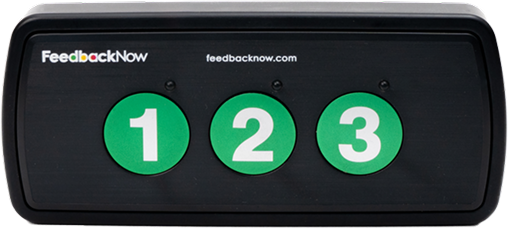
The original wireless, one-touch terminal. Anonymous, app-free, and time-tagged at the point of experience.
Six fully configurable buttons for category-specific feedback - cleanliness, staff, wait time - and richer analytics.
People counters and noise monitors that add environmental context to every rating.
Live dashboards and instant notifications that route a frown to the team that can fix it within minutes.
The original smiley is a friendly face on a powerful brain. Press it and the brain wakes up.
How FeedbackNow describes its own deviceSkepticism is fair. Plenty of "real-time" tools are dashboards that refresh on a schedule nobody acts on. FeedbackNow's defense is in the field data. One European retailer - station operator Grandi Stazioni Retail among the reference accounts - lifted checkout satisfaction from 73% to 77% in twelve weeks, a four-point move across a large network. The U.S. Department of Veterans Affairs uses the buttons to watch patient and visitor experience across multiple hospitals. Some clients now collect well over a million presses a year.
Checkout satisfaction, one European retail network
Four points sounds small until you multiply it by every checkout lane in a national network. That is the argument for measuring in minutes instead of quarters.
Four points sounds modest. Tell that to the manager who finally found the slow lane on the day it was slow.
The case for real timeCEO Steve Peltzman - MIT engineering, Columbia MBA, and a former Chief Business Technology Officer at Forrester - frames the spin-out as a chance to chase one idea without a public company's quarterly distractions: move experience measurement from survey-based hindsight to AI-powered foresight. The investors agree. "FeedbackNow's innovative roadmap aligns perfectly with the future of AI in business operations," said Rob May of AI Growth Capital Partners.
The mission is not "more feedback." It is feedback that arrives early enough to change the outcome. A frowning button at gate 12 is only valuable if someone reaches gate 12 before the next hundred travelers do. The whole company is built around shrinking that gap from days to minutes.
There is a reasonable worry here. Three buttons cannot capture nuance; a smiley does not explain why someone is unhappy. FeedbackNow's answer is volume and context. One vague frown is noise. Ten thousand frowns clustered at the same checkout, at the same hour, next to a noise sensor that spiked and a people counter that flagged a crowd - that is a sentence the data writes by itself. The bet is that breadth, layered with AI, beats the depth of a survey almost nobody answers.
Whether that bet pays off will decide if FeedbackNow stays a clever airport gadget or becomes the default way physical businesses feel their own pulse. The independent company is young again, well funded, and pointed squarely at that question.
So you walk through the airport, press the smiling face without thinking, and keep moving. The difference now is that somebody, somewhere, is already moving too.
Back where we startedThat box past security has not changed. What changed is everything behind it. The press that used to vanish into a quarterly slide now lands on a screen while you are still tying your shoes at the gate. The survey asked how it went. FeedbackNow just watches it happen - and occasionally, fixes it before you notice anything was wrong at all.