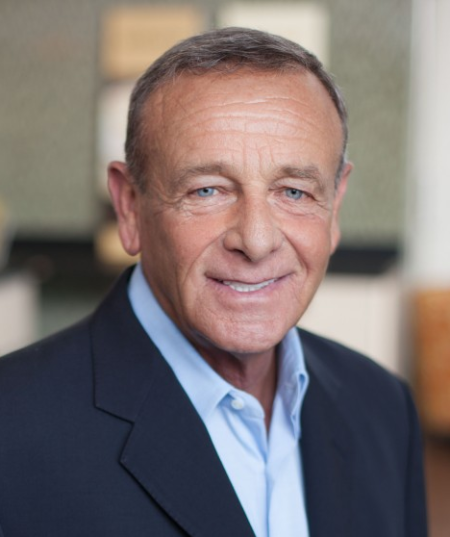
01 / The PitchCafeteria food, but cooked.
Fedele Bauccio runs a company in Redwood City that serves Google's engineers lunch, Duke's freshmen dinner, and the Getty Center's tourists a sandwich. Bon Appetit Management Company operates more than a thousand cafes across thirty-three states and clears revenue north of a billion dollars a year. He has been its CEO since it existed.
The whole thing was supposed to be impossible. In 1987, when Bauccio and his partner Ernie Collins launched the company out of Palo Alto, the rule of contract food service was simple and brutal - buy the cheapest ingredient, reheat it, charge the client, repeat. Bauccio's pitch broke the rule on purpose. Hire trained chefs. Buy real ingredients. Cook from scratch. Charge a little more. The investors he showed it to said clients would never pay for it. The clients he showed it to said they had never been offered it.
He kept going. The business did too. Bon Appetit was acquired by the British giant Compass Group in 2002, and instead of being absorbed, Bauccio kept the kitchen lights on and the name on the door. He still uses the word "we" the way founders do, even after almost four decades. He still tastes the food on site visits. He still drives the cherry-red Vespa.
02 / The ArgumentThe cafeteria as politics.
Most food service companies sell calories. Bauccio sells a worldview. Walk through one of his cafes and you will see the menu, sure, but you will also see a placard about gestation crates, a poster about Florida tomato pickers, a tag identifying the farm that grew the lettuce. None of it is decorative. It is procurement policy made legible.
In 1999 he launched Farm to Fork, a program with a specific number attached - at least twenty percent of every cafe's ingredients had to come from small, owner-operated farms within 150 miles of the kitchen door. The word "locavore" was not yet in the dictionary. The phrase "supply chain transparency" was not yet on consultant slide decks. He just had chefs and a region and a rule.
The numbers stacked up. By 2008, Nation's Restaurant News named him Innovator of the Year for proving that scratch cooking and local sourcing could scale past the boutique stage and into corporate cafeterias the size of a small town. By 2014, EY gave him the National Retail and Consumer Products Entrepreneur of the Year for the same reason, in fancier language.
The fights he has picked
Procurement as activism
- First contract food company to commit to cage-free shell eggs.
- Phased out pork from suppliers using gestation crates.
- Removed milk from cows treated with the growth hormone rBGH.
- Sources seafood only from Seafood Watch "best choice" or "good alternative" lists.
- Adopted the Coalition of Immokalee Workers' Fair Food Program standards for tomato suppliers.
- Antibiotic-stewardship policy on beef, chicken, and turkey.
Each of those policies costs more than the alternative. Each of them began with Bauccio telling buyers, in the politest possible Italian-American way, to stop. He has been doing this long enough that the rest of the contract food industry has had to follow him; the writers of corporate sustainability reports now use his categories.
03 / The BackstoryThe dentist who didn't.
He was raised by Italian immigrants. He arrived at the University of Portland intending to become a dentist. The college needed dishwashers and he needed money, so he took a tray of dirty plates as a freshman in 1960 and stayed. By his junior year he was managing the campus food service. He graduated in 1964 with a degree in economics, and in 1966 with an MBA from the same school. Dentistry never came back up.
From there it was Saga Corporation, the now-defunct Bay Area food service giant where a generation of operators trained. Bauccio climbed through Saga to Divisional President and then to President of the Specialty Foodservices Group. When Saga was sold in the mid-1980s, he and Ernie Collins did what former Saga executives often did - they started their own thing. Theirs lasted.
04 / The Sentinel YearsFrom operator to advocate.
Between 2006 and 2008 he served on the Pew Commission on Industrial Farm Animal Production, a bipartisan group that ended up calling for the phasing out of confinement systems in U.S. animal agriculture. Most members were academics and policy people. He was the operator in the room - the one whose company actually bought millions of pounds of meat a year. The Commission's report read, in places, like Bon Appetit's purchasing manual.
He kept showing up. He testified, he wrote op-eds, he flew to Washington for hearings on antibiotics. In 2018 the James Beard Foundation handed him one of its inaugural Leadership Awards, alongside Michelle Obama and a small bench of food-system reformers, for being one of the people who had made the conversation possible. The International Association of Culinary Professionals gave him a Lifetime Achievement Award for the same reason. The University of Portland gave him an honorary doctorate in 2004. The President of Italy honored him in 2023 for his contributions to food and Italian-American culture.
Where the food comes from
Source: Bon Appetit public sourcing standards. Bars indicative.
05 / The OperatorWhy the food still tastes like food.
Most food service CEOs talk about "platforms" and "concepts." Bauccio talks about stock. He has spent four decades insisting that stocks be made from bones, not boxes; that dressings be whisked, not poured from jugs; that vegetables be cut in the building where they will be served. He treats this as a moral position because, in the contract food industry, it has functioned as one.
It is also a hiring strategy. The company employs more than 10,000 people across the country, and its kitchens skew toward people who trained in restaurants and got tired of restaurant hours. He gives them produce, a budget, and a brief - cook the way you were taught to cook, only on a larger scale. The chefs stay. The clients stay. The contracts compound.
He has built the company without acquiring its peers, which is unusual in his industry. He has built it without going public, which is also unusual. The Compass Group acquisition gave Bon Appetit the parent-company ballast it needed to grow into universities and museums; what it kept was a separate brand, separate chefs, and a co-founder who keeps showing up at six in the morning to argue about lentils.
06 / The QuirksNotes from the margins.
07 / What NowThe next thirty years.
He is past the age when most CEOs retire and he keeps not retiring. He still writes the columns. He still gives the speeches. He still goes after the suppliers. There is a generation of food service operators now whose entire vocabulary - "scratch kitchen," "farm-direct," "low-carbon menu" - he basically wrote, and he is not finished writing it. The climate fight, in his framing, is a food fight that nobody has admitted is a food fight yet.
Bon Appetit publishes a public Food Standards Dashboard so anyone can see, in numbers, how it is doing on the policies he wrote. Most operators in his industry would consider that a liability. He treats it as the point. If a company will not show you what it serves, he likes to say, it is because the company knows.