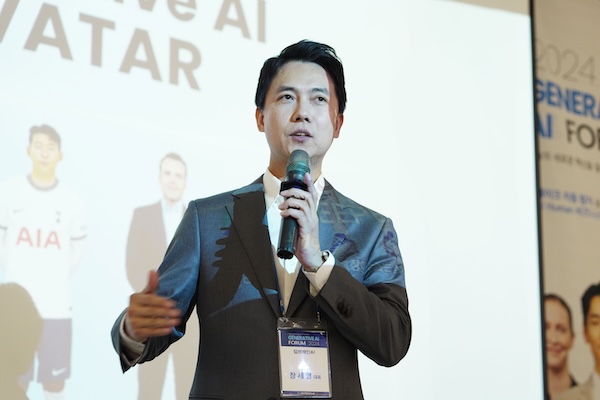
The man who decided AlphaGo changed everything
March 2016. Lee Sedol, one of the greatest Go players in history, loses four games out of five to a machine. The world watches and argues about whether it means something. Eric Seyoung Jang watches and starts building.
He had already run companies. He had already written code at SK Holdings, built mobile banking systems at Finger Inc., and been CTO before most people had a clear idea of what a CTO actually did. Three entrepreneurial ventures behind him, none of them quite the thing. Then AlphaGo played its 37th move in Game 2 - a move no human would ever have considered - and Jang saw not a curiosity but an inevitability.
He founded MoneyBrain in 2016. By 2021, it had become DeepBrain AI. By 2022, it had a valuation of 200 billion Korean won and headquarters in Palo Alto. The trajectory was not gradual.
"My goal has been to become the largest AI company in the world since I started my business."- Eric Jang, Founder & CEO, DeepBrain AI
What DeepBrain AI does is deceptively simple to describe and extraordinarily hard to build: it makes digital humans. Not animations. Not cartoons. Video-synthetic humans that a frame-by-frame pixel comparison places at 96.5% similarity to real footage. Chinese television stations use them as news anchors. Korean banks deploy them as customer service agents at kiosk terminals. The Korean National Police Agency uses a related tool - a deepfake detection system built by the same team - to catch people misusing the technology.
That last detail is worth pausing on. The company that made the best fake humans also built the best fake-human detector. Jang understood that building powerful synthesis technology and then ignoring its misuse potential would be, at minimum, irresponsible. The result: a deepfake detection tool actively used by law enforcement.
From Woori Bank's mobile app to AI anchor desks in Beijing
Seoul National University's engineering program produced the technical foundation. The venture club - where Jang became vice president - produced the entrepreneurial itch. He graduated in 2006 and spent the next decade in Korea's technology sector, accumulating a fluency in both code and commerce that would matter later.
At Finger Inc., where he served as CTO, he built mobile security and banking applications for major Korean financial institutions. The work was rigorous and unglamorous - the kind of infrastructure that nobody notices until it breaks. What he took from it was a clear-eyed understanding of what large institutions actually need from technology: reliability, trust, and the ability to serve customers at scale without proportionally scaling headcount.
That insight sits at the core of DeepBrain AI. An AI banker in a kiosk is not replacing a teller out of malice - it is extending banking access to hours and locations that human staffing cannot cover. The frame that Jang uses for everything his company builds is "AI for Human Life." It is not marketing language. It is the correction he made after his own early mistake.
"One significant mistake I made early on was focusing too much on the technical aspects of our solutions without considering the user experience."
He has said this openly, which is unusual for founders. Most prefer to narrate their path as a series of strategic insights. Jang admits that he over-indexed on the technology and under-indexed on the person using it. The correction produced the guiding philosophy of the company and, arguably, the product line that followed.
Lip-sync at the frontier, and a graveyard for easy competitors
The core technical challenge in synthetic video is not making a face look right. It is making a face move right while it speaks. Lip-syncing - matching mouth shape to phoneme, frame by frame, in real time - is where most systems fall apart. DeepBrain AI's claim to distinction is built here.
"The most important technology when implementing artificial humans is lip-synced image synthesis technology that matches the shape of lips with what is said," Jang has explained. His team achieved what he describes as a 96.5% similarity score comparing synthesized video against source footage - a benchmark rigorous enough that the result was adopted for broadcast journalism use cases.
(2021)
Valuation
Available
Supported
(Current)
Benchmark
The product suite that has grown around this core technology covers territory that would have seemed science fiction five years ago. AI Studios lets users create polished video content from a script, a presentation file, or a URL - no camera, no studio, no production crew. AI Human builds conversational agents that look and respond like people. AI Kiosk deploys those agents in physical hardware - the "AI Banker" terminals now operating in Korean bank branches. And Rememory is the product that gets the most difficult press: a service that uses existing video footage of deceased individuals to create interactive replicas that families can speak with.
Jang describes Rememory without apology but with care: "a warm technology developed with the purpose of providing comfort to families who miss the deceased." Whether that framing satisfies every observer is a separate question. That it required moral deliberation to ship is not in doubt.
What the record actually shows
- First company worldwide to commercially deploy video synthesis technology at scale
- Raised $44M in Series B funding at $180M valuation, led by Korea Development Bank
- Built DeepBrain AI from zero to 200 billion KRW (~$171M USD) corporate value within five years
- Deployed AI avatar news anchors with Chinese broadcasters MBN and LG HelloVision
- Installed AI Kiosk "AI Bankers" across KB Kookmin Bank branches in South Korea
- Developed DeepFake Detection Tool, adopted by the Korean National Police Agency
- Achieved 96.5% human-similarity benchmark in AI avatar video synthesis
- Expanded AI Studios to support 80+ languages and 100+ customizable avatars
- Secured partnership with Microsoft Azure Pegasus Program for startup acceleration
- Named CES Innovation Awards Honoree in consecutive years (2022, 2023)
Quotes that say it straight
"AI can indeed transform many job roles, but the perception that it eliminates jobs is often overstated."
on AI and employment"We were the first player in the AI avatar market, and our tech continues to stay on the cutting edge."
on competitive positioning"Start with a specific problem that AI can solve and invest in the right talent."
advice to founders"We have more sophisticated lip-sync technology, for example, that is more enhanced than other companies."
on technical differentiation"AI human technology has infinite potential for expansion, so it can be used in various industrial fields."
on market opportunity"Our technology is designed to enhance job efficiency, not replace human roles."
on DeepBrain AI's missionCulture, costumes, and the cost of growth
Ask Eric Jang what he treasures most about building DeepBrain AI and he does not name a product launch or a funding round. He names a Halloween costume contest.
The company organized it before the pandemic. Employees dressed up. People laughed. It sounds trivial and Jang knows it sounds trivial, which is exactly why he mentions it. The costume contest was the kind of thing that builds the connective tissue of a company - the shared memory that makes a group of engineers and marketers and salespeople into something that can survive the difficult periods. He watched that connective tissue form, and then he watched the pandemic arrive, and he understood in retrospect how valuable the accumulation of ordinary moments had been.
This is a characteristic Jang move: drawing a straight line between something that looks soft and something that is strategically critical. The same pattern appears in how he talks about the mistake of ignoring user experience early on, in how he built the deepfake detector alongside the deepfake generator, in how he describes Rememory as a service for families rather than a technical showpiece. He thinks in systems where others think in features.
His aspiration is not modest. He wants DeepBrain AI to be the largest AI company in the world. He has said this publicly, plainly, without hedging. In the context of a field where the competition includes trillion-dollar incumbents and billions in venture-backed challengers, it reads as either extraordinary ambition or extraordinary confidence. Given what he has built so far from Seoul and Palo Alto, it is probably both.
Details worth knowing
The company's original name, "MoneyBrain," reflected its roots in financial AI chatbots. The rebrand to DeepBrain AI came when the product vision outgrew the origin story.
DeepBrain AI's video synthesis technology has appeared on Chinese national television - the AI presenter reads the news and looks, to most viewers, indistinguishable from a human anchor.
To build an early custom avatar (a "digital twin"), a person had to fly to Korea and record themselves reading 300 sentences. Jang's team spent years making this global and affordable.
Jang was vice president of Seoul National University's venture club - his first leadership role, long before his first company. The itch started there.