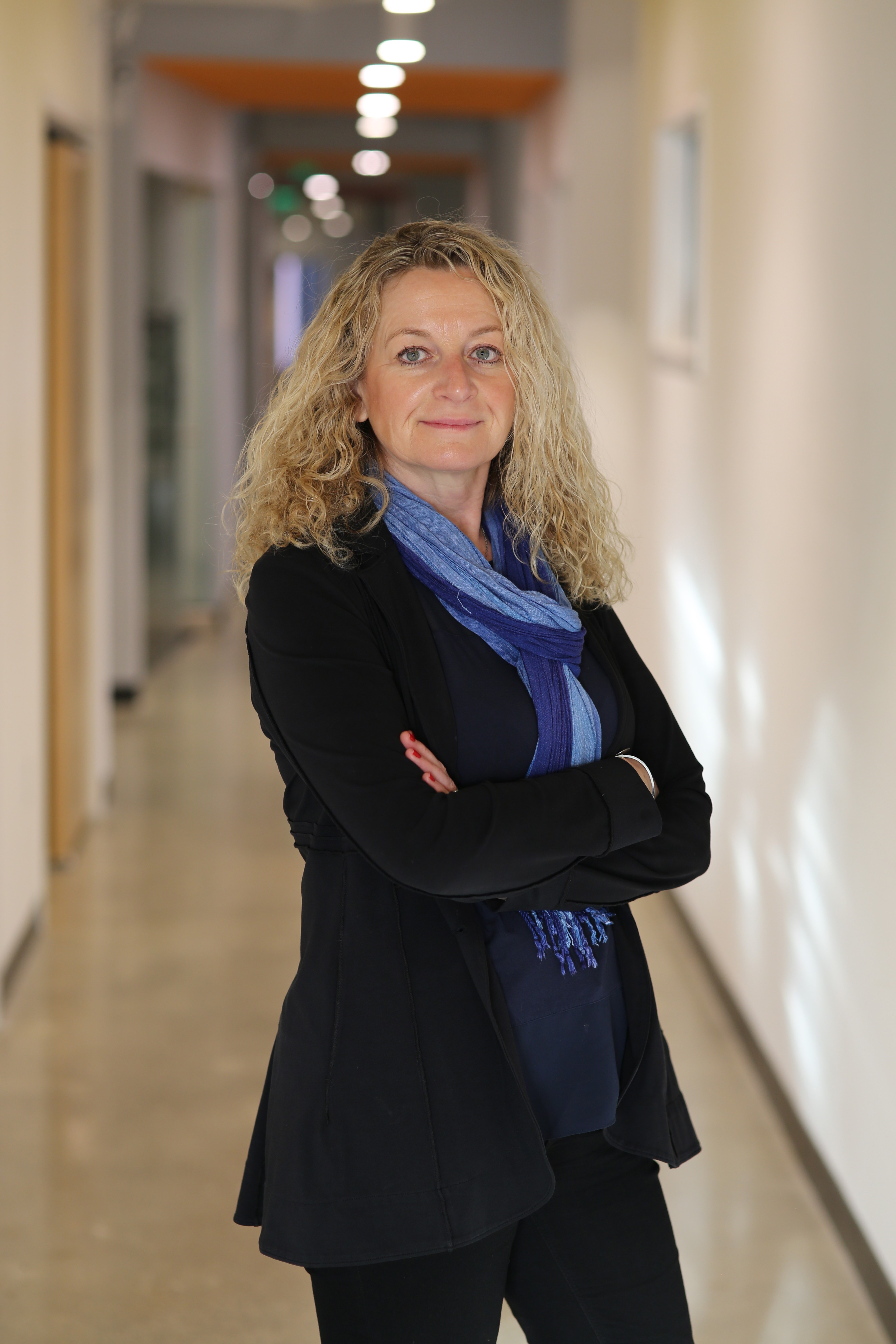
Boston · Biotechnology
Dominique
Dominique
Verhelle
She is building drugs against the part of the genome that most of the industry spent decades ignoring.
Co-Founder, President & CEO / NextRNA Therapeutics
She is building drugs against the part of the genome that most of the industry spent decades ignoring.
Co-Founder, President & CEO / NextRNA Therapeutics
At NextRNA Therapeutics, a small company on Guest Street in the Brighton neighborhood of Boston, Dominique Verhelle is chasing a target most drugmakers avoided for a generation. Almost every medicine on the market goes after proteins. NextRNA goes after something upstream of them - long non-coding RNA, the sprawling stretches of the genome that do not code for proteins at all but help decide which genes switch on and off.
For years that material was written off as genomic noise. Verhelle, who co-founded NextRNA in 2021 and became its chief executive in 2022, treats it as a pharmacy that has not been opened yet. The company's approach is to find the non-coding RNAs that drive a disease, identify the proteins they latch onto, and design selective small molecules that break those interactions apart. The first programs are aimed at cancers and neurological disorders, areas where existing options run thin.
It is a deliberately hard problem, and Verhelle runs it from an unusual seat. She has served as co-founder, chief scientific officer, and chief executive at the same time - the person setting the science and the person raising the money and hiring the team. The company is lean, a handful of scientists working through two lead programs and a discovery engine, backed by a $56 million Series A.
“Many of the women I know in this field are founders of companies. They did it because they believe in the science, not just because they wanted to have the title.”
Identify the long non-coding RNAs that drive a specific disease.
Pin down the proteins those RNAs bind to and depend on.
Build selective small molecules that disrupt the interaction.
Advance programs toward cancers and neurological disorders.
Source: NextRNA Therapeutics / Biocom California profile
Verhelle's path into biotech was not a straight line. In interviews she has described once wanting to be a flight attendant before science pulled her in a different direction. What followed was a career assembled in deliberate stages, each one adding a skill she would later need to run her own company.
She earned a PhD in life sciences from Universite Cote d'Azur in France, then crossed the Atlantic and, years later, added an MBA in entrepreneurship from the Rady School of Management at UC San Diego. The combination - deep bench science plus formal business training - is rarer than it sounds, and it shaped how she would operate.
Her early industry work was at Celgene, where she contributed to unraveling the mechanism of action of IMiDs, a class of drugs central to the company, and helped stand up its internal epigenetics group. Epigenetics - the machinery that controls gene expression without changing the underlying DNA - became a recurring theme. At Pfizer, she was director of epigenetics inside the Oncology Research Unit, again building drug-discovery efforts around hard, early-stage biology.
Then she switched sides of the table. As a principal at Third Rock Ventures, one of the best-known biotech venture firms, she helped launch two companies from scratch: Fulcrum Therapeutics, which later went public on the Nasdaq, and Cedilla Therapeutics. Company creation, not just science, became part of her toolkit. She followed that with a stint at Takeda as head of academic innovation in its Center for External Innovation, building research partnerships with academic investigators around the world, and served as a board director at Bridge Medicines.
By the time she co-founded NextRNA in 2021, Verhelle had done nearly every job in the drug-development ecosystem except run her own company. That was the piece she went back for. When NextRNA closed its Series A and named her chief executive in August 2022, she framed it around the work rather than the promotion. “I am excited about the tremendous progress we are making on our two lead programs and our proprietary target and drug discovery engine,” she said, adding that she looked forward to “building and advancing our pipeline of non-coding RNA-directed medicines.”
The move fit a pattern she has spoken about openly. The women she knows who start biotech companies, she has said, tend to do it because they believe in the science, not because they want a title. She has also argued that women leaders often manage differently, including a greater willingness to take risks - a claim that reads less like theory and more like a description of her own decision to leave secure roles at large firms to build something small and uncertain.
That conviction extends beyond her own company. Verhelle is candid about the gender imbalance still visible on biotech conference stages. When she notices an all-male panel, she does not just note it - she emails the organizers and volunteers to speak, treating representation as something to fix in practice rather than complain about. Her work sits inside one of the densest life-sciences clusters in the world; in Massachusetts, biopharma accounted for a substantial share of statewide job growth in recent years, and the competition for talent and attention is fierce.
What makes NextRNA a genuine bet is the target itself. The non-coding genome is enormous, and much of it has resisted the standard tools of drug discovery. Small molecules that reliably disrupt RNA-protein interactions are not a solved problem. Verhelle's wager is that the two decades she spent learning how drugs get made - and unmade - are exactly what the moment requires, and that timing, as she has emphasized, matters as much as the idea. If the platform works, it opens a category of targets the industry has mostly left alone. If it does not, it is the kind of hard problem that only gets attempted by someone who has seen enough of the field to know what they are walking into.
Illustrative weighting of Verhelle's roles across the drug-development world.
Weights are illustrative, not to scale.
“I am honored to take on the role of CEO at NextRNA. I am excited about the tremendous progress we are making on our two lead programs and our proprietary target and drug discovery engine.”
“I look forward to expanding our team and capabilities as we build and advance our pipeline of non-coding RNA-directed medicines.”
“Many of the women that I know in this field, they are founders of companies. They did it because they believe in the science.”
On advocacy: when she sees a male-dominated conference panel, she emails organizers and volunteers to speak, so more women are visible on stage.
She is a French-born scientist and biotech entrepreneur, co-founder and CEO of NextRNA Therapeutics, a Boston company developing small-molecule drugs that target non-coding RNA.
NextRNA identifies disease-causing long non-coding RNAs and their interacting proteins, then develops selective small molecules to disrupt those interactions, aimed at cancers and neurological disorders.
She holds a PhD in life sciences from Universite Cote d'Azur and an MBA from UC San Diego's Rady School, with prior roles at Celgene, Pfizer, Third Rock Ventures, and Takeda.
As a principal at Third Rock Ventures she helped launch Fulcrum Therapeutics and Cedilla Therapeutics, and she later co-founded NextRNA Therapeutics.
NextRNA raised a $56 million Series A financing, announced around the time she was named CEO in 2022.