The digital-human company turning a text box into a video studio - and a video into a conversation.
DeepBrain AI is a generative-AI company built around a single, stubborn idea: that making a video, or holding a conversation with a machine, should not require a camera, a studio, or a call center. Its flagship platform, AI Studios, takes a plain text script, pairs it with a hyper-realistic digital human, and returns a finished video in minutes. Its sibling technology, AI Human, takes those same avatars and teaches them to listen and answer in real time - the face behind interactive kiosks, virtual receptionists, and even television news anchors.
The company was founded in Seoul in 2016, not as a media company but as Moneybrain, a chatbot service aimed at streamlining call centers. The deep-learning core survived; the surface changed. By 2020 the team had turned its models toward synthesizing lifelike virtual humans, and by 2021 it had a product - AI Studios - and a name to match its ambition. Today it operates from Seoul with a US headquarters in Palo Alto, California, and additional presence in Silicon Valley and Beijing.
What DeepBrain AI sells, in plain terms, is the removal of production friction. A marketing team that once booked a shoot now types a script. A bank that once staffed a counter now runs an avatar that greets customers in their language. A broadcaster that once needed a presenter now has an AI anchor that reads the news on schedule. The pitch is not that the technology is magical - it is that it is cheaper, faster, and, for a growing list of use cases, good enough.
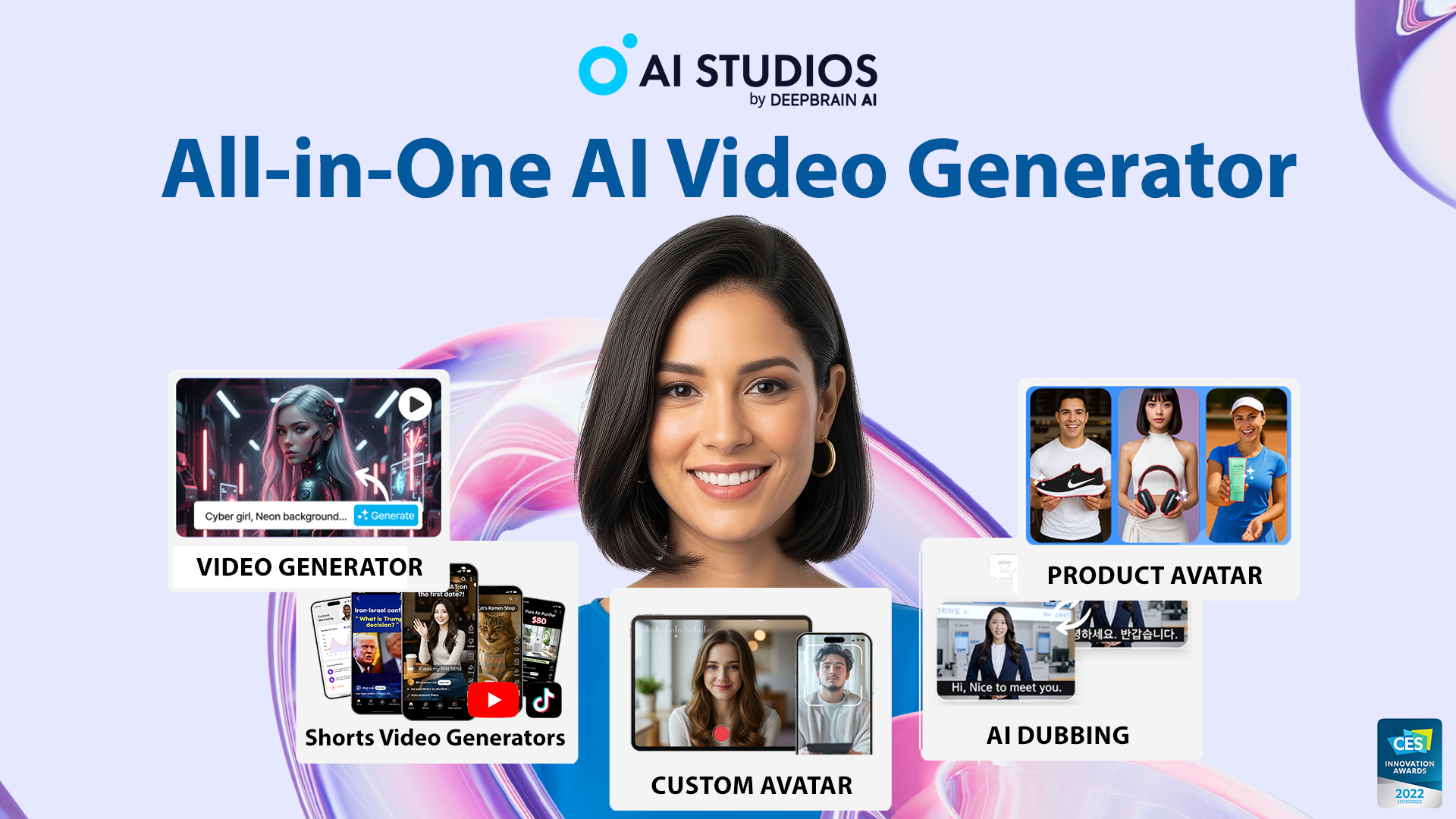
DeepBrain AI works both sides of the market: self-serve creators who need video fast, and enterprises that need digital humans they can trust in front of customers.
Social clips, product explainers, and ads produced without a shoot - one script, many languages.
Corporate training and e-learning teams turn documents into narrated, on-brand video courses.
Kiosks and virtual agents for banks and stores - references include Shinhan Bank and Samsung Securities.
Broadcast-grade AI anchors and public-service digital humans, including work with NEC in Japan.
Traditional video is expensive because of everything around the idea: the camera, the studio rental, the voice actor, the editing suite, the reshoot when the script changes. For a global company, multiply that by every market and every language. DeepBrain AI's wager is that most business video does not need a film crew - it needs a reliable presenter, a clean script, and a fast turnaround.
By collapsing that pipeline into a subscription, the company changes the economics. A script edit becomes a re-render, not a re-shoot. Localization becomes a dropdown of 80-plus languages rather than a budget line. And a customer interaction that once required a staffed desk becomes an avatar that can be deployed thousands of times over. The savings are real; so are the trade-offs, which reviewers name openly - render times can lag, and custom avatars are an enterprise process measured in weeks, not minutes.
The portfolio runs from self-serve video to real-time conversational deployment - all built on the same AI Human core.
Text-to-video platform with scene-based editing, 100+ avatars, 80+ languages, templates, AI dubbing and translation.
Conversational avatar engine powering virtual receptionists and agents that listen and respond.
Interactive digital-human kiosks with NLP for retail, finance, and healthcare.
Lifelike anchors that read the news on schedule - deployed with broadcasters including NEC.
Builds a talking avatar from a single image and roughly ten seconds of voice.
Two-way conversational avatars for agentic workflows, deployable at enterprise scale.
The avatar-video category is crowded. Synthesia and HeyGen dominate the conversation, with D-ID, Hour One, Colossyan, and Elai close behind. On the raw job - turn a script into an avatar video - the field looks similar from a distance. DeepBrain AI's distinction is where it points next: not just generating a video, but powering a real-time conversation.
Its AI Human engine, kiosks, and news anchors put it in the same room as interactive-digital-human specialists like Soul Machines and UneeQ, while most video-first rivals stay one-directional. That combination - production tool plus conversational platform - is the moat the company is digging. Its enterprise reference list reads like a trust ledger: SAP, Shinhan Bank, Samsung Securities. When regulated institutions put your avatars in front of customers, you have cleared a bar most AI demos never reach.
DeepBrain AI sits at the intersection of three markets - generative video, conversational AI, and digital-human research. It is not the biggest name in any single lane, but it is one of the few companies operating credibly across all three, with a decade of deep-learning work and a public roadmap it renews at CES each year.
Self-serve AI Studios subscriptions (entry tier around $30/mo) plus enterprise licensing for custom avatars, AI Human, and kiosks.
Reported 2024 revenue per Latka; Apollo estimates land near $5M. Figures are approximate across sources.
Research-led, mission-oriented, spanning Seoul, Silicon Valley, and Beijing.
Series B led by Korea Development Bank, with investors including POSCO Capital and IDG Capital. Funding totals vary by source (Crunchbase, PitchBook, Apollo).
Eric Seyoung Jang starts the company in Seoul as a call-center chatbot service.
Launches real-time conversational avatars and its first AI news anchors.
Ships its text-to-video platform and closes a Series B led by Korea Development Bank at a ~$180M valuation.
AI Studios wins a CES Innovation Award in the streaming category.
The AI memorial service is named a CES 2023 Innovation Award honoree.
At CES 2024, avatars built from one photo and a 10-second voice recording.
Enterprise conversational avatars for agentic, two-way workflows.
DeepBrain AI is led by founder and CEO Eric Seyoung Jang, who started the company in 2016 and steered it from chatbots to digital humans. The through-line across that decade is the deep-learning research core - the same discipline that made the chatbots work now drives face synthesis, voice cloning, lip-sync, and real-time dialogue.
The company frames its work around three pillars it states publicly: human-AI collaboration, ethical and trustworthy AI, and real-world impact. In practice that means a research-led culture pushing hyper-realistic avatars while trying to keep consent, disclosure, and reliability in the frame - questions that matter more, not less, as the technology gets convincing enough to clone a person from a photo.
Uses Azure OpenAI and Cognitive Services to power its avatars; listed on the Microsoft marketplace.
Cloud collaboration for deploying digital-human workloads.
Bringing AI-powered news anchors to Japan's broadcasting industry.
Korean-ecosystem partnerships on AI and digital-human initiatives.
Product demos and channel highlights from DeepBrain AI. Links open on YouTube.
It builds hyper-realistic digital humans. Its AI Studios platform turns text scripts into avatar-led videos, and its AI Human technology powers real-time conversational avatars for kiosks, customer service, and news anchoring.
AI Studios is DeepBrain AI's flagship generative-video platform. You type a script, pick a digital-human avatar and template, and it renders a professional video in minutes, with support for over 80 languages.
It was founded in 2016 in Seoul by Eric Seyoung Jang, originally as a chatbot company called Moneybrain before pivoting to digital humans.
The company raised a $44M Series B in 2021 led by Korea Development Bank at a reported ~$180M valuation, with total funding reported in the range of roughly $52M–$67M across sources.
Marketers, e-learning and corporate-training teams, broadcasters, and enterprises. Named reference customers include SAP, Shinhan Bank, and Samsung Securities across media, finance, education, and the public sector.
Sources: Crunchbase · PitchBook · Tracxn · CB Insights · Microsoft Customer Stories · GlobeNewswire · PR Newswire · Unite.AI · Gartner Peer Insights · Product Hunt · aistudios.com. Figures approximate; funding and revenue vary by source.