He looked at an industry making headsets heavier every year and did the opposite. Bigscreen Beyond fits in a jacket pocket.
The guy who watched all of Dune in a headset to win an argument about comfort.
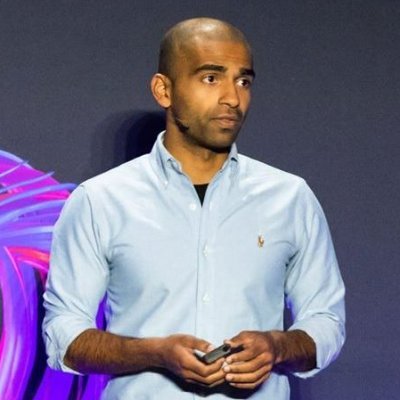
Most founders chase more. Darshan Shankar chased less - less weight, less bulk, less of the headset you can feel on your face.
Today Darshan Shankar runs Bigscreen as its founder and CEO, and the company he started as a virtual movie theater now manufactures one of the most talked-about pieces of consumer VR hardware in the world. The Bigscreen Beyond is marketed as the smallest VR headset ever made, weighing a little over a quarter of a pound at a time when the leading headsets had been doing the opposite - roughly doubling in weight since 2016. His pitch is almost stubbornly simple: a headset you forget you are wearing beats a headset that does more but sits on your face like a brick.
The follow-up, Bigscreen Beyond 2, started shipping in July 2025 and quickly began selling around three times the volume of the original. December 2025 was the company's largest shipping month, demand outran supply through the year, and over half of all sales now come from outside the United States. Shankar has said Bigscreen is on track to cross $100 million in annual revenue, and he thinks Beyond could land among Steam's top five VR systems within a year or two. For a company that started with one person sharing a PC desktop inside a virtual room, that is a long way to travel.
The Beyond 2 itself is an exercise in refinement rather than reinvention. Shankar has talked through its optical improvements - a wider field of view and sharper clarity - while keeping the headset light, the trait that defined the original. It is the kind of iteration you only get from a founder who uses his own product constantly and notices the half-millimeter things. Reviewers picked up on it too, with one writing after watching an entire film in the original Beyond that the picture quality in Bigscreen's virtual theater was "seriously impressive." That phrase, comfort plus clarity, is the whole company in five words.
What makes him unusual is not the ambition. It is the restraint. When asked why Bigscreen never expanded to flat screens or chased every adjacent market, his answer was a kind of creed: "We've stayed focused on VR, and I think that's our strength." Ten years in, that focus has not wavered.
The discipline shows up in the supply chain too. Shankar has committed to manufacturing Beyond 2 with SteamVR Lighthouse tracking for the next two years and has secured the inventory to keep producing it, a quiet signal to PC VR enthusiasts that the platform they are buying into is not going to be quietly discontinued. He has also been candid about growth: demand for Beyond 2 outran the company's own supply projections through 2025, the kind of problem most hardware founders would happily trade for. The plan for early 2026 includes opening a facility in the Netherlands specifically to shorten European delivery from as much as three to ten days down to one or two - logistics treated as a feature, not an afterthought.
We built Beyond because we felt VR was too heavy, bulky and uncomfortable. We invented new technologies to increase comfort and developed ultra-high-end components like OLED microdisplays and pancake optics to increase immersion.
Every Beyond ships with a facepad custom-made from a 3D scan of the buyer's own face.
The very first thing Shankar showed in a demo was the difference between your facepad and someone else's.
IPD is fixed per user from the scan, roughly 58 to 72mm, with prescription inserts for those who need them.
A dev-tools startup. A pivot. A decade of refusing to lose the plot.
Shankar grew up and went to Brookfield Central High School in Wisconsin before heading west to the University of California, Berkeley, where he earned a BS in Electrical Engineering and Computer Science in 2010. The same year he graduated, he started his first company, Flotype, an enterprise developer-tools startup. It carried him through Y Combinator's Winter 2011 batch and raised around $1.4 million from a roster that founders dream about - Andreessen Horowitz, Y Combinator, and Salesforce Ventures.
Then he changed lanes. In 2014 he founded Bigscreen and pointed the whole thing at virtual reality. By July 2015 it was a private beta that let people pull their entire PC desktop into VR and share screens together. In April 2016 the shared co-watching experience arrived on Steam, and Bigscreen became a long-running social VR theater - a place to watch movies, work, and hang out with other people who were physically nowhere near you. A 2017 Series A, about $11 million with total funding near $14 million, brought in backers including True Ventures and Andreessen Horowitz.
The hardware came later, and it came from frustration. Bigscreen had spent years building the software people used inside headsets, which meant Shankar knew exactly where headsets fell short. The Beyond, announced in 2023, was the answer - a software company deciding it could build the box better than the box-makers. By 2026 Bigscreen was marking ten years of shared co-watching on Steam, operating across eight regions, and planning a Netherlands facility to cut European shipping from as long as ten days down to one or two.
There is a through-line here that predates the company. Long before Beyond, Shankar was writing publicly about the unglamorous problems of virtual reality - how to keep frame rates high, how to light a Unity scene, how to rotate a camera without making someone queasy. Titles like "12 performance tricks for optimizing VR apps in Unity 5" and "VR camera rotation without nausea: a counterintuitive discovery" read less like marketing and more like a developer thinking out loud. The same instinct that made him document comfort tricks for other developers is the one that later led him to 3D-scan customers' faces and ship a different facepad to each of them. Comfort was never a feature he bolted on. It was the premise.
It also explains his read on where the industry is heading. Watching VR split into camps, he compared it to old platform wars - "Just like Mac vs. PC, Xbox vs. PlayStation, there are now 'sides' to pick in VR." Rather than try to be everything to everyone, Bigscreen picked its side: the high-end PC VR enthusiast who will pay for premium components and expects the headset to vanish on their face. That is a smaller market than mass-market standalone headsets, but it is one Shankar clearly understands, because in many ways he is the customer.
Graduates UC Berkeley (BS, EECS) and founds Flotype, an enterprise dev-tools startup.
Goes through Y Combinator (W11); raises ~$1.4M from a16z, YC, and Salesforce Ventures.
Founds Bigscreen and bets the company on virtual reality.
Launches Bigscreen as a private beta - share your PC desktop and watch screens together in VR.
Shared co-watching lands on Steam, becoming a long-running social VR theater.
Raises a Series A (~$11M) from investors including True Ventures and Andreessen Horowitz.
Announces Bigscreen Beyond - the "world's smallest VR headset," with OLED microdisplays, pancake optics and custom facepads.
Beyond 2 announced in March, ships in July, sells ~3x the original; December is the biggest shipping month yet.
Ten years of co-watching on Steam; eight regions, majority-international sales, targeting $100M+ revenue.
Bigscreen grew into one of the largest VR platforms in the world and the go-to social theater on Steam.
Beyond turned a software company into a hardware maker, shrinking VR while rivals kept it heavy.
OLED microdisplays, pancake optics and per-face 3D-scanned facepads, built to make immersion comfortable.
Beyond 2 outsells the original roughly 3 to 1, with demand consistently outrunning supply.
Eight regions served, over half of sales abroad, and a Netherlands facility planned to speed delivery.
Beyond his own company, Shankar became a Venture Scout at True Ventures in 2022.
It's so interesting to watch the VR industry mature. Just like Mac vs. PC, Xbox vs. PlayStation, there are now "sides" to pick in VR.
We've stayed focused on VR, and I think that's our strength.
We invented new technologies to increase comfort... to increase immersion.
Bigscreen began as a way to drag your entire PC desktop into VR - not as a hardware company at all.
To prove Beyond was comfortable, he reportedly sat through the full 2021 film Dune in the headset with a journalist, talking the whole two hours.
While the industry's flagship headsets roughly doubled in weight after 2016, he pushed his down to about a quarter pound.
He keeps a personal blog full of deep VR engineering notes - "12 performance tricks for optimizing VR apps in Unity 5" is exactly his energy.
One of his posts is titled "VR camera rotation without nausea: a counterintuitive discovery." Comfort has always been the obsession.
From Brookfield Central High in Wisconsin to UC Berkeley EECS to two venture-backed startups - he has only ever shipped his own ideas.