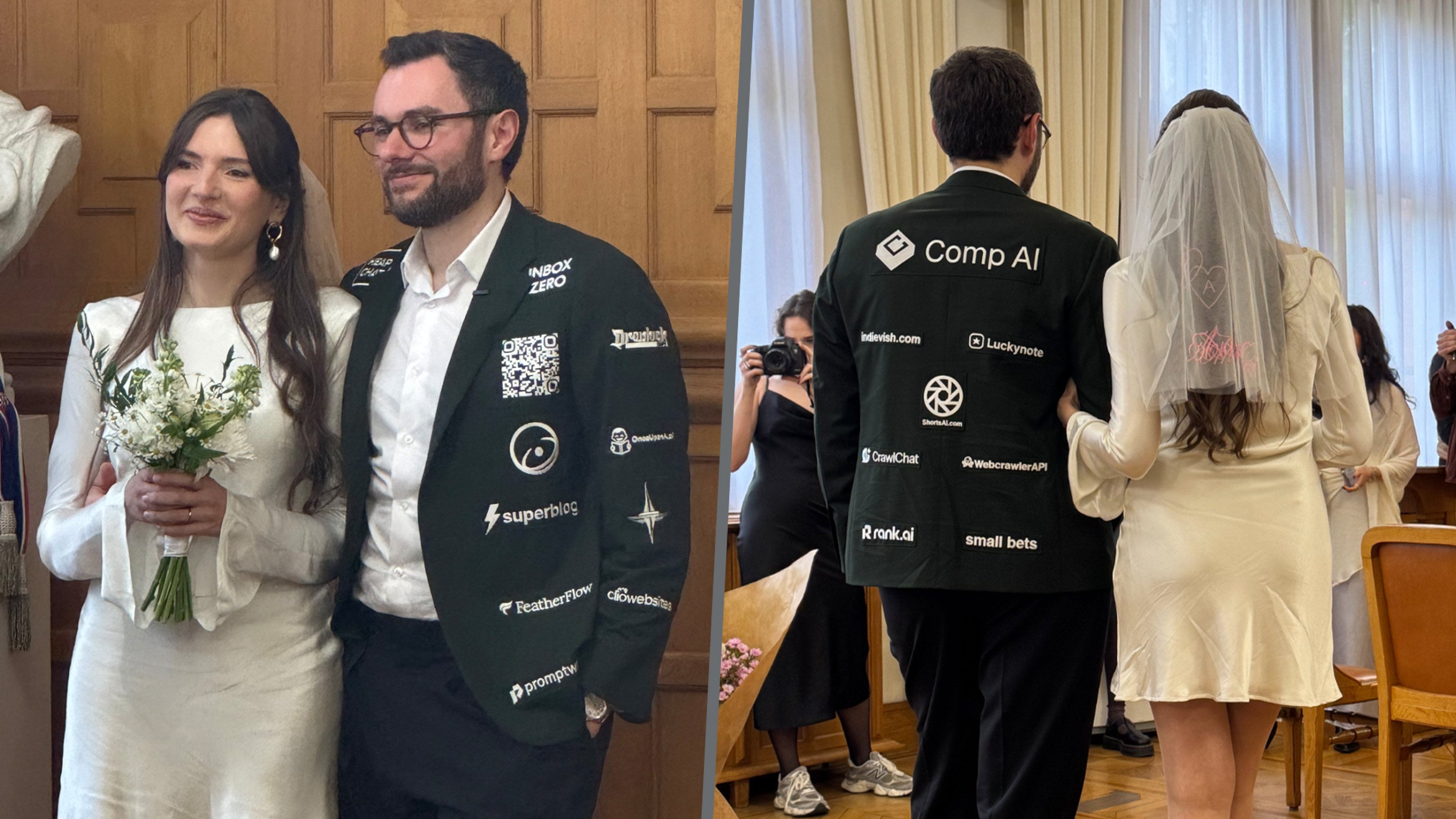
The man who put 26 startup logos on his wedding suit, walked down the aisle, went globally viral, and got hired by one of the sponsors - then called himself a "Corporate sellout."
In July 2025, Dagobert posted a plan on X: he was going to sell advertising space on his wedding tuxedo. His wife Lucie had one condition - only indie companies he knew personally. No faceless logos from brands neither of them cared about.
Twenty-six startups bought spots. Tiered pricing: the top of the back ran €1,600. Average spot around €300. Total raised: roughly €10,000. The custom tuxedo - a remarkable bright green creation covered in embroidered and sewn-on logos - cost €5,500. After taxes, net profit: around €2,000.
He walked down the aisle on October 25, 2025. The story went global within days. South China Morning Post. DNYUZ (New York Times syndicate). NDTV. BusinessToday India. Hindustan Times. Yahoo Finance. Dozens more.
One of the 26 sponsors was a co-founder at Comp AI, a New York startup building AI agents to automate compliance. He saw the campaign. He saw a person who understood how to market to an indie founder audience in a way no ad budget could buy. He offered Dagobert a sales job.
Dagobert took it. Changed his Twitter bio to "Corporate sellout." Kept building LaunchDay on the side.
The Logology story is a masterclass in the difference between growth and scale. Dagobert used Twitter to grow Logology revenue 700% year over year. That is a genuine, impressive number. The problem: 700% of not-enough is still not-enough.
At its peak, Logology was bringing in around $4,600/month with roughly 100 customers. In France, with a business to run, a partner to pay, and no other income, that is a slow-motion crisis dressed up as a success story. After 36 months of peak operation, total Logology revenue came to approximately $40,000. Over five years, they invested over $100,000 of their own savings.
The math was never going to work. AI didn't kill Logology - AI accelerated a conclusion that was already written. What Dagobert did was learn more about marketing, community, and honest communication from that failure than most founders learn from their wins.
A career built entirely on learning things by doing them, sharing the process publicly, and refusing to make it look easier than it was.
"Marketing is really when you have understood your product - and at the beginning you don't."The Bootstrapped Mafia Podcast, Ep. 1
"The big mistake is trying to aim for the mountain before you can even survive."The Bootstrapped Mafia Podcast
"When I share something that's really in my heart, even if I get one like, I'm so happy because I feel like somebody sees me."On authentic Twitter engagement
"As an entrepreneur, you need someone you've been through shit with already."On co-founding with his wife, The Bootstrapped Founder Podcast
"I dream of a future where 30% of the population is working for themselves and building their own business."IdeaMensch Interview
"I could have started the entrepreneur's journey much sooner. When I was 20 I wanted to build things but chickened out because I didn't think I was capable."IdeaMensch Interview
What you notice after reading 5 years of his public output
Product launch platform for indie makers. The Product Hunt alternative built by someone who actually uses Product Hunt. Gives smaller, independent products a chance to find their audience.
Visit LaunchDay →Co-hosted with James McKinven. Covers the dark side of entrepreneurship - the parts other podcasts skip. Episode 22: Closing Down Logology. That kind of show.
Listen Now →Video course on Gumroad. Made $8,073 in first 24 hours. Covers the daily meme + text tweet formula, reply strategy, algorithm updates, and daily routine. Updated September 2024.
Get the Course →Automated logo and brand design for early-stage startups. Co-founded with wife Lucie. Five years, $100K in savings invested, 700% revenue growth, still not enough. Shut down with full transparency.
Companion podcast to the launch platform. Interviews indie founders about their products and journeys. Available on Spotify and Audible.
Listen on Spotify →26 indie startup logos on a bright green tuxedo. €10,000 raised. Global press coverage. One unexpected job offer. The best marketing campaign of 2025 that nobody at an agency will ever claim credit for.
His name "Dagobert" is the French name for Scrooge McDuck. He did not choose this. He inherited it. He has made peace with the irony of being a bootstrapped founder named after the world's most famous fictional billionaire.
He started building 3D models at age 13 from online tutorials. No teacher, no class, no plan - just internet and curiosity. This is the exact same method he used to learn web development, UX, content marketing, and sales.
His wife Lucie co-founded Logology with him and has one immovable rule for the wedding suit campaign: only indie companies he knew personally. No faceless brands. This filter is a portrait of their values.
He went from "Emopreneur" to "Corporate sellout" in his Twitter bio. This two-word arc covers five years of building, losing, recovering, and pivoting. Most startup memoirs are longer and less honest.
He works remotely from Lille, France for a New York startup - exactly what he did as a freelancer over a decade ago. The circle completed itself through a green wedding suit.
His Twitter course made $8,073 in its first 24 hours. He'd spent years giving away the strategy for free on Twitter. When he packaged it, people paid. The irony: the proof that it worked was already sitting on his public timeline.
His Bluesky handle is @dagorenouf.com - he uses his domain as the identifier. Small detail. Reveals that he thinks about personal brand with the same precision he applies to everything else.