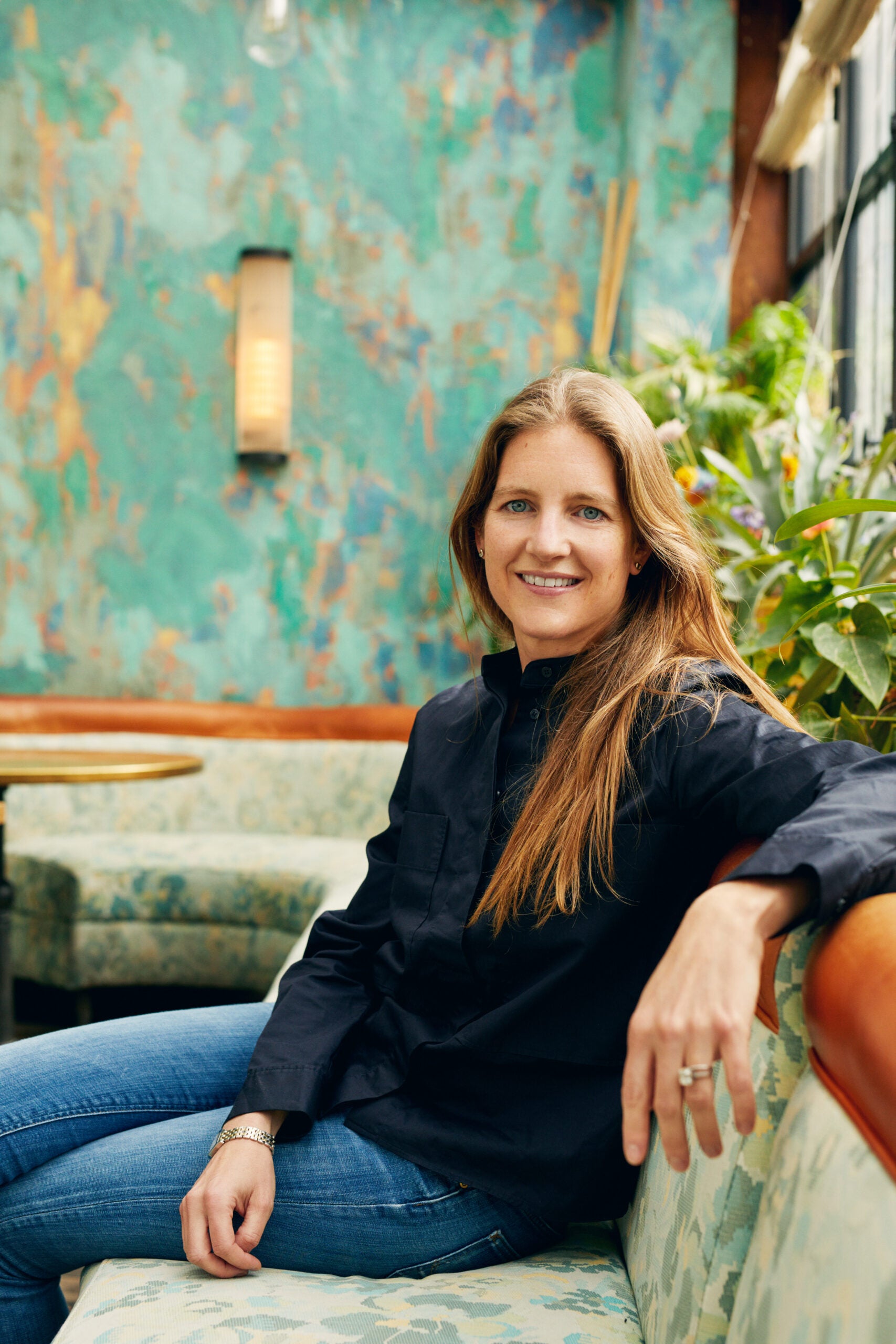
The Story
Catch her mid-stride
Scan, glance, walk out the door. The whole transaction takes about as long as reading this sentence. That is the wager Christine de Wendel made when she co-founded sunday: that the worst ninety seconds of a good meal - the part where you flag a server, wait for a terminal, do the tip math, and split the bill four ways - did not have to exist at all. Sunday turns it into a QR code at the corner of the table. The bill appears on your phone. You leave.
De Wendel runs the U.S. side of that company from Atlanta, the city she grew up in and left for two decades. The leaving is the interesting part. She graduated from the Atlanta International School the year the Olympics came to town, went north to Georgetown's School of Foreign Service, and walked out in 2002 with a plan to run the United Nations. The plan required passing the U.S. Foreign Service exam. She passed the written sections and failed the oral one. Three times. Management consulting was the consolation prize, and it took her to Paris.
She stayed fifteen years. Bain first, then business development at Starwood Hotels, then the Paris launch of the German fashion juggernaut Zalando, then chief operating officer at ManoMano, the DIY marketplace that became one of France's billion-dollar names. Two unicorns, built from the operator's chair - the seat where someone has to actually make the warehouse, the payments, and the org chart function while the founders dream. It is not the seat people write profiles about. It is the seat that teaches you how a company really works.
The leap of faith
Somewhere in that Paris orbit she met Victor Lugger and Tigrane Seydoux, the founders of Big Mamma, the Italian restaurant group that turned Parisians into people who queue for two hours for burrata. Restaurateurs who understood the floor. An operator who understood scale. The three of them looked at the same recurring, observable, universally hated problem - paying the check - and decided it was a software problem wearing a hospitality costume.
"The hardest step is taking the leap of faith."
— Christine de Wendel
She took it at 40, as a mother of three. That detail matters because the founder mythology rarely includes it. The standard story is a 22-year-old in a dorm. Hers was a woman with two decades of operating scars and a school run, betting that her experience was an asset rather than a reason to stay safe. Her father, an entrepreneur, had told her since childhood that building something of your own was the real prize. She believed him eventually.
French engineering, American speed
Sunday launched in 2021 and did not tiptoe. Inside its first year it raised roughly $124 million, scaled to about 400 people across eight countries, and started processing restaurant transactions by the billion. De Wendel packed up her husband and three children - then 4, 8 and 11 - in the middle of a pandemic and moved them to Atlanta to open the U.S. front. The pitch was deliberate: sunday would be an American company with deep European roots, pairing what she calls French engineering with American boldness, speed and scale.
The hypergrowth did not hold. When the market turned in 2022, sunday cut roughly three-quarters of the company and refocused on the unglamorous business of profitable growth. De Wendel does not hide that chapter. She describes herself as an optimist and a recovering people pleaser who grew a thick skin somewhere along the way, and she talks about resilience the way people do when they have actually needed it. The company she runs now is smaller, sharper, and still chasing the same idea: that checkout should disappear.
The dinner-table test
Ask her how she hires and she gives you a rule that sounds like a joke until you realize she means it literally. If she would not be excited to sit beside a candidate through an entire dinner, they are not joining the team. For a company built around restaurant tables, it is almost too on the nose. It is also a real filter: she hunts for outliers, exceptional people aligned with the culture, and she leads by refusing to ask anyone to do what she would not do herself.
Her line on technology is the same one that animates the product. Sunday markets itself, insistently, as a hospitality company that happens to use software - not a tech company that happens to serve restaurants. Technology, in her telling, should remove the friction and then get out of the way, leaving the human parts of a meal untouched. She talks about AI as an enabler of judgment, not a replacement for it. When a product genuinely solves a problem people feel every day, she says, selling stops being a pitch and becomes a conversation.
The ambition does not stop at restaurants. The same ten-second checkout, she argues, belongs in retail, in malls, in transit, in parking - anywhere a human currently stands in a line that a QR code could erase. The woman who wanted to run the United Nations did not get to redraw the world order. She is settling for redrawing the moment you reach for your wallet, one table at a time.