British entrepreneur and host of Modern Wisdom — a show that crossed 1 billion views after 1,000 episodes over 7.5 years. Known for extracting the operating system beneath big ideas.
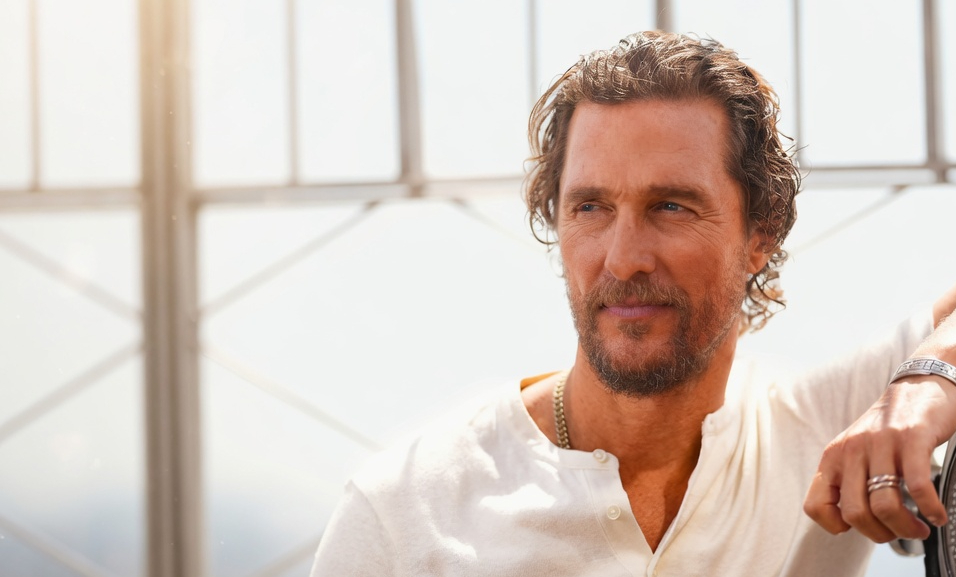
Academy Award-winning actor, author of Greenlights and now Points of Prayers. The man who walked away from a $14.5M romcom offer and rewrote Hollywood's rules for himself.
A Setting Built for the Occasion
The backdrop wasn't accidental. Alberta, Canada. The corn fields of Interstellar. The road Cooper drives down before liftoff. Production had planted all those rows — stretching as far as the eye could see. And there was Hans Zimmer's famous countdown. Ten. Nine. Eight. "Leaving children to follow dream. Liftoff."
McConaughey's eyes lit up. He knew this place. He'd lived here, in his Airstream, parked at the edge of base camp, faced toward the mountains. When filming wrapped, he let his young son take the wheel of his truck and rip 360s through those endless corn fields at full throttle. "I had checked — they go, 'No, it's just like the salt flats. Hit it.'" There's footage of that too, somewhere. It is, he says simply, "top."
It's the kind of story that tells you something about the man before the philosophy even starts: McConaughey doesn't just visit a place. He inhabits it. He barters ribeye steaks for salmon with the Squamish Nation. He gets an Airstream paddle as a parting gift from a chief named Mike Hunt. He wakes up at 4 a.m. when a freight train thunders six feet from his bed — unbeknownst to him having parked directly on the rail. This is a man who is, demonstrably, alive.
Life Rhymes — But the Verse Is Yours to Write
Williamson opened with a question about coincidence and serendipity. McConaughey, being McConaughey, flipped it. "First time I have it is deja vu," he said. "And you have it twice, I call it vu deja." The world turned upside down and inside out. Both sides of the coin. The man doesn't observe ideas — he reverses them, examines the underside, and hands them back brighter.
The thread he kept returning to was one of his own making: life rhymes. He credited Mark Twain with a version of it — "history rhymes" — but McConaughey's formulation goes deeper. The debits and assets, the ebb and flow, the way every new technology destroys an old culture while something else quietly fills the gap. "For every new technology, we lose an old culture," he said. But it balances. It always balances. There's something ecclesiastical in it — a time to plant, a time to gather, a time to spread. The sun also rises.
This is where the episode's central thesis crystallizes. McConaughey's new book, Points of Prayers, is about belief. Not just belief in God — though that's personal and present for him. It's about belief as a survival technology. "If doubt wins," he said near the close, "we're all going to lose." The argument is that faith and self-reliance are not contradictions. During his agnostic years, he said, he refused to pray, refused to rely on anything outside himself: it's on me, man. When he returned to faith, he didn't feel God rebuking that period. He heard applause. "Thank you for having your hands on the wheel," he imagined hearing. "I need that."
Williamson, ever the foil, offered his secular complement: "God doesn't want to do everything. Some of it's up to you." McConaughey: "Amen." The two were finishing each other's sermons within the first twenty minutes.
Model the Rise, Not the Result
Halfway through the episode, Williamson produced one of those formulations that makes a podcast worth a thousand episodes. They had been circling the question of balance versus imbalance — whether the cultural obsession with equilibrium is, in fact, a conspiracy against greatness. McConaughey had already said he thought we "overpraise balance a bit." Williamson tightened the argument into a blade.
The point is devastating in its simplicity. The people with the platforms large enough to give advice — Warren Buffett, the Zen master, the recovered addict turned guru — they are all speaking from the summit. They are telling you what they do now. How long they read. How slowly they move. How they've found peace. But you are not at the summit. You are at base camp. And what got them there was not reading and stillness. It was hustle, imbalance, outlaw behavior, dark times, grinding teeth, waking up at 3 a.m. in a cold sweat.
McConaughey swallowed this whole. "Everybody who's achieved something great was some sort of outlaw. Some sort of hustler. Out of balance, out of whack." He includes himself. He's bullshitted his way into things. Pulled stunts. Faked it until the craft caught up with the ambition. He's not proud of every move. But he's honest about the architecture of the rise.
Don't ask Warren Buffett how he spends his Sunday. Ask him what he was doing at 25. That's the blueprint you need — not the portrait of arrival, but the texture of the climb.
Icarus in Reverse
Here is the McConaughey move that should be printed on every motivational poster in every mediocre office in the Western world, replacing every sunflower and every "hang in there" cat.
We all know the Icarus myth. Fly too close to the sun. Wax melts. Wings dissolve. Pride punished. The warning is ancient, encoded in the culture: don't overreach. McConaughey disagrees — or rather, he believes most of us have completely misidentified where the danger lies.
The actual problem isn't hubris. It's the premature retreat disguised as wisdom. It's people invoking the cautionary tale of Icarus while banking at 10,000 feet when the sun is at 100,000. The wax isn't melting — it's barely warm. And they turn back, satisfied they were responsible, while what they really felt was fear.
Williamson extended this into the territory of emotions. He'd been thinking a lot about feelings — about the way we keep one foot out of relationships, self-transformation projects, friendships. We invest 60% so that if it fails, the wound is manageable. We call this caution. What it actually is, Williamson argued, is a retreat that is "plausibly deniable." You can always say you weren't fully committed. That's the inner citadel Isaiah Berlin described: if the world won't give you what you want, you teach yourself to not want it. Spiritual suicide dressed as serenity.
McConaughey reframed the same instinct as the difference between an owner's mentality and a renter's mentality. The renter flips, exits, never lets the house become a home. The owner goes in hoping it lasts forever — knowing most of the time it won't, but extracting ten times more from the investment because the intention was different from the start. "Barely any of them do [last]," McConaughey admitted about his own hires. "But that's how you entered the relationship."
The Nice Guy and the Good Man
It was the romcom era that gave McConaughey his defining personal crisis. Not a crisis of talent or of opportunity — those were abundant. It was a crisis of identity. He was number one. The go-to guy. He could roll out of bed and deliver a romcom by Thursday. And the problem with that kind of effortless dominance is what it reveals about the self beneath the performance.
"I was feeling like my work was just me as a nice guy," he said. "And in life, I was not just a nice guy." Camila was pregnant. He was, in his own word, feral with masculinity. His real life was vital, urgent, difficult, and deep. His work was buoyant, frictionless, and emotional bubble wrap. The gap between those two realities became intolerable.
— Matthew McConaughey
So he quit. Walked away. Turned down a $14.5 million offer somewhere in the 20-month silence. Considered becoming a teacher. A wildlife guide. Seriously. He wrote himself what he believed was a one-way ticket out of Hollywood. And then something happened. Hollywood started wondering what he was up to. The very act of refusing the game made him more interesting than any film could have. When he finally returned — to True Detective, to Dallas Buyers Club, to the McConaissance — it was on his terms, in his register, as a good man.
His father's advice, offered when a teenage McConaughey wanted to swap law school for film school, is perhaps the most economical piece of wisdom in the episode. Dad paused. Looked at his son. Said: "Is that what you want to do?" Heard yes. Then: "Well, don't half-ass it." Full stop. No slides, no qualifiers, no TED talk. The end. McConaughey said he waited for more. "That was it. Nothing better he could have told me."
Forgiveness Is Not a Receipt. It's a Promissory Note.
The conversation turned, as all great conversations eventually do, to what we owe each other after we've caused harm. McConaughey has a strict and surprisingly structural view of forgiveness. It is not a transaction that ends with absolution. It is the beginning of an obligation.
If I steal from you, and you forgive me, the moment you say those words the debt does not disappear. It shifts entirely onto me. The first thing on the docket — the very first thing — is me doing everything possible not to have to come back and say I'm sorry for the same damn thing again. "If you forgive me and I'm a repeat offender," McConaughey said, "I wouldn't trust me." Neither would he. Neither should you.
The harder version of this, and the one McConaughey lingered on longest, is self-betrayal. The forgiveness we give ourselves too quickly. The resilience that becomes a liability. We dust ourselves off, call it growth, and repeat the offense because we never sat in the discomfort long enough to actually not want to do it again. The penance was skipped. The lesson didn't hurt enough to stick.
"There is a hell in the mirror," he said. His poem Daymares lives in this territory. Nightmares end when you wake up. Daymares follow you into your day — they are the living hell of the repeat offender who knows exactly what they're doing, has confessed it, has been forgiven, and shows up again. "You got to look over your shoulder. Who do I owe? What bridge did I burn? What person did I betray to get where I am?" That life, he said, "is a living hell. Forget that."
Masculinity: The Redefinition Nobody Asked for but Everyone Needs
This is the section of the episode that will mean the most to the most people and make the most people the most uncomfortable — which is, of course, exactly the territory worth exploring.
McConaughey is careful here. He praises the legitimate corrective of the Me Too movement. He understands what it was trying to do. He names Harvey Weinstein. But he also names the cost. Good men — men who were not offenders, men who opened doors and made space and showed up — absorbed a wave that wasn't aimed at them and either retreated into confusion or doubled down into posturing. Neither is useful.
Williamson offered his most clinical insight of the episode here: the asymmetry of absorption. Advice broadcast at scale hits the wrong people first. The men who most needed to hear "don't be pushy" are precisely the men who won't internalize it. The men who heard it and took it to heart were the ones who already had approach anxiety, who needed slightly more encouragement to be present in the world. The solvent dissolved what you were trying to keep and left intact what you wanted to remove.
Mass-broadcast advice is absorbed disproportionately. The people most likely to respond are the ones who needed it least. The people who needed it most don't hear it at all.
McConaughey's definition of masculinity — the one he arrived at, not the one he inherited — is built around reliability. Men want to be relied upon. That isn't toxic. That is, in his view, biological and beautiful. "What's one of the best things for women all over the world? More good men." The truly masculine man is not an oppressor. He is not macho. He is not chauvinist. But he is damn sure masculine. "The most masculine I've ever felt," McConaughey said, "was after the birth of my first child."
Vulnerability and Humility: Two Words That Needed New Definitions
Late in the episode, two words got the renovation they deserved.
McConaughey had long struggled with the word humility. In its conventional form, it made his shoulders sink. It meant smallness. Passivity. Missed opportunities. Standing aside when you should have stepped forward. Then he encountered Jordan Peterson's formulation: humility is admitting we have more to learn. That was it. The reframe. Suddenly humility wasn't retreat — it was forward motion. "I'm in. Let me sign up."
Williamson matched it with a new definition of vulnerability that deserves to be carved somewhere prominent: "Vulnerability is saying your truth in spite of the consequences, especially when they're scary." McConaughey loved it immediately. "That sounds fun. That's a different kind of surrender." It has offense to it. It puts you on the front foot. It is not the vulnerability of collapsing in front of someone. It is the vulnerability of a soldier in motion.
Both men circled the same insight from different directions: the words we use to describe virtues often carry the wrong emotional charge, and the wrong emotional charge makes people run the wrong way. Call humility "staying curious." Call vulnerability "offensive honesty." The virtue remains identical. The person who engages with it is now entirely different.
Time Is on Your Side — But Only If You Move With It
Here is the quietest idea in the episode, and perhaps the most radical: we are not behind. We have not lost. Time is not our enemy.
McConaughey's counter-intuitive position on longevity is that quantity of years without quality of experience is "success without the profit." Profit, in his framework, is not a financial concept — it is the measure of how much of your life was actually lived. You can pile up the years. You can optimize every biomarker and hit a hundred without ever having loved something recklessly, made a bet you didn't know you could cover, or felt genuinely afraid of what you wanted.
His advice for the chronic overthinker — record yourself overthinking, then listen back — is the most practical thing he says in two hours. "You're giving it a proper name. Everything's significant. If everything's significant, there's no significance at all." The wisest people he knows are the briefest. Their stuff is short. You wait for more, and they're already looking at you like, that's it. His father's "don't half-ass it" arrives here as exhibit A.
He quoted John Wooden, the legendary UCLA basketball coach: Be quick, but don't be in a hurry. Miss a piece of the Lego set because you rushed it, and you end up at the end with twelve leftover pieces and the wrong answer. The architecture collapses because you got ahead of time instead of moving with it.
On AI and information overload, McConaughey was blunt: people who are drowning in data don't sound smarter. They sound dumber. "I didn't hear the theme. I didn't hear the thread. It was digits. Where was the soul?" You can give someone a billion facts and they won't synthesize them into a single truth. Wisdom is what happens when facts are slow-cooked with a bass line — when the rhyme is found in the reason, not the other way around.
A Thousand Reasons to Keep Going
The conversation returned, gently, to where all genuine conversations about belief eventually arrive: the place where the math stops adding up and something else has to take over. McConaughey read a poem — Heaven or Not — that sits at the center of his new book. It acknowledges the privilege of having time to plan and project. It acknowledges the people for whom tomorrow is not today's measurement because the misery is too immediate. And it offers this: if you can find something — anything, no matter how small — to keep going, your life here will be better. "Heaven or not."
That's the sales pitch for belief, stripped of its religious packaging: faith is not about being right. It's about having a direction. A direction that, even if it leads nowhere, is categorically better than the certainty of remaining exactly where you are.
Williamson ended by calling it what it was. A thousand episodes. Seven and a half years. A billion views. A building built from conversations, one brick at a time. And on this particular day, in a virtual corn field, with a countdown from Hans Zimmer still echoing, the brick was heavier and better-made than most. It will hold weight. It deserves to.
Key Takeaways
- Model the rise, not the result — study what successful people did to get there, not what they do now that they've arrived.
- A nice guy says yes to everything. A good man has ideals he'll stand for — and stand against.
- Science is the practical pursuit of God. The pursuit is the point — not the proof.
- Peace requires rage to reach. Contentment is not passive. It takes punk rock to get there.
- Vulnerability redefined: saying your truth in spite of the consequences, especially when it's scary.
- Humility redefined: admitting you have more to learn — a step forward, not a step back.
- Most of us turn back from the sun way too early. We're nowhere near Icarus territory.
- Life is a verb. There is no result — only approach. You never arrive anywhere that matters.
- Owner's mentality vs. renter's mentality: go in hoping it lasts forever, even though it usually doesn't.
- AI and information overload produce digits without soul. Find the rhyme in the reason.
- Forgiveness doesn't zero the ledger. It opens the bank. The work of repayment still belongs to the offender.
- Take 100 risks and get 8, rather than 8 risks and get 7. God prefers the bigger swing.