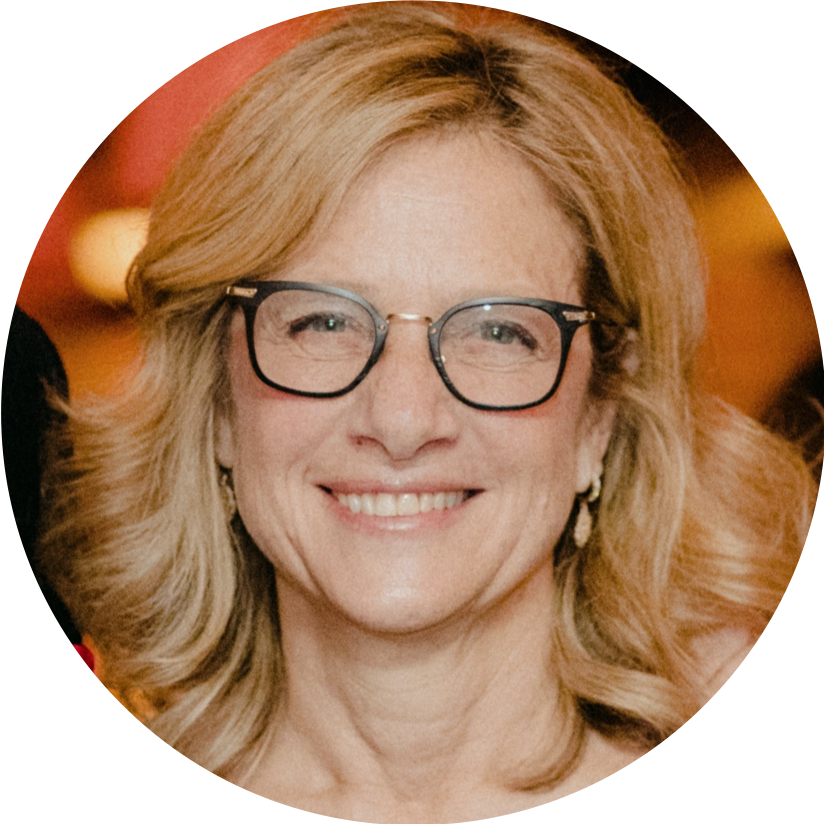
The Story
A career built on launches. The last one runs on soap.
Most people spend their sixties slowing down. Caroline Vanderlip bought industrial dishwashers. Her company, Re:Dish, occupies a Brooklyn facility packed with custom machinery, proprietary software and a startling amount of automation, all aimed at a deceptively simple task: take a used food container, clean and sterilize it, and send it back out to be used again. Up to 75,000 times a day.
The pitch sounds humble until you sit with it. The American foodservice industry runs on the idea that a container should be born, used once, and buried. Re:Dish argues that's the strange part - not the washing. Caroline's bet is that one day single-use will feel "foreign and absurd," the way leaded gasoline does now. She is building the infrastructure to make that day arrive.
Re:Dish swaps disposable cups and clamshells for durable, USA-made ones, then handles the unglamorous middle: collection, warewashing, sanitizing, and daily redistribution. Clients - Fortune 500 offices, school systems, Barclays - get a closed loop and a dashboard called DishTrack that tallies the carbon and water they're saving in real time. When a container finally wears out, it isn't thrown away. It's ground down and remade into a new one.
It just made so much sense to think about how we could successfully reuse lots of different products rather than being so wasteful.
- Caroline Vanderlip, on the idea that started it all
The 2019 conversation that wouldn't leave her alone
Caroline grew up in New York City, where overflowing sidewalk bins are simply scenery. You stop seeing them. Then in 2019 a conversation about how little of that waste actually gets recycled flipped a switch. She started reading about the circular economy and couldn't stop. Her research convinced her that packaging waste isn't a problem the industry can manage its way out of - the only real exit is to stop making single-use in the first place.
The first version of Re:Dish aimed at restaurant takeout. Then COVID-19 closed the restaurants. Worse, it exposed the flaw: restaurants had no washing infrastructure, and nervous customers weren't about to mail their containers back. A lesser founder might have folded. Caroline pivoted to institutions - offices, schools, universities - and then did the patient, invisible work, spending twelve to sixteen months building the back-end systems before the market told her she'd guessed right.
The lease that aged badly
Re:Dish signed a four-year lease on its first Brooklyn warehouse. It outgrew the space in two months. "Don't underestimate your business," is roughly the moral she took from it.
Inside the machine that makes reuse boring
The genius of Re:Dish is that it asks customers to change almost nothing. A worker grabs a reusable bowl instead of a clamshell, eats, and drops it in a return bin. Everything after that is Caroline's problem - and she has engineered it to be unremarkable. Containers travel back to the facility, run through high-capacity warewashing lines that sanitize and sterilize at scale, and return to circulation the next day. The hardware is custom. The software is proprietary. The automation is the point: reuse only beats disposability if it's cheap, fast, and invisible.
That obsession with the unglamorous middle is why the containers are made from polypropylene rather than something flashier. Caroline's team scored twenty-one separate characteristics - durability, weight, heat tolerance, recyclability, the way it survives a thousand wash cycles - before committing. And because the material can be ground down and remanufactured, the loop never leaks into a landfill. DishTrack, the company's inventory layer, turns all of this into a number a sustainability officer can show a board: gallons of water saved, carbon avoided, packages diverted, updated in real time.
Caroline is unusually generous about her competition. She describes the reusable-foodware space as collaborative rather than cutthroat, a field where everyone is still learning from everyone else. "It's exciting to see how everyone is innovating and we're all learning from each other," she has said - a posture that makes sense when the real enemy isn't a rival startup but a century of habit. Partners like Barclays have folded Re:Dish into their own net-zero journeys, treating the dishwashing as one visible, countable piece of a much larger climate ledger.
Before The Dishes
She helped write CNBC into existence
Long before warewashing, Caroline was a serial launcher inside big institutions. At NBC from 1988 to 1995, she rose to Senior Vice President of NBC Cable & Business Development and helped launch NBC SuperChannel across Europe. She helped construct the original business plan for CNBC and became one of its first employees - a footnote most people would build an entire career around.
Then she kept going. President of AT&T's Personal Online Services group. CEO of Softbank Interactive Marketing. Executive Vice President at the insurance giant ACE INA, where she ran an employee-benefits venture called YouDecide.com. She founded SharedBook, a publishing-technology platform that reshaped content through annotation. She did a turn as SVP of Corporate & Business Development at the education company Amplify. Television, telecom, insurance, software, education - and now, dishes.
The through-line isn't an industry. It's the act of starting something inside the unknown and refusing to be intimidated by it. She discovered this about herself at 23, when a publishing employer handed her a blank page and asked her to launch a new business. She's been doing versions of that ever since.
Love what you do. It will energize you as a person and improve the quality of your work.
- Caroline Vanderlip
Three words on what holds women founders back
Asked about the hardest part of being a woman shaking up an industry, Caroline didn't reach for nuance. "Access to capital, access to capital, access to capital," she said, pointing to the stubborn single-digit share of venture funding that goes to women each year. She talks openly about the discomfort of fundraising from the people closest to you - "there is nothing harder," she says, than asking friends and family to back an idea - and insists on frank, honest conversations about the real odds of failure before anyone writes a check.
It's a tell about how she operates. She is candid where others would spin, nimble where others would dig in, and curious enough to evaluate twenty-one separate characteristics before settling on polypropylene as the right material for a reusable container. The detail matters because the whole model dies if the container can't survive the dishwasher a thousand times.
The payoff isn't only tonnage diverted from landfill. After surveying one client's staff, Caroline learned that roughly a third had started adopting circular habits at home - carrying their own cups, refusing the disposable by reflex. That ripple, the quiet behavior change, is the metric she seems proudest of. A clean plate, it turns out, is contagious.
Transitioning to reuse will eliminate a lot of waste and the need to manufacture single-use products.
- Caroline Vanderlip, on the long game
Her five-year vision is geographic and stubbornly literal: a Re:Dish washing center in every U.S. market, plus reverse-logistics infrastructure that other companies can plug into to go circular themselves. Armed with a BA in American Studies from Vassar and an MBA in finance from NYU, she calls herself a lifelong learner. The label fits. Few people pivot from launching a cable network to running a dishwashing empire and treat both as the same job.
There's a quiet symmetry to it. The young executive who helped a cable channel find its first audience is now helping a behavior find its first audience - reuse as default rather than novelty. She has built businesses inside parent companies and from nothing but an idea, and she'll tell you plainly that the second kind is harder and more alive. Re:Dish is the purest version yet: no parent company, no inherited brand, just a warehouse, a payroll, and a wager that the next economy will be measured not by how much we make but by how many times we use it. The recognition has started to follow - Inc. named the company to its Best in Business list for sustainability in 2023 - but the metric she keeps coming back to is smaller and stranger. It's the employee who, somewhere along the way, simply stopped reaching for the disposable.
And when the unknown gets loud, she has a rallying cry, borrowed and well-worn: "Don't let the bastards get you down." It's not a strategy. It's a posture. For a founder rebuilding an industry around the radical notion of using things twice, posture may be the whole game.