Founded 1978 in Southern California by an 18-year-old college student155+ showrooms across 5 countries~2,200 employeesA FirstService Brands company since 1998Invented the custom closet categoryFree consult to one-day installLimited lifetime warrantyFounded 1978 in Southern California by an 18-year-old college student155+ showrooms across 5 countries~2,200 employeesA FirstService Brands company since 1998Invented the custom closet categoryFree consult to one-day installLimited lifetime warranty
YesPress Profile · Company
California Closets
The brand that convinced America an empty wall was a problem worth paying to solve.
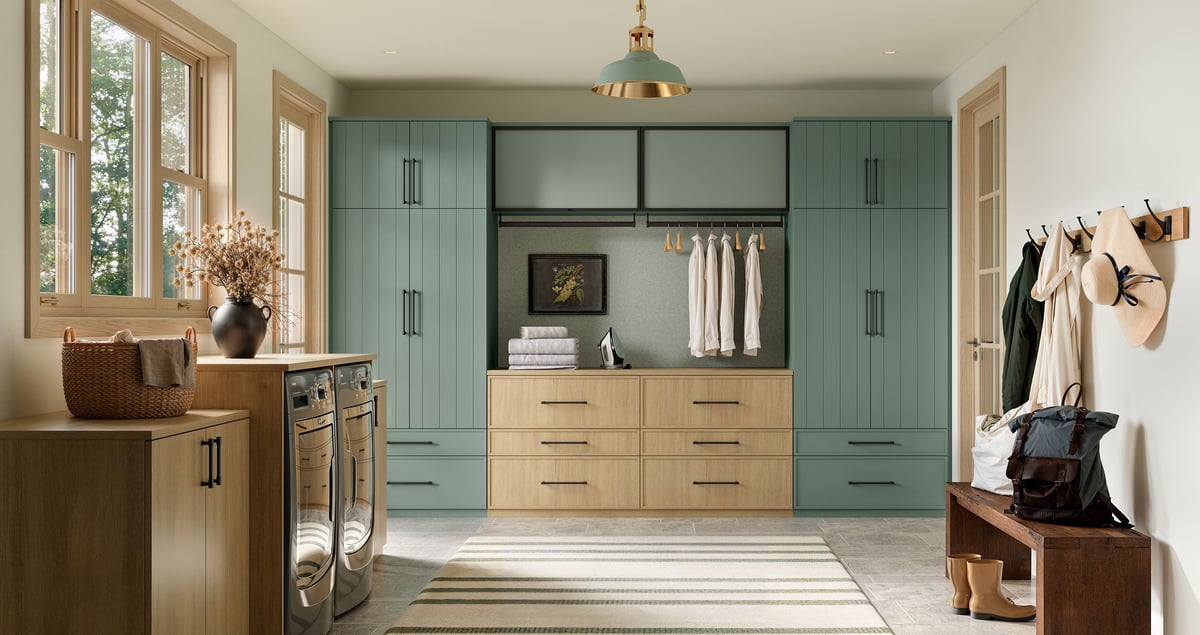
Exhibit A: a hallway that used to hold a coat hook and a pile of regret. Custom entry cabinetry, green finish, Richmond build. Photo via California Closets.
Who they are now
The quiet giant of organized space
Walk into any of the 155-plus California Closets showrooms and you will not find clothes. You will find samples of finishes, drawer glides that close themselves, and a designer with a tablet asking how you actually live. This is a company that sells a feeling - the small daily relief of opening a door and seeing everything where it belongs - and dresses it up as cabinetry.
Nearly five decades in, California Closets is the default answer to a question most people did not know they were asking: what if the room you already own could hold twice as much, and look better doing it? The company designs, manufactures, and installs custom storage for closets, garages, home offices, pantries, and the awkward corners in between. It is a subsidiary of FirstService Brands, a roughly $5.5 billion home-services parent, and it employs around 2,200 people.
"California Closets originated the custom closet industry in 1978."- The company's own, and largely uncontested, claim
The problem they saw
Everyone had stuff. Nobody had a system.
In the late 1970s, a closet was a rod and a shelf. You hung what you could, stacked the rest on the floor, and shut the door on the evidence. Storage was an afterthought built by whoever framed the house, and it showed. The problem was not that people lacked space. It was that the space they had was dumb - one height, one purpose, zero flexibility.
The insight was almost embarrassingly simple. Shelves should move. Drawers should exist. Shoes deserve their own real estate. Treat the inside of a closet like a designed object instead of a leftover, and suddenly a small room holds more than a big one. That is the tension this company has worked for forty-seven years: most homes waste the space they have, and almost nobody notices until someone shows them.
Field note: the phrase "California Closet" entered everyday speech as a generic term for a built-in closet system. Becoming a verb is hard. Becoming a noun your competitors get mistaken for is harder.
The founder's bet
A teenager, a friend's closet, and a hunch
The origin story is the kind that sounds invented. In 1978, an 18-year-old Southern California college student named Neil Balter built some shelves in a friend's closet. People noticed. A professor, the story goes, suggested he franchise the idea rather than treat it as a weekend favor. He did.
The bet was not really about woodworking. It was that ordinary homeowners would pay a premium for organization the same way they paid for kitchens and bathrooms - as a considered, designed part of the house. National television did the convincing. Balter and his closets turned up on Good Morning America and The Oprah Winfrey Show, and a regional hustle became a household name.
"He started the business after putting shelves in a friend's closet."- Wikipedia, on the least glamorous billion-dollar idea
Ownership changed hands more than once. Williams-Sonoma bought the company in 1990 and sold it in 1994. In 1998, FirstService Corporation acquired it, and that is where it has stayed - now a flagship inside FirstService Brands, alongside names like Paul Davis Restoration and CertaPro Painters.
The shelf-by-shelf timeline
1978
Neil Balter builds shelves in a friend's closet and franchises the idea. The custom closet category is born.
1980s
National TV appearances - Oprah, Good Morning America - turn a local business into a recognized brand.
1990
Williams-Sonoma, Inc. acquires California Closets.
1994
Williams-Sonoma sells the company.
1998
FirstService Corporation acquires California Closets as a subsidiary - its long-term home.
2017
Rolls out virtual reality and 3D technology so clients can walk through a closet before it exists.
2021
FirstService expands company-owned operations by acquiring franchised territories.
2026
FirstService completes further tuck-under acquisitions adding to California Closets' company-owned footprint.
The product
A consultation that ends in cabinetry
What California Closets actually sells is a process more than a product. It starts with a free consultation, in your home or over video, where a designer measures the room and interrogates your habits. That becomes a 3D model you can rotate and second-guess. The pieces are manufactured locally, then installed - often in a single day - by people who do this for a living rather than by you and a borrowed drill.
Walk-In & Reach-In Closets
Adjustable shelving, drawers, shoe storage, specialty compartments, and integrated LED lighting.
Garage Systems
Cabinetry and shelving that turn the garage from a junk drawer into a workspace.
Home Offices
Built-in desks and storage tuned for the remote-work era.
Pantry & Kitchen
Custom pantry and kitchen storage for people who actually cook.
Murphy Beds & Media
Wall beds, entertainment centers, and rooms that have to do two jobs.
Mudroom & Laundry
Entryway and laundry systems for the spaces guests never see but families live in.
"Advanced from simple storage to luxury rooms with center islands, vanities, and benches."- On what a closet became when nobody was looking
The proof
The numbers behind the tidy
Scale is the quiet argument here. The brand operates across the United States, Canada, Mexico, Puerto Rico, and the Dominican Republic, and its work shows up regularly in shelter magazines from Architectural Digest to House Beautiful. The custom storage unit reportedly generates on the order of $150 million in annual revenue inside a parent that pulls in roughly $5.5 billion.
1978
Year founded
155+
Showroom locations
5
Countries served
~2,200
Employees
Reach by the numbers
Selected public figures, indexed for comparison. Revenue figures are approximate.
Showrooms
155+
Employees
~2,200
Unit revenue
~$150M
Parent revenue
~$5.5B
Read the chart like this: California Closets is a meaningful slice of a much larger home-services machine. The closet you order helps fund a company that also dries out flooded basements and repaints office parks.
The mission
Get more out of the home you already have
Strip away the finishes and the mission is modest, which is part of why it works: help people get more out of their homes. No one is promising to change your life. They are promising you will find your other shoe. In a culture that keeps telling people to buy bigger, a company that helps you use what you own better is running quietly against the grain.
The lifetime warranty on materials and workmanship is the tell. It is a bet that the system outlasts the wardrobe, the trend, and probably the homeowner's patience for clutter. Sustainability talk and designer collaborations sit on top, but underneath is the same 1978 idea: space is a design problem, and design problems have answers.
"Helping people get more out of their homes - one organized room at a time."- The pitch, minus the marketing gloss
Why it matters tomorrow
The category it started is still growing up
Homes are not getting bigger. Remote work turned spare bedrooms into offices and garages into gyms. The pressure to make existing square footage do more has rarely been higher, which is convenient for a company that has spent half a century selling exactly that. The competitors are real - The Container Store, Closet Factory, IKEA's PAX, a thousand local installers - but California Closets still owns the name.
Now circle back to that hallway from the top of the page. The coat hook and the pile of regret are gone. In their place is a wall of cabinetry that knows where the keys go, where the boots live, and where the dog leash hangs. The room did not get bigger. Someone just finally treated it like it mattered. That, more than any finish or warranty, is the thing California Closets has been selling since a teenager built some shelves for a friend.