Breaking
Co-founder & Co-CEO, Institute for Progress "Scientific efficiency is about the breakthroughs we could be missing" Metascience · High-skilled immigration · Biosecurity From a Kansas business degree to D.C. innovation policy Testified to Congress on federal AI R&D funding Co-founder & Co-CEO, Institute for Progress "Scientific efficiency is about the breakthroughs we could be missing" Metascience · High-skilled immigration · Biosecurity From a Kansas business degree to D.C. innovation policy Testified to Congress on federal AI R&D funding
Person / Innovation Policy

Caleb Watney

He builds policy for breakthroughs that haven't happened yet - the rules that decide whether the next mRNA vaccine arrives in ten years, or never.

Institute for Progress Metascience Washington, D.C.
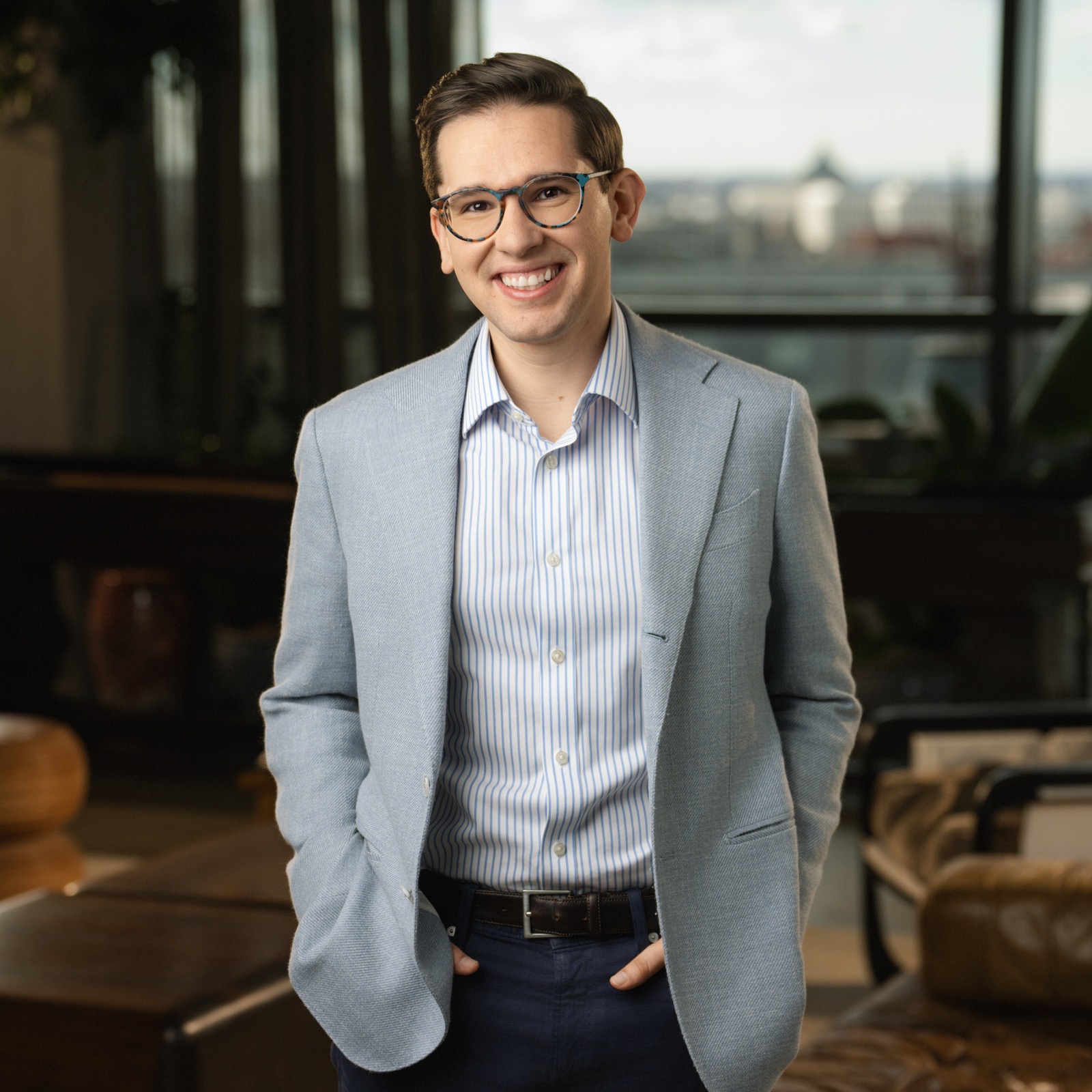
Caleb Watney portrait

The look of a man who reads grant-funding mechanisms for fun - and means it.

2022
IFP Founded
3
Core Missions
5%
Odds Worth Betting On
7B
People In The Math
The Frontier

A think tank built like a startup

Caleb Watney spends his days hunting for the levers that almost nobody is pulling. As co-founder and co-CEO of the Institute for Progress, he runs the teams working on metascience, high-skilled immigration, and emerging technology - three areas where, he argues, the private market has little reason to act and the public sector often forgets to.

IFP is nonpartisan by design and impatient by temperament. Watney and his co-founder, Alec Stapp, launched it in 2022 to drag ideas out of the "progress studies" conversation - the loose intellectual movement asking why the rate of scientific and economic progress slowed - and put them in front of the people who write actual legislation.

The pitch is unusual for a Washington outfit: treat the machinery of progress as an engineering problem. How does a federal grant get awarded? Who decides what counts as a fundable idea? What happens to a brilliant graduate student when her visa runs out? These are not abstractions to Watney. They are bugs in a system, and bugs can be fixed.

His own research keeps circling back to one stubborn question: what are the specific policy choices that would rebuild American state capacity and raise the long-term rate of innovation? Not the slogans - the mechanisms. Risk tolerance in science funding. The plumbing of the immigration system. The way the government buys, builds, and bets on emerging technology like AI.

In 2023 he took that case to Congress, testifying on where federal AI R&D funding could go furthest. In 2024 he assembled scientists, economists, and technologists for a "Metascience 101" podcast series meant to bring the public up to the frontier of a field most people have never heard of. By 2025 he was publishing arguments with titles that read like manifestos: "American Science Should Take a Lot More Risks."

Scientific efficiency isn't primarily about the dollars we could save. It's about the breakthroughs we could be missing.

- Caleb Watney

The Obsessions

Three problems, one mission

IFP narrows its energy to a short list. The logic is consistent: pick the places where good ideas die for lack of an owner.

Mission 01

Metascience

The science of how science gets done. Watney wants funding systems that reward bold swings instead of safe ones - to fund the people peer review tends to pass over.

Mission 02

High-Skilled Immigration

Train the world's best minds, then send them home. Watney calls it a self-inflicted wound, and pushes for the policy fixes that let talent stay and build.

Mission 03

Biosecurity

The next pandemic is a matter of when. Watney treats preparation as an investment problem - cheap insurance against catastrophic, civilization-scale downside.

The Diagnosis

Science plays too many singles

Watney's favorite metaphor is baseball. Tenure clocks and consensus peer review, he argues, push researchers toward "singles and doubles" - reliable, incremental, fundable. The home-run swings, the high-variance bets that change everything, get averaged out of existence. His proposed fix: a "golden ticket" that lets a single reviewer guarantee funding for a project they truly believe in. He says he borrowed the idea from TV talent shows like The Voice.

What the system rewards: safe singles85%
What it underfunds: home-run swings15%
Watney's target: more shots on goal50%

Illustrative framing of Watney's argument, not measured data.

The Long Way Round

Kansas, James Bond, and a market failure

He was born in California and grew up in Kansas from junior high on. As a kid, he watched James Bond movies and decided he would become a spy. The career plan changed. The taste for high-stakes, world-scale problems did not.

He studied business administration at Sterling College, a small school in Kansas, with a minor in economics - then went east for a master's in economics at George Mason University. It is not the resume of a typical Washington policy chief, and that may be the point.

What pulled him toward policy was a specific intuition: the most important problems are often the ones with no natural owner. "There's actually a lot less incentive to do that at a social level," he has said of the work markets ignore. He went looking for those gaps on purpose.

The climb was a steady move up the ladder of abstraction. A graduate research fellowship at the Mercatus Center. A technology policy fellowship at the R Street Institute, where early work touched things as specific as cybersecurity for self-driving cars. A consulting stint for Uber. Then director of innovation policy at the Progressive Policy Institute - and finally his own shop.

Each step traded narrow questions for wider ones, until the subject became progress itself. By the time he co-founded IFP, the through-line was clear: find the neglected lever, prove it matters, and put it in front of someone who can pull it.
The Trajectory

From research assistant to co-CEO

EARLY CAREER
Graduate research fellow at the Mercatus Center while earning his economics master's at George Mason.
TECH POLICY
Technology policy fellow at the R Street Institute; consulting work for Uber on questions like autonomous-vehicle cybersecurity.
PPI
Director of innovation policy at the Progressive Policy Institute - immigration, science funding, R&D incentives, AI.
2022
Co-founds the Institute for Progress with Alec Stapp.
2023
Testifies to Congress on where federal AI R&D funding can go the furthest.
2024
Hosts the "Metascience 101" podcast series, opening the field to the public.
2025
Publishes "American Science Should Take a Lot More Risks" and a blueprint for strategic AI R&D investment; speaks at the Progress Conference.
If you have a 5% chance of positively impacting 7 billion people, that's a bet worth taking.

- Caleb Watney, on why he chose the long odds of policy

Exhibit A

The vaccine that could have come a decade early

Watney keeps one story close, because it makes the stakes concrete. In the 1990s, Katalin Kariko struggled to win NIH grants for her work on mRNA. The funding system did not know what to do with her.

Decades later, that same line of research powered the COVID-19 vaccines. Watney's point is uncomfortable and precise: with better funding mechanisms - ones willing to back the unproven bet - the breakthrough might have arrived ten years sooner. The cost of a timid grant process is not measured in wasted dollars. It is measured in the years humanity waited for something it could have had already.

This is the engine under everything he does. Small tweaks to invisible systems compound into very large, very human consequences. Fix the plumbing, and the breakthroughs flow faster.

Margin Notes

Things that don't fit in a bio

Childhood PlanWanted to be a spy after watching James Bond. Settled for influencing the entire R&D budget of a superpower instead.
RootsBorn in California, raised in Kansas. The small-college-to-D.C.-think-tank path is rarer than it looks.
MethodHis "golden ticket" idea for science grants was lifted from TV talent shows like The Voice.
FaithA Christian who rejects political quietism - he cites Martin Luther King Jr. as the model and preaches intellectual humility.
Home BaseLives in Washington, D.C. with his wife Katarina and son Teddy.
By-lineWords in The Washington Post, The Atlantic, Politico, the WSJ. Cited by the NYT and The Economist.
The North Star

A golden age, on purpose

The aim is not modest, and Watney does not pretend it is. He wants to rebuild the country's capacity to do big things - to make breakthroughs arrive sooner and reach more people.

It is a worldview of calculated optimism. He accepts long odds because the payoffs are enormous, and he picks the problems others skip because that is where the leverage hides. Reform how science is funded. Keep brilliant people in the country. Get ahead of the next pandemic. Each is a wager on a future that does not have to wait.

The Paper Trail

Follow the work

Spread It

Share this profile

If progress is a choice, more people should know who's working on the choosing.