The corporate world once had a fairly odd policy for people who found holes in its software: please go away. A curious outsider could discover an exposed database or a clever route around a login screen, send a careful email and receive silence, a legal threat or both. Bugcrowd's founding insight was less about hacking than diplomacy. If companies wanted the benefit of unpredictable outsiders, somebody had to make the encounter predictable.
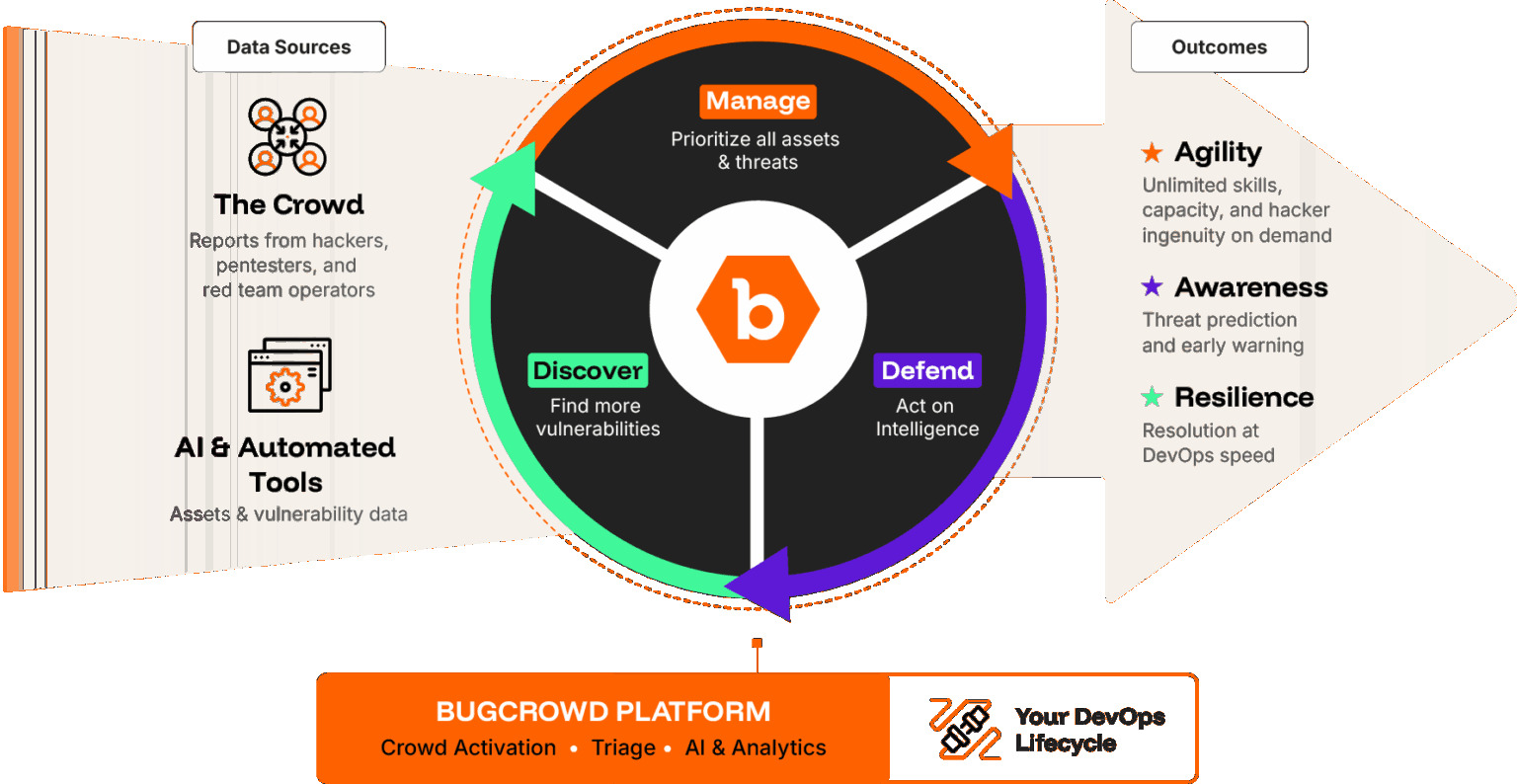
That somebody became a platform, a set of rules and a lot of administrative labor. Bugcrowd connects security teams with independent hackers and pentesters, defines what may be tested, matches talent to targets, checks incoming reports, filters duplicates, helps route fixes and pays rewards. The hacker contributes adversarial imagination. The customer gets a finding it can act on instead of a chaotic inbox. Bugcrowd operates the switchboard between them.
A marketplace disguised as a security test

Casey Ellis says the idea crystallized on September 1, 2012, during a flight from Melbourne to Sydney. Silicon Valley companies were experimenting with bug bounties - cash rewards for responsibly reported vulnerabilities - but the practice still looked reckless to much of the enterprise market. Ellis had been asking organizations why they were not doing it. Their hesitation became the product brief.
Bugcrowd launched in Australia, shifted its corporate center to the United States and raised $1.6 million in 2013. At that point its community numbered about 3,000 vetted testers. By the company's 2016 Series B announcement, the figure was above 27,000 and customers included Fitbit, Motorola, Tesla, TripAdvisor and Western Union. The important change was not simply more hackers. Recognizable customers made the category feel less like an experiment.
Government provided the sharpest piece of social proof. In 2018, Bugcrowd, HackerOne and Synack were selected for a U.S. Department of Defense contract vehicle for bug-bounty work worth up to $34 million. The practical job was finding vulnerabilities. The symbolic job was larger: if the Pentagon could invite outside hackers under controlled rules, a retailer or software company had less room to insist the model was inherently irresponsible.
The bounty is the visible transaction. The business is everything required to make that transaction safe, useful and repeatable.YesPress analysis
What happens after someone says, “I found something”
A customer begins with scope: which domains, apps, APIs, devices or cloud systems researchers may touch, and which techniques are off limits. Bugcrowd can invite a private group or open the program more widely. Researchers test, submit evidence and receive a priority rating. Managed triage checks whether the issue is reproducible, novel and in scope before the customer's engineers inherit it. Integrations can then push findings into tools such as Jira, ServiceNow, GitHub, Slack or PagerDuty.
Define scope
Match talent
Prove the flaw
Triage and route
Fix and pay
This is where the company differs from a scanner and from a conventional consultancy. A scanner is cheap to repeat but can produce a long list of theoretical problems. A consultancy provides known people for a defined period and usually ends with a point-in-time report. Bugcrowd offers variable human talent on demand, then wraps it in software and managed operations. Its closest platform alternatives are HackerOne, Synack, Intigriti and YesWeHack.
The crowd's advantage is variation. One researcher understands an obscure payment flow; another enjoys disassembling firmware; another sees that three harmless quirks can be chained into an account takeover. Its disadvantage is also variation. Reports duplicate one another. Severity creates arguments. A popular program may attract more attention than its engineering team can absorb. Triage is not glamorous, but it is the hinge.
The product grew around the awkward parts
Managed bug bounty remains the recognizable center: continuous testing with rewards tied to valid results. Around it, Bugcrowd built vulnerability-disclosure programs for organizations that need a safe public front door but may not offer cash; penetration testing as a service for scheduled assurance and compliance work; red-team engagements for broader attack scenarios; and attack-surface management for discovering assets nobody remembered to put on the testing list.
The 2024 acquisition of Informer strengthened the last two areas. Informer's external attack-surface and continuous testing technology fed into what Bugcrowd now calls Savant Vista, which discovers and scores exposed assets before sending the interesting ones into human or automated testing. The distinction matters. Visibility alone can become another backlog. Bugcrowd wants discovery and proof of exploitability to live in the same loop.
The customers span technology, finance, retail, healthcare and government. Public examples include Atlassian, Cisco, CISA, Mastercard, OpenAI, Okta, T-Mobile, Tesla, NETGEAR, Cloudinary, Outreach and Rapyd. The common customer is not simply “a company with software.” It is an organization with enough exposed technology to need fresh eyes and enough internal maturity to act when those eyes find trouble.
So what does it cost?
The honest answer: two budgets
A managed bounty generally combines Bugcrowd's platform or service fee with a separate reward pool reserved for researchers. Most enterprise prices require a quote. Public entry points include a free self-managed disclosure tier, managed VDP plans listed from $299 per month, and a standard one-time penetration test listed from roughly $5,000.
The reward pool is not ordinary software spend. It rises when researchers prove more valid vulnerabilities. That creates a slightly uncomfortable success condition: a productive program can reveal both technical debt and a larger bill. Yet paying for demonstrated results can be attractive beside consulting day rates or the impossible cost of staffing every specialist internally.
Bugcrowd itself has been funded like a growth software company. After seed and Series A rounds came $15 million in Series B funding, $26 million in Series C and $30 million in Series D. General Catalyst led $102 million in strategic growth financing in February 2024, joined by Rally Ventures and Costanoa Ventures. Silicon Valley Bank added a $50 million growth-capital facility later that year. The company used the expansion budget for international growth, product work and acquisitions rather than staying a single-product bounty broker.
What failed first was the old social contract
Bugcrowd did not begin with a famous product failure that forced a pivot. The failure preceded the company: informal vulnerability disclosure. Researchers had little assurance they would be heard or protected; companies had little assurance strangers would stay inside bounds. Bugcrowd's earliest task was to replace ambiguity with scope, safe-harbor language, coordinated disclosure and payment mechanics.
The open-source disclose.io project made that work visible beyond Bugcrowd's own platform. Co-created in 2018, it promoted readable, vendor-neutral safe-harbor terms for good-faith research. That may sound like legal housekeeping. In a market built on asking outsiders to break things, the rules are part of the product.
What changed enterprise minds was accumulation, not one slogan: household-name customers, public case studies, government programs and evidence that external researchers could fit into normal engineering workflows. A security leader no longer had to defend an eccentric idea from scratch. There were procurement patterns, severity taxonomies, program managers and peers who had already done it.
Now the machine covers the map
Bugcrowd's second transformation arrived through AI. It acquired Mayhem Security in November 2025, bringing in autonomous testing built around fuzzing and symbolic execution. In 2026 it launched reinforcement-learning environments containing hundreds of thousands of exercises derived from authentic open-source vulnerabilities. AI developers can train agents to find, exploit and repair flaws, with objective scoring at each step. Bugcrowd says customer and researcher data are not used to build those environments.
July brought Savant Pathseeker, an early-access agentic pentesting product for external web applications and APIs. Its agents perform reconnaissance, map possible vulnerabilities, attempt non-destructive exploitation and return evidence. Human pentesters remain available for the part machines handle poorly: business-logic mistakes, long exploit chains and genuinely novel behavior. General availability is planned for later in 2026.
Machines are useful when the job is “test everything again.” Humans remain useful when the job is “notice the one thing nobody thought to ask.”The division of labor behind Savant
The timing is sensible and risky. AI lets attackers probe continuously, so annual testing looks increasingly quaint. But autonomous testing can also create industrial quantities of low-value noise, wander beyond scope or turn the research community into unpaid training data. Pathseeker includes guardrails and a manual kill switch; Bugcrowd also says it does not train its models on customer or researcher data. Those promises will matter as much as benchmark speed.
What a security team can copy tomorrow
The useful lesson is not “launch a public bounty on Friday.” Start with a disclosure channel and explicit safe harbor. Pick a narrow asset whose owner can respond quickly. Define prohibited behavior in plain language. Set rewards high enough to attract the expertise the target requires. Measure valid unique findings, time to triage and time to remediation - not raw submission volume. Expand only after the response loop works.
The same logic applies inside a company. Separate discovery from validation. A scanner alert is a lead, not a verdict. Route proved findings into the system engineers already use. Give one person authority to settle scope and severity disputes. And treat researchers as recurring partners: slow replies and arbitrary downgrades teach the best people to hunt elsewhere.
It will not work under several common conditions. A vague scope invites conflict. A tiny reward pool attracts little sustained attention. A legal team that treats good-faith reports as threats destroys trust. Most of all, a company without remediation capacity should not summon a crowd to produce a queue it cannot clear. More findings do not equal more security when the fixes sit idle.
The company between two kinds of ingenuity
Bugcrowd's market position now stretches from human marketplaces to security automation. That breadth can become a coherent platform or a crowded product menu. Its advantage is the loop connecting engagements, vulnerability data, researcher reputation and remediation outcomes. Better matching should create better findings; better findings enrich the knowledge graph; better data should improve the next match and the next automated test.
The company also has more institutional access than its 2012 self could have imagined. It achieved FedRAMP Moderate authorization in March 2026, partnered with Carahsoft to reach public-sector buyers and added European data residency in June. These are not colorful hacker stories. They are the compliance plumbing required to sell unconventional testing to conservative organizations.
Fourteen years after that Melbourne-to-Sydney flight, Bugcrowd is still translating between groups that regard risk differently: hackers who want room to explore, engineers who want reproducible proof, executives who want measurable reduction and now AI agents that want an environment in which to practice. The company wins when those interests line up. The moment they do not, the switchboard gets noisy.