BrightView Technologies
Design brilliance meets visual intelligence.
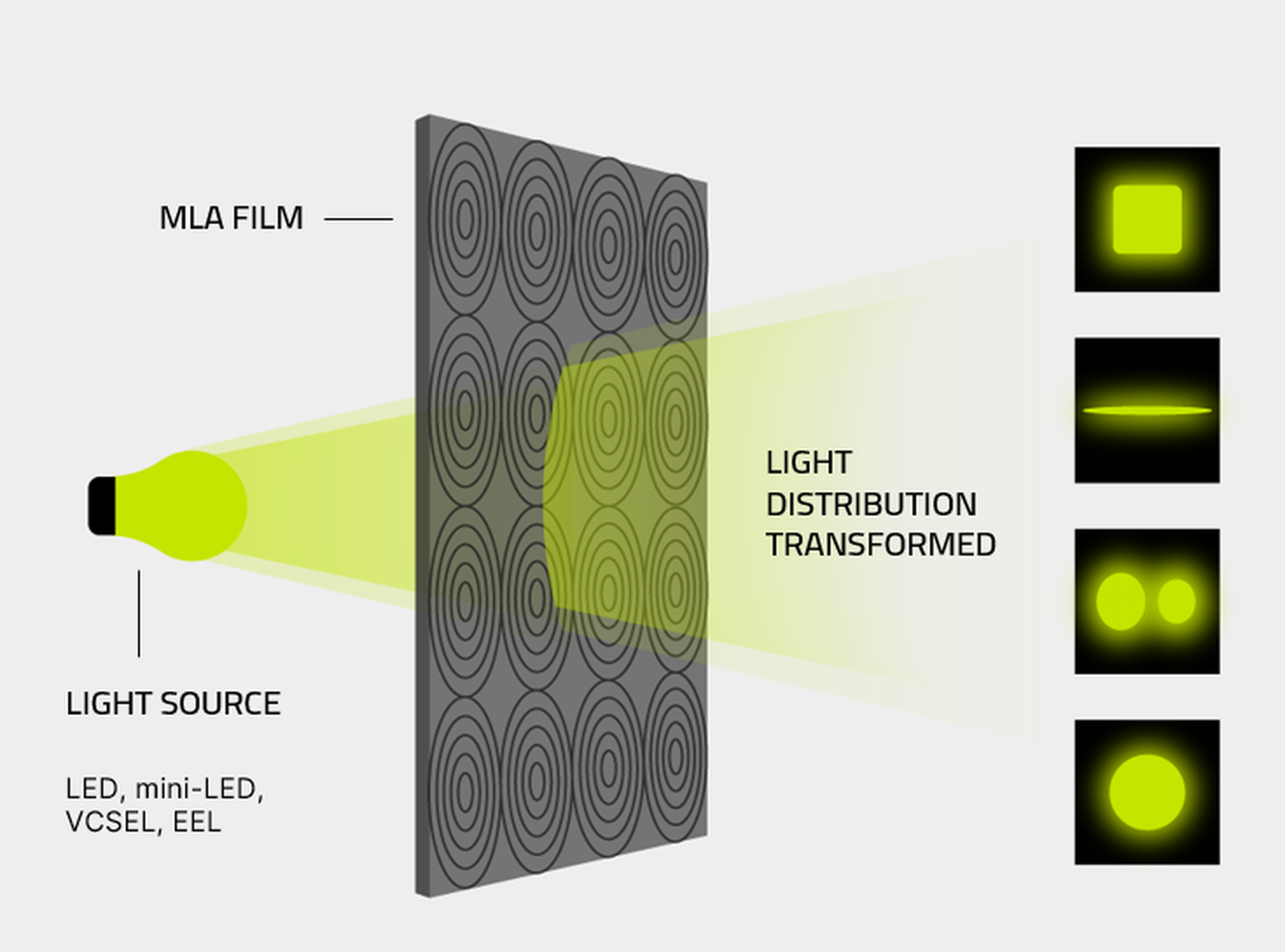
A roll of nothing-much becomes a sheet of precisely aimed light. BrightView's micro lens array film - the part of your screen you were never meant to notice.
Design brilliance meets visual intelligence.
Somewhere on a quiet street in Durham, North Carolina, a machine is unspooling a clear roll of plastic film. By the time that film reaches the other end of the line, it has grown a skin of microscopic lenses - structures smaller than a human hair - and it now does something the raw plastic could not: it tells light exactly where to go. That film will end up inside a car dashboard, a phone's flash, an AR headset, or a LiDAR sensor. You will never see it. That is the entire point.
This is BrightView Technologies. About fifty people, one facility, more than two hundred customers, and a stubborn specialty in the unglamorous physics of pointing light in the right direction. They call the discipline computational optics. Most of us would call it the reason a screen looks bright and even instead of blotchy and dim.
"We supply advanced Micro Lens Array solutions to global leaders across display, AR/VR, mobility, 3D sensing, and LED lighting."
- Jennifer Aspell, CEOLight is a terrible employee. Point an LED at a screen and it glares in one spot and abandons the rest. Pack a display with mini LEDs and you can see every single one of them, like streetlights through fog. Send a laser into a LiDAR module and it scatters where it pleases. Engineers have spent decades fighting this, mostly by throwing more power, more components, and more cost at the problem.
BrightView's bet was simpler, and slightly annoying in its obviousness: don't fight the light, redesign the surface it passes through. Engineer the microstructure of a film so precisely that the light has no choice but to spread evenly, hide its sources, or focus into a clean beam. Geometry instead of brute force. The catch - and there is always a catch - is that designing those structures and then manufacturing them at the scale of millions of square feet is genuinely hard.
How do you make a screen brighter without using more power? You stop blaming the bulb and start engineering the film in front of it.
- The whole pitch, in one sentenceBrightView started in 2002 as a venture-backed company built on optics intellectual property licensed from Duke University. Its first big idea was making components for rear-projection televisions - which, if you remember those enormous living-room boxes, you can already guess how this story almost ended. The company raised around $30 million by 2008. Then the Great Recession and flat-panel TVs arrived more or less together, and the rear-projection market evaporated.
In 2010, Tredegar Corporation acquired the business and Jennifer Aspell stepped in to run it. Aspell had already spent two decades commercializing emerging optical technology, which is a polite way of saying she knew how to take a clever lab idea and make a factory profitable from it. Her bet was that the microstructure expertise BrightView built for dead TV technology was, in fact, the foundation for everything coming next: displays, sensors, headsets, self-driving cars.
"We want to enable the next generation's fourth industrial revolution - and become a dominant player in the world of visual intelligence."
- Jennifer Aspell, CEOIt is a big claim for a fifty-person shop in North Carolina. It is also, inconveniently for skeptics, the kind of claim that the customer list keeps backing up.
BrightView's whole catalog is variations on a single trick: print precisely engineered microstructures onto film, then roll it out at volume. The structures change; the principle doesn't. Pair that with in-house optical design software, and the company can simulate a film's behavior before a single roll is made.
Micro lens arrays that control how light spreads and focuses - the backbone product across displays, sensors and lighting.
Boost LCD brightness and efficiency without adding power. The screen looks brighter; the battery doesn't notice.
For mini LED and FALD displays - smooths individual LEDs into one uniform, glowing surface.
Diffusion and beam control for LED lighting, AR/VR field-of-view, and LiDAR beam shaping.
Bespoke films co-designed with customers, backed by simulation data and BSDF measurements.
Newer 2025 films built to enhance flash and sensor performance in smartphones and tablets.
Venture-backed launch in Research Triangle Park, making optics for rear-projection TVs.
Capital pours in - just as the rear-projection TV market begins to disappear.
New ownership, new CEO, and a pivot toward modern micro-optics.
Repurposes film lines to manufacture PPE face shields - then returns to optics.
Established across consumer electronics, automotive and lighting markets.
FORVIA HELLA and Technology Venture Partners invest; a new MLA production line opens in Durham.
Strategic collaboration adds Asia-based manufacturing and global supply-chain reach.
The numbers tell a strange little story: a company you've likely never heard of, supplying parts you can't see, to companies you absolutely have heard of. Two hundred-plus customers. Roughly fifty employees. A single facility. And in early 2025, a $7 million Series B led by FORVIA HELLA - one of the world's large automotive lighting and electronics groups - alongside Technology Venture Partners.
That FORVIA HELLA led the round is the most telling detail. Automakers don't write checks to optics startups for fun; they do it because head-up displays, interior lighting, sensor systems and dashboards all increasingly depend on exactly the kind of light control BrightView sells. The 2026 Focuslight partnership then bolted on something a fifty-person company usually can't reach: scalable manufacturing in Asia.
"This partnership enhances our manufacturing flexibility and strengthens our global supply chain."
- Jennifer Aspell, on the Focuslight collaborationBrightView describes what it's building as "visual intelligence" - the layer where digital images meet the physical way light actually travels. It sounds abstract until you list what depends on it: virtual reality that doesn't strain your eyes, automotive displays you can read in direct sun, sensors that see accurately enough to steer a car, lighting that's bright without being harsh.
The mission underneath is narrower and more honest than the buzzwords suggest. Give engineers precise, manufacturable control over light. Not light in theory - light in a product, shipping at volume, at a price a factory can live with. That gap between a clever optical idea and a clever optical idea you can actually buy a million of is where most optics startups quietly die. BrightView has spent two decades living in it.
Every screen is getting brighter, every car is getting more displays, every headset is fighting for a wider field of view, and every autonomous system is hungry for cleaner sensor data. All of that runs on controlling light - and controlling light at scale is a manufacturing problem more than a physics one. That's the bet BrightView made before it was obvious, and the reason a small Durham company keeps showing up in the supply chains of much larger ones.
Go back to that quiet street in Durham. The machine is still running, still turning a clear roll of nothing-much into a sheet of precisely aimed light. The difference now is where that film ends up: not the back of a dead television, but the dashboard of a new car, the flash of a phone, the lens of a headset. BrightView didn't change what it does. It changed what the world needed it for - and then it built the second production line to keep up.
The best optical film is the one you never see. BrightView has built a business out of being invisible on purpose.
- The quiet ambition of an optics company