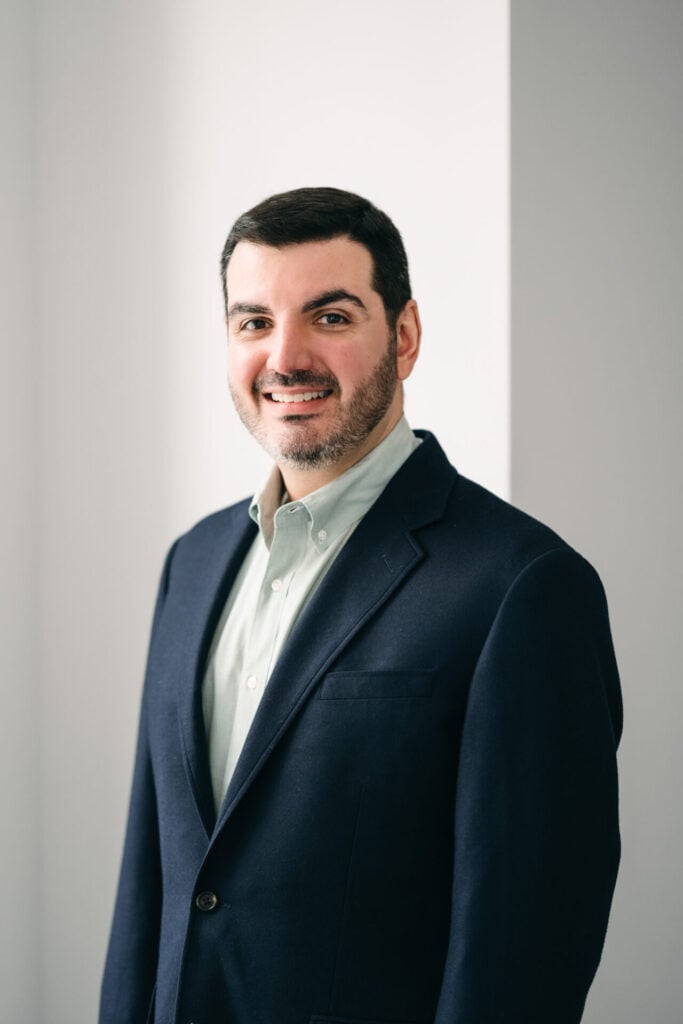
The loyalty nerd who rebuilt the waiting room
There is a sentence Brad Olson likes to repeat, and it doubles as his entire business plan. Standing in a hospital years ago, on the wrong side of the consumer experience he would later spend his career dismantling, he turned to his husband and said the quiet part out loud: "If any consumer business ran like that, they'd be out of business the next day." Most people who think that thought go home and forget it. Olson runs a company built on it.
That company is Sollis Health, a members-only outfit that does urgent and emergency care the way a five-star hotel does check-in. Walk in, and an ER-boarded physician sees you in zero to fifteen minutes. There are hospital-grade labs and imaging in the building. A doctor does not just patch you up - they call your regular physician, coordinate the specialist, handle the scheduling, then text you the next day to see how you slept. To anyone who has ever spent an afternoon on a vinyl chair under fluorescent lights clutching a clipboard, it sounds less like medicine and more like fiction.
Olson is the chief executive, and he arrived in medicine the way good ideas usually arrive: by accident, sideways, and slightly late. He had never heard of Sollis when a headhunter called on behalf of its board. He and his husband joined as members at the Tribeca clinic the following week, mostly out of curiosity. They fell for it. Not long after, in late 2022, he took the top job. The customer became the CEO - which is exactly the kind of conversion story a loyalty program would put on a billboard.
A resume that reads like a customer-experience textbook
To understand why a hotel-and-fitness executive ended up running clinics, you have to follow the thread he has been pulling his whole career: emotional loyalty. Why do people stay? Why do they come back? Why do they tell their friends? Olson has chased that question through three industries that, on paper, have nothing to do with one another.
He started at Bain & Company in Chicago, a self-described "traveling nerdy consultant" who served clients in healthcare, industrials, consumer packaged goods, and airlines without falling for any of them. What he did fall for, oddly, was the loyalty program of the hotel chain he kept staying in. So after about seven years at Bain, he jumped to Starwood Hotels - first as Head of Brand Strategy across its nine brands, then as the global head of strategy and operations for Starwood Preferred Guest, the loyalty program with more than 21 million members. It was his first taste of a big profit-and-loss statement and a big global team. He has called it a blast, and you believe him.
When Marriott swallowed Starwood in 2016, Olson was offered a seat on the combined program that became Marriott Bonvoy. He passed. Instead he took what he calls a leap of faith and joined Peloton as one of its first hundred employees, with a mandate to build the end-to-end customer experience and a retention-marketing function from scratch. Over five and a half years he ran social, community, email, and CRM, and eventually became general manager of the Subscription business unit - an operation worth roughly $800 million. The headline number is the one he is proudest of: membership scaled something like a hundredfold, and the renewal rates and net promoter scores held while it did. Anyone can grow fast. Growing fast without your customers quietly hating you is the trick.
One patient per hour. Try that in a hospital.
Then COVID-era tailwinds turned, and so did he
By the back half of his Peloton run, the pandemic boom was fading and Olson found himself pulled into cost-restructuring work that swallowed his calendar. He has been candid that this was not how he wanted to spend the next few years of his life. The Sollis call landed at exactly the right moment. He had recently watched the American emergency-care experience from the inside and come away stunned - not by the clinicians, who he thought were remarkable, but by how little time and how few resources the system gave them, and how grim the experience was for the person on the table. The headhunter described a company already solving precisely that. As he put it, his mind was blown.
Born in a doctor's frustration
Sollis was co-founded by Dr. Bernard Kruger, one of New York's top concierge primary-care physicians, who hated sending his own patients into crowded ERs. The company grew out of a concierge PCP practice.
Member first, CEO second
Olson signed up at the Tribeca clinic a week after first hearing the name. He liked it enough to run it. He still keeps an in-network primary doctor for his annual physical and routes everything acute to Sollis.
Hiring people who see corners
He recruited Jia Jia Ye (ex-One Medical, ex-Oscar, founder-CEO of Springtide) as COO and Dylan Margalit (ex-Bond Vet) to run finance. "An embarrassment of riches," he calls it.
Why ER physicians defect
Sollis offers equity, performance bonuses, and a flat org where every full-time doctor knows the CEO by name. One told him on a clinic walk-through: "This is the way I always thought I would practice medicine."
First-contact resolution, but for your body
Ask Olson what the rest of urgent care gets wrong and he answers in the language of a call center, which is to say the language of someone who has thought hard about customers. In the consumer world, he points out, the metric that matters is first-contact resolution: the first time you call, the first time you walk in, can we actually solve your problem? Most urgent-care clinics cannot. By his telling, one study found they refer out more than half of what comes through the door - to a lab for bloodwork, a pharmacy for a drug they do not stock, an imaging center, or the ER itself. You skip the wait only to start a scavenger hunt.
Sollis is built to be the one stop. ER-boarded clinicians, on-site labs, advanced imaging including CT, telemedicine, house calls, and a coordination team that chases down your specialist follow-up. The result, per the company's own figures, is that only about half a percent of visits end in a referral to a hospital ER - and when they do, the patient arrives carrying a doctor's write-up, the labs, and the images, which is its own small mercy for an overloaded system. Olson likes that part. He frames Sollis not as a competitor to the safety-net ER but as a release valve for it.
Small but dangerous
That is Olson's favorite description of his own company - "small but dangerous" - and it captures the posture of a category creator that has spent eight years quietly building while nobody was watching. Today Sollis runs across the New York metro and the Hamptons, South Florida, Southern California, and Northern California. In April 2024 the healthcare investment firm CRG put money in to fund the next leg. Olson has been blunt about where he wants to plant flags next: the markets with a dense population of high-net-worth households where concierge primary care has already proven people will pay for premium care. That list runs through Dallas-Fort Worth, Washington D.C., Chicago, Boston, Atlanta, and Seattle - and through the unclaimed corners of his own backyard, like Brooklyn and Westchester, where Sollis has not yet opened a door.
He is also widening the aperture beyond the moment something goes wrong. When members kept asking about preventive full-body MRI scans, Sollis struck a partnership with Prenuvo rather than pretend the demand did not exist. Olson is careful about it, though. He insists the company stay in its lane as an urgent and emergency provider, using its physicians to vet anything new before it reaches members. It is the discipline of an operator who has watched companies sprint past their own competence and pay for it.
The man behind the membership card
Olson holds two Harvard degrees - a bachelor's from Harvard College and an MBA from Harvard Business School - which on most resumes would be the headline and on his is almost a footnote. He serves as a trustee for the Greater New York region of the National Multiple Sclerosis Society. He talks about his team the way the best operators do, in specifics and with obvious delight, and he has a habit of crediting the people around him for making the company better. The through-line, across hotels and bikes and clinics, is a near-religious belief that loyalty is earned in the unglamorous details: the follow-up text, the doctor who knows your name, the wait that never happened.
What makes Olson interesting is not that he runs a fancy clinic. It is that he refuses to treat healthcare as a special case exempt from the rules every other consumer business lives by. Treat people's time as precious. Solve the problem on the first try. Earn the renewal. He learned those rules selling hotel points and exercise subscriptions, and he is betting the entire next chapter of his career that they work just as well when the stakes are a fever at 2 a.m. instead of a free night in a suite. The waiting room, it turns out, was never a medical necessity. It was just a business that nobody had bothered to fix.