BitPatrol and the case for a scanner that reads the code the way a hacker does
A former Stripe engineer spent years finding other companies' leaked secrets on HackerOne. Then he built a tool to find them first - before the countdown to a breach begins.
Every leaked credential is a stopwatch. The moment an API key, a database password, or an auth token lands in a public commit, a clock starts - and the only question that matters is whether you or an attacker reaches it first. For most of the last decade, the tools guarding that clock have worked the same way: match a string against a pattern, fire an alert, repeat. BitPatrol was built on the bet that pattern-matching is not enough anymore.
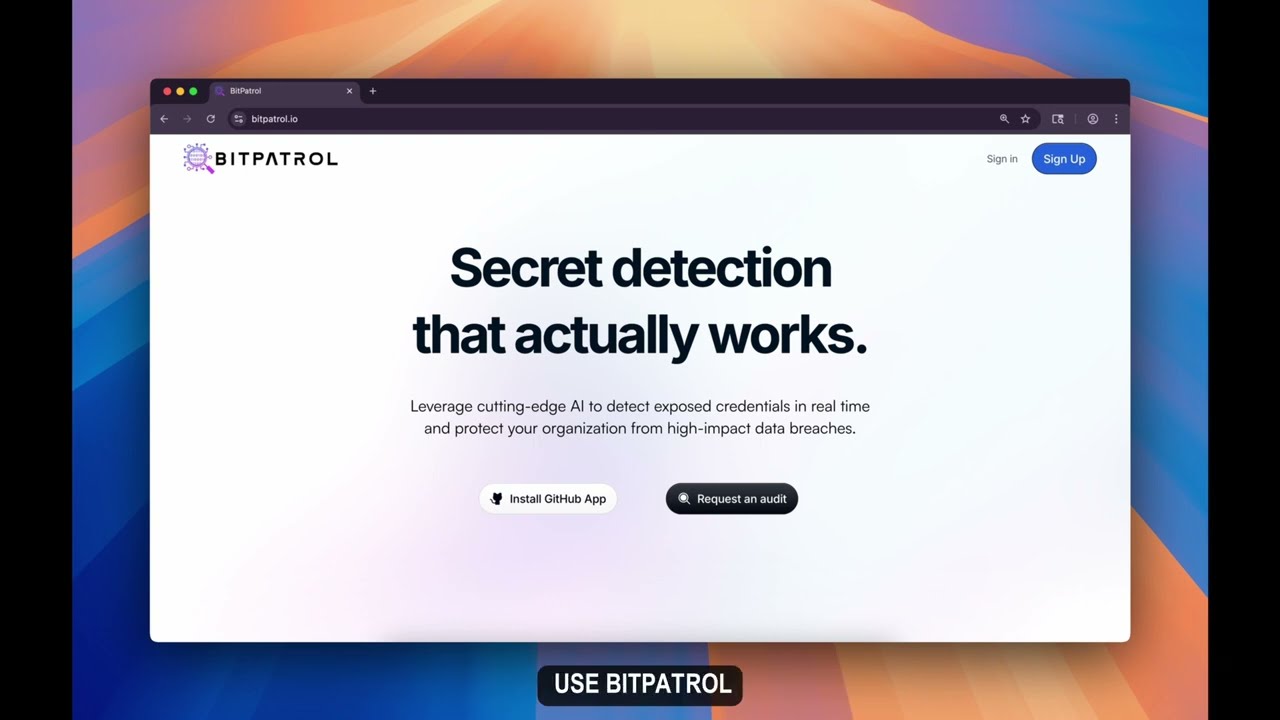
Founded in New York in 2024 by Christopher Lambert and accepted into Y Combinator's Spring 2025 batch, BitPatrol is a code-security company with a narrow, unglamorous job: watch source code, and catch secrets the instant they are exposed. It plugs into GitHub as an app, scans on every push, and pings a team through Slack, PagerDuty, or a webhook when something looks wrong. The pitch on its homepage is blunt - "Stop secret leaks before they become breaches."
What makes the company worth a closer look is not the category, which is crowded, but the person who built it and the approach he chose.
01The hacker who switched sides
Lambert did not arrive at secret detection from the vendor side. He arrived from the other end of the exploit. A former engineer at Stripe - with earlier stops that included work in payments and infrastructure - he spent years as a bug-bounty researcher and climbed into the top 2% of hunters on HackerOne, the platform where companies pay outsiders to find their holes. His specialty was the leaked secret: the key sitting in a forgotten commit, the token baked into a Docker image, the credential that enterprise scanners had waved through.
That background is the product's real moat. Anyone can write a regular expression that matches the shape of an AWS key. It takes someone who has actually exploited leaks to know how they hide - in encodings, in test fixtures, in strings that look like noise until you understand the code around them. BitPatrol is, in a sense, one hacker's intuition turned into software.
There is a useful asymmetry in that story. A defender has to be right about everything; an attacker only has to be right once. Lambert spent his research years on the winning side of that math, which meant he saw the same failure again and again - a company with a respectable security budget and a name-brand scanner, still leaking a key that a determined outsider could find in an afternoon. The gap between what the tools caught and what a person could catch was the opening. BitPatrol is an attempt to close it with a model rather than more people.
02What it actually does
The core product is a GitHub App. Once installed, it inspects code as it is pushed, looking for exposed credentials - API keys, database passwords, authentication tokens, and the long tail of secrets that do not fit a tidy format. When it finds one, it routes an alert to wherever the team already lives: Slack for a fast heads-up, PagerDuty for an on-call page, a webhook for anything custom. There is a historical audit that rakes through a repository's past to surface secrets that leaked long ago and may still be live, and an external-only public code audit that checks a company's exposed footprint the way an attacker would - from the outside, without access.
The interesting part is step two. Legacy scanners largely decide with regular expressions: does this string match a known pattern? BitPatrol runs a proprietary machine-learning model that weighs the surrounding code and the apparent intent of the change, then cross-references what it finds against a large corpus - billions of public commits, Docker images, open-source packages - to judge whether a flagged string is a genuine live secret or harmless noise.
The corpus is what turns a guess into a judgment. A forty-character hex string sitting next to a variable named "example" and matching a value that already appears in ten thousand public repositories is almost certainly a placeholder. The same string, unique, wired into a production config, and never seen anywhere else, is almost certainly a live key. Regex cannot tell those two apart. Context can, and that distinction is the entire reason the product exists.
03The false-positive problem
Ask any security engineer why they stopped trusting their scanner and the answer is usually the same: it cried wolf. Regex-based tools are generous with alerts, and a tool that fires constantly trains people to ignore it. The dangerous alert then arrives in a stream of noise and gets dismissed with the rest. Alert fatigue is not a nuisance - it is the failure mode.
BitPatrol's whole design points at that problem. By reading context instead of matching strings, it aims to say less and be right more often. The company frames it directly: catch what competitors miss, and stop flagging what does not matter.
04Who it is for, and how it sells
The customer is any engineering or security team that keeps its code on GitHub - startups that cannot afford a breach and enterprises that cannot afford to miss one. The business model is straightforward B2B SaaS: a per-developer subscription, listed early at $20 per developer per month, wrapped around the real-time GitHub integration. For larger buyers, the roadmap referenced the usual enterprise checklist - single sign-on, role-based access control, on-premise deployment, and API access.
It is worth being honest about scale. BitPatrol reported a team size of one. This is a founder-built company, and much of its credibility rides on that founder's track record rather than a large go-to-market machine. In a category defined by trust, that is a defensible place to start, though not an easy one to grow from alone.
05Where it sits in the market
Secret detection is not an empty field. The names a buyer weighs it against - GitGuardian, TruffleHog, Gitleaks, GitHub's own Advanced Security scanning, Nightfall - are established, and several are open source or bundled into platforms teams already pay for. BitPatrol's wedge is not breadth but the detection engine: the argument that context-aware machine learning catches the leaks regex misses and stays quiet when regex would shout.
That is a real differentiator only if the model delivers, and the market appears to have taken the bet seriously. The company raised a $500K seed in June 2025 from Y Combinator and Caffeinated Capital, and by late 2025 it had been acquired - Y Combinator lists its status as acquired, with the standalone GitHub App slated for deprecation on October 6, 2025. A roughly one-year arc from founding to exit is fast, and it says something about how much appetite there is for smarter detection in a space everyone assumed was solved.
It also fits the shape of the market. Secret detection is a feature as much as a product - the kind of capability that platforms and larger security suites want to own rather than send customers elsewhere for. A sharp detection engine built by a credible founder is exactly the sort of thing an acquirer folds in rather than rebuilds. For BitPatrol, being narrow and technically pointed was not a limitation; it was the whole strategy, and it appears to have worked on its own terms.
06The takeaway
BitPatrol is a clean example of a pattern worth noticing: the sharpest defensive tools tend to come from people who spent time on offense. Lambert did not theorize about how secrets leak - he found them, over and over, in places the incumbents had cleared. The company he built is that experience compressed into a scanner that reads code instead of skimming it.
Whether BitPatrol survives as a standalone product or lives on inside its acquirer, the idea it pushed forward is likely to stick around: that the next generation of secret detection will be judged less by how much it flags and more by how rarely it is wrong.