Designer. Founder. Contrarian.
The man who makes the beautiful feel obvious.
Born in London. Based in Los Angeles. He sold a company at 23, built crypto's most beautiful wallet, and just became Design Lead at X — the platform Elon Musk calls the future of everything. He's 26.
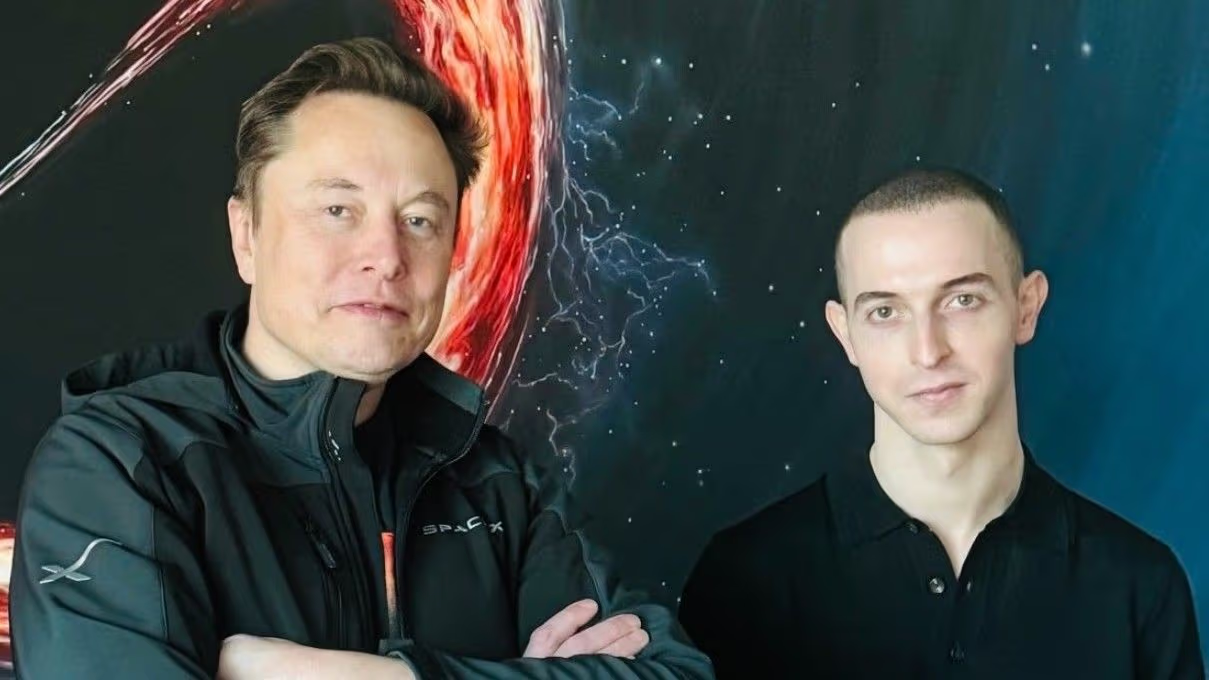
In a post that racked up 10.1 million views overnight, Benji Taylor announced he was joining X as Design Lead. "I believe this is the most important platform in the world," he wrote, "and I can't think of a more exciting place to help shape the future." Musk responded with a single word: welcomed. The internet took note. The design world gasped. And Benji, as usual, got to work.
There is a certain kind of designer who looks at the world and finds it insufficiently polished. Every button too sharp. Every transition too static. Every font slightly wrong. Benji Taylor is that designer — and he has been since he was fifteen years old, alone in London, building an iPhone game because he wanted to see if he could.
He built it. He put it on the App Store. He failed his school project. He got 10,000 downloads. The pattern was set.
By 16, he was Creative Director of Next Exit, his own design studio. Artists like Ram Riddlz and A$AP Ant came calling. Dazed magazine profiled him. Most teens were figuring out their GCSEs. Benji was redesigning the music industry's visual culture from his bedroom.
He moved to Los Angeles — and named his company after the first neighbourhood he lived in. Los Feliz Engineering. Because of course he did.
Professional networks tell you what someone has done. Let's tell you who he is — and where every twist was, in hindsight, inevitable.
"I met Benji six years ago when I invested in his app. It was one of the most well-designed products I'd encountered. I knew right away he was on track to become one of the best designers in the world. After 6 months of convincing, we're finally teaming up."
Beyond his day jobs, Benji co-founded Dip — a project that creates and publishes open-source tools for interface excellence. Products include cmdk (a widely-used command-menu component) and Agentation. Because apparently one career isn't enough.
Three words. Every product. No exceptions. If it violates one, it doesn't ship.
Not the absence of features — the absence of confusion. Fundamentals at your fingertips. Everything else appears when most relevant. Complexity is never gone. It's just hidden until you need it.
Moving through water, not teleporting between rooms. Each animation has an architectural purpose. "We fly instead of teleport." A lifeless product feels like a dead product — and a dead product feels uncared for.
Delight isn't decoration. It's selective emphasis. The fancy restaurant with the dirty bathroom? That's delight done wrong. Every corner of an app — even the unused ones — deserves craft.
A London teenager keeps a folder of thousands of saved images, animations, and UI designs. "Every day I'll look through it and find some forgotten gem," he later says. The obsession has a name.
Dazed magazine profiles him: "The 16-year-old designer shaking up the music industry." A$AP, Ram Riddlz, Kevin Abstract. He's still technically in school.
Moves to Los Angeles. Lands in Los Feliz. Founds Los Feliz Engineering. Because why not wear your hometown on your sleeve?
Family: a self-custody crypto wallet hailed as the best UX in the industry. So beautiful, other apps copied its components. "The most impressive consumer-grade wallet product." — Suji, Mask Network
March 25, 2026. One tweet. One photo. One announcement. Design Lead at X. "Lots to do!" — Elon Musk. The rest, as they say, is future history.
Timeline: roughly 2015 → 2026. From a school assignment to the world's most-watched platform.
Honk was a real-time messaging app with a radical premise: no send button, no chat history, no drafts. Every character appeared on your friend's screen instantly — every typo, hesitation, and edit unfolding live. When you wanted to say something else, you tapped to clear, like wiping a whiteboard.
It had custom typefaces (Honk Sans, Honk Chat — both commissioned). It had a sound designer (Ethan Mueller) who composed audio to match the timing of every interaction. It had a physics engine for emoji collisions. It had mini-games that paused if your friend left the screen. It had 2.6 billion characters typed before it was sun-setted.
Family was a self-custody crypto wallet for iOS. In an industry famous for confusing interfaces, it felt like a native iOS app designed by someone who actually used it. The dynamic tray system — components that expand, contract, and adapt — inspired so many recreations that designers wrote blog posts about how to build just that one feature.
Fluidity everywhere: buttons morphing into trays. Chevrons animating direction. "Continue" transforming letter-by-letter into "Confirm." Confetti when you backed up your wallet. A sequin easter egg hidden inside the QR code. Trash tokens tumbled into a skeuomorphic bin with a satisfying sound.
Aave Labs acquired the company that built it. The wallet was eventually wound down in early 2026 — but its design language lives in every Web3 mobile app that came after it.
London → design career. Los Angeles → Los Feliz Engineering. It's not branding. It's autobiography.
"Going to a fancy restaurant but finding it has a dirty bathroom." That's what an unpolished corner of your app does to a user. He doesn't tolerate dirty bathrooms.
Alongside apps, a design studio, and music industry clients — because why not. He has always needed more surfaces to design on.
"A pet peeve of mine is when a component already visible on screen unnecessarily duplicates itself during an animation." If it's already there, it shouldn't appear again. Period.
In his Honkish essay, he captions the emoji physics engine with genuine disbelief. Genius with a sense of humour about itself. Refreshing.
In a serious design essay about delight, he parenthetically noted that the usual rule "specialness diminishes with repetition" doesn't apply to Nerds Gummy Clusters. Priorities.
Hey, Benji —
You've made things beautiful that most people never noticed. You built Honk for people who wanted presence, not permanence — and they loved you for it even when it was gone. You built Family to make crypto feel like it had a soul. You named your company after a street.
There's a thread here: you have always believed that good design is a form of respect. Respect for the user's time. Their intelligence. Their feelings while they're using the thing you made.
Now the platform is X. The canvas is billions of people. Lots to do, indeed.
We're watching — and we think you'll make it feel like it was always supposed to look this way.
Benji is actively hiring product designers to join him at X and xAI. He described it as "the best work of their careers" — which, coming from someone who's built apps that inspired entire design communities, is not a small claim.
With X Money set to launch in April 2026 — offering peer-to-peer payments, bank deposits, a debit card, and cashback across 40+ US states — his crypto-native background isn't coincidental. It's the whole point. The everything app needs an everything designer.
His scope spans X, xAI, and SpaceX. The man who made a crypto wallet feel like a lifestyle product is now designing the interface layer of Elon Musk's empire.
His essays on Honk and Family are masterclasses in principled product design. Read them at benji.org.
cmdk is used by thousands of developers. Agentation is his latest. Both via dip.org.
He's hiring product designers at X and xAI. Follow @benjitaylor for updates.
He posts sparingly but meaningfully on @benjitaylor. Low noise. High signal. Very on-brand.