Five founders, one full-time seat
A media company can begin with a complaint. Keeping it alive requires a calendar. No Cap Space has both: a conviction that women’s basketball deserves better coverage, and an operation that must keep publishing when most of its founders have another job to do. Ambition is plentiful. An uninterrupted afternoon is a luxury.
In beehiiv’s July 1, 2026 customer account, Tyler DeLuca is the sole full-time employee among five founders; the other four have other jobs. The team moved from Substack in November 2025. That is the snapshot behind this story, rather than a claim about its staffing forever.
DeLuca, Chaunte’l Powell, Greer Engonga, Andrew Haubner and Rashard Hall first connected through women’s basketball’s online community. Their own account describes the turn from criticizing coverage to producing it. The publication’s mission spans levels and countries, placing the game’s history beside its present. Its about page identifies Powell as managing editor, Engonga as chief marketing officer, Hall as draft scout and insider, Haubner as editor-in-chief, and DeLuca as director of video content. A small payroll need not mean a small range of skills.
The front page arrives by email
The July case study describes a daily 3 p.m. newsletter connecting two weekly podcasts, video, game reporting and recommended reading. A fan gets a route through the work in one inbox. The alternative demands an attentive customer who remembers which app holds which conversation. Even a devoted basketball fan has errands.
Think of the email as an edition. A headline gives a hurried reader somewhere to start; an episode offers company on a commute; reporting gives a disputed take something firmer to stand on. Each format has a different use, so collecting them in one edition can make the whole publication easier to understand.
That arrangement makes an editorial promise: come here and we will help you find what matters. The inbox supplies a recurring appointment. The editors still have to earn it. A collection of links becomes a publication only when someone exercises judgment about what belongs together and what deserves the reader’s time.
No Cap Space’s own site extends that promise to its paid Ball-Knower’s tier, listing insider reporting, additional content and discounts on merchandise and live-event tickets. Audio sits inside a broader relationship. A reader can arrive for a useful free issue and decide later which privileges are worth buying.
The publishing model
A single edition gives fans a path into every format.
Remove the errands around the episode
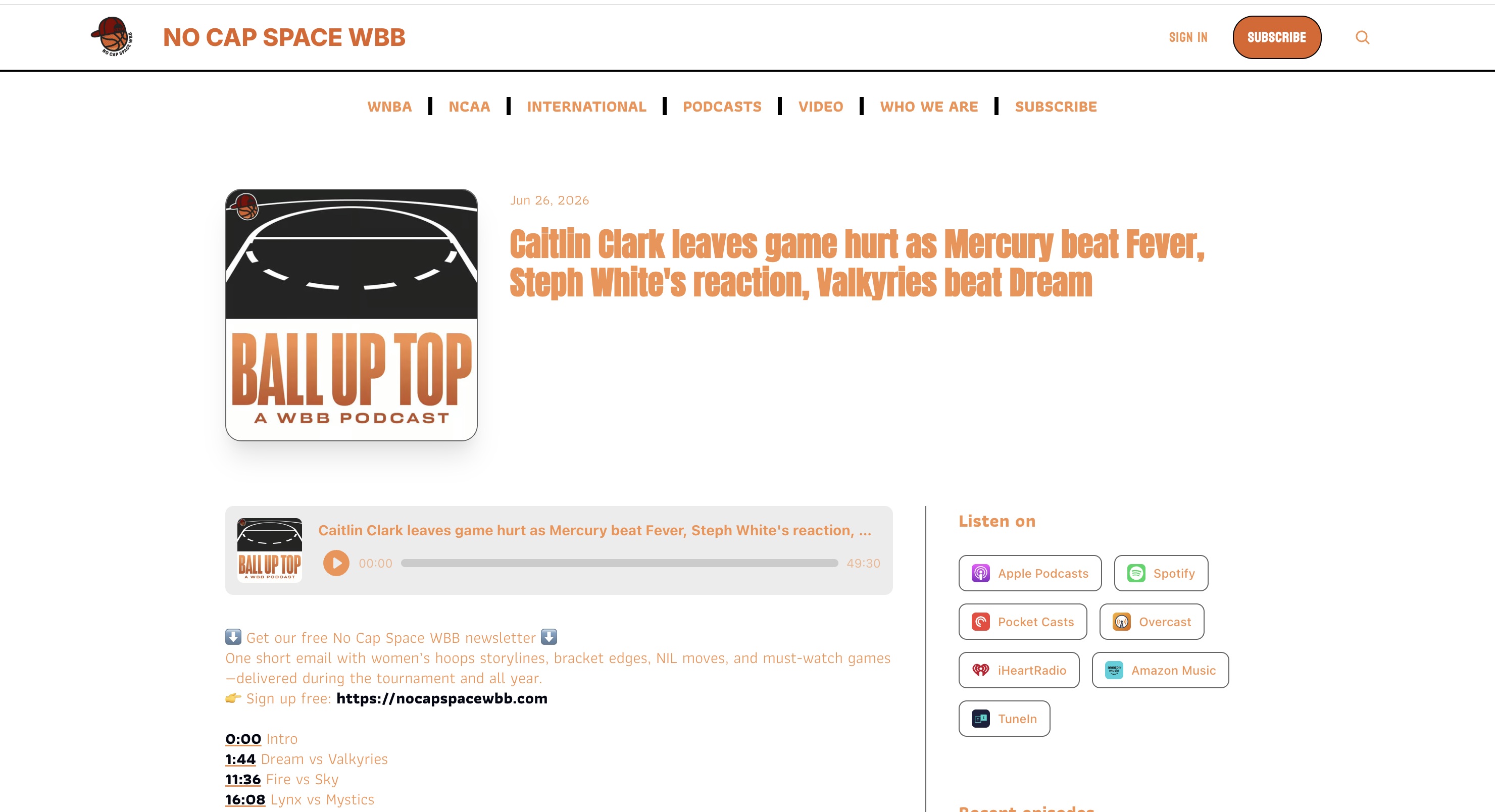
The team credits native podcast embeds with removing two to three distribution steps from a Spotify-and-third-party workflow. It also reports that approximately 10% of paid subscribers use the premium audio feed, which repackages its videos for listening. Those are customer-reported observations in the July account.
There is a modest elegance to this: let an existing piece of work travel further. Someone who cannot watch a video may still have time to hear it. That changes where the audience can fit the publication into a day without requiring a second editorial production for every listener.
The useful business question is whether serving that preference costs less than the value it adds. A minority feature can matter to the people who use it. But usage alone cannot tell us how many subscriptions it sold or saved. The reported percentage establishes an audience for the feed; it does not establish the feed’s effect on revenue.
Likewise, removing publishing steps creates room in a schedule. It does not manufacture an interview, verify a rumor or choose a good question. Software can carry the parcel. Journalism still has to put something inside.
“It takes absolutely nothing on our end.”ANDREW HAUBNER · ON THE PREMIUM AUDIO WORKFLOW
beehiiv customer account, July 1, 2026
Zero take, real costs
beehiiv’s pricing page lists a 0% take rate on paid subscriptions. Its paid software plans still cost money, and payment processing remains a separate expense. Substack’s documented model is free publishing with a 10% subscription-revenue fee once paid subscriptions are enabled, plus Stripe fees. The distinction is a fixed software bill versus a platform share that rises with subscription receipts.
Consider an illustrative $1,000 of subscription revenue. Substack’s 10% platform share would be $100; beehiiv’s subscription share would be $0. That comparison stops before software, processing, taxes and other expenses. It is arithmetic, not No Cap Space’s income statement. Neither the team’s actual subscription revenue nor its software bill is established here.
A publisher therefore needs two numbers before declaring a winner: the plan cost appropriate to its operation and the subscription revenue subject to a percentage fee. Below a certain revenue level, a fixed bill can weigh heavily. As revenue grows, a percentage fee grows with it. Ownership becomes tangible when the ledger reaches the desk.
PLATFORM SHARE ON AN ILLUSTRATIVE $1,000
Your newsletter should be an asset you own.
beehiiv is the newsletter platform built for publishers who want to grow a list, send beautiful issues, and monetise without stitching five tools together.
July brought three more ways to connect
On July 30, 2026, beehiiv announced episode-triggered email automations, premium episode previews and an RSS archive importer. These arrived after the July 1 customer account. They are product capabilities, not additional measured No Cap Space results.
On paid plans, publishing an episode can trigger an email automation with episode details. Separate shows can have separate automations. For an operation organized around an inbox, that creates another way to alert listeners, provided editors decide how those alerts fit beside the daily edition. More messages should have a reason to exist.
Premium previews let publishers select an audio clip or upload a preview file for a gated episode. Non-subscribers can sample it on the episode page; paid subscribers receive the full episode. The practical proposition is simple: let someone hear the work before asking them to buy access. Whether that improves conversion for this team remains unreported.
The importer brings episode files, titles, descriptions and artwork across from an existing RSS feed, with guidance for a redirect. That addresses the unglamorous obstacle of moving an archive. For No Cap Space, the larger lesson is already visible in its publishing structure: make the next piece easy to find and the next edition manageable to produce. Five people can have a large appetite for a sport. The business needs a routine that lets them keep feeding it.