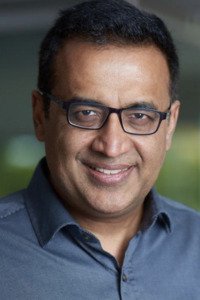
A camera, an algorithm, and the idea that the human driver is worth saving.
Most of the auto industry spent the last decade trying to remove the driver. Avneesh Agrawal looked at the same problem and decided to keep the human and make them better. That single decision is why Netradyne exists.
Today Agrawal runs Netradyne from San Diego, where roughly 950 people and a second engineering hub in Bengaluru build the brains behind a small camera mounted on a truck's windshield. The product, called Driver-i, watches the road and the cab in real time, processes what it sees on the device itself, and turns thousands of micro-decisions into a coaching signal the driver actually gets while still behind the wheel. Fleets that install it report accident reductions of 30 to 50 percent. The platform has now chewed through more than 20 billion miles of driving data.
In January 2025 the company closed a $90 million Series D led by Point72 Private Investments, with Qualcomm Ventures and Pavilion Capital alongside, pushing Netradyne past a billion-dollar valuation and into the rarefied unicorn club. The number that interests Agrawal more, though, is a different one: fewer than ten percent of the roughly 28 million commercial vehicles on American roads carry a safety camera. The market he is chasing is mostly empty road.
What if we could combine edge computing, vision, and AI to solve real-world problems?
Twenty years inside Qualcomm
Before any of this, there was Qualcomm. Agrawal joined in 2002, fresh from a Stanford PhD, and spent more than a decade at the center of the company's research engine. He led 4G LTE research and chipset product development - the unglamorous, foundational work that put fast data into the phone in your pocket - and rose to Senior Vice President of Technology, heading corporate R&D. The patent count from those years tells the story plainly: more than 150 US patents bear his name.
From 2011 to 2015 he changed jobs entirely, moving to Bangalore as President of Qualcomm India and South Asia, responsible for business, sales, and marketing across the region. He had gone from inventor to operator, from the lab bench to the P&L. It was a useful detour. Running a region taught him the parts of company-building that a research title never does.
You're growing fast, in a massive industry, with limited resources and a lot of constraints. You need to focus on what really matters.
The pivot that defined the company
Around 2014, Agrawal noticed three trends arriving at once. Camera sensors had become absurdly cheap. Computing had moved to the edge, meaning a device could now think for itself instead of phoning home to a server. And deep learning had matured from academic curiosity into something you could actually ship. That convergence, in his words, sparked the aha moment. In 2015 he left Qualcomm and co-founded Netradyne with David Julian, another Qualcomm veteran who became the company's CTO.
His first instinct was autonomous driving - the obvious destination for anyone with computer vision and a transportation problem. He quickly concluded the technology wasn't ready. Rather than wait years for self-driving to arrive, he reframed the mission around a goal he could deliver immediately: make the road safer today by enhancing human performance. Instead of replacing the driver, Netradyne would coach them. The system flags risky behavior, but it also rewards good driving with a GreenZone score, a deliberate choice to build a tool drivers trust rather than one they resent.
That choice has aged well. Netradyne picked up a FICCI Road Safety Award from the Government of India in 2024 and landed on the Forbes list of America's Best Startup Employers in 2025. The trust, the technology, and the data, Agrawal says, work together to drive real change.
The man who finishes early
A small detail says a lot about how Agrawal moves. He entered Stanford in 1990 and earned a bachelor's in Computer Systems Engineering in three years, not four. He then completed a master's in Electrical Engineering in a single year. He returned later for a PhD in Electrical Engineering, finishing in 2002. Two of the milestones most engineers measure in years, he measured in a fraction of that.
He is candid about what was hard. Building the product, he has said, was not the difficult part. Scaling the company was - the logistics, the supply chains, the unforgiving physics of getting hardware into trucks across a continent. It is the kind of admission you rarely hear from a founder, and it hints at why he keeps returning to the same word: focus. In a massive industry with limited resources, knowing what to ignore is the whole job.
Where he is pointed next is clear enough. Generative AI, he argues, gives the platform flexibility and scale it didn't have before, and he watches Qualcomm's edge-AI roadmap closely - a former insider still rooting for the home team. The ambition is not subtle: put vision and intelligence at the edge of every commercial vehicle that still drives blind. For a man who spent twenty years making phones see further, teaching trucks to see at all is a fitting second act.