Company Profile · Commerce Technology · Est. 2015
Arta.
The quiet infrastructure that ships, insures, and tracks the art world's most fragile, most expensive things.
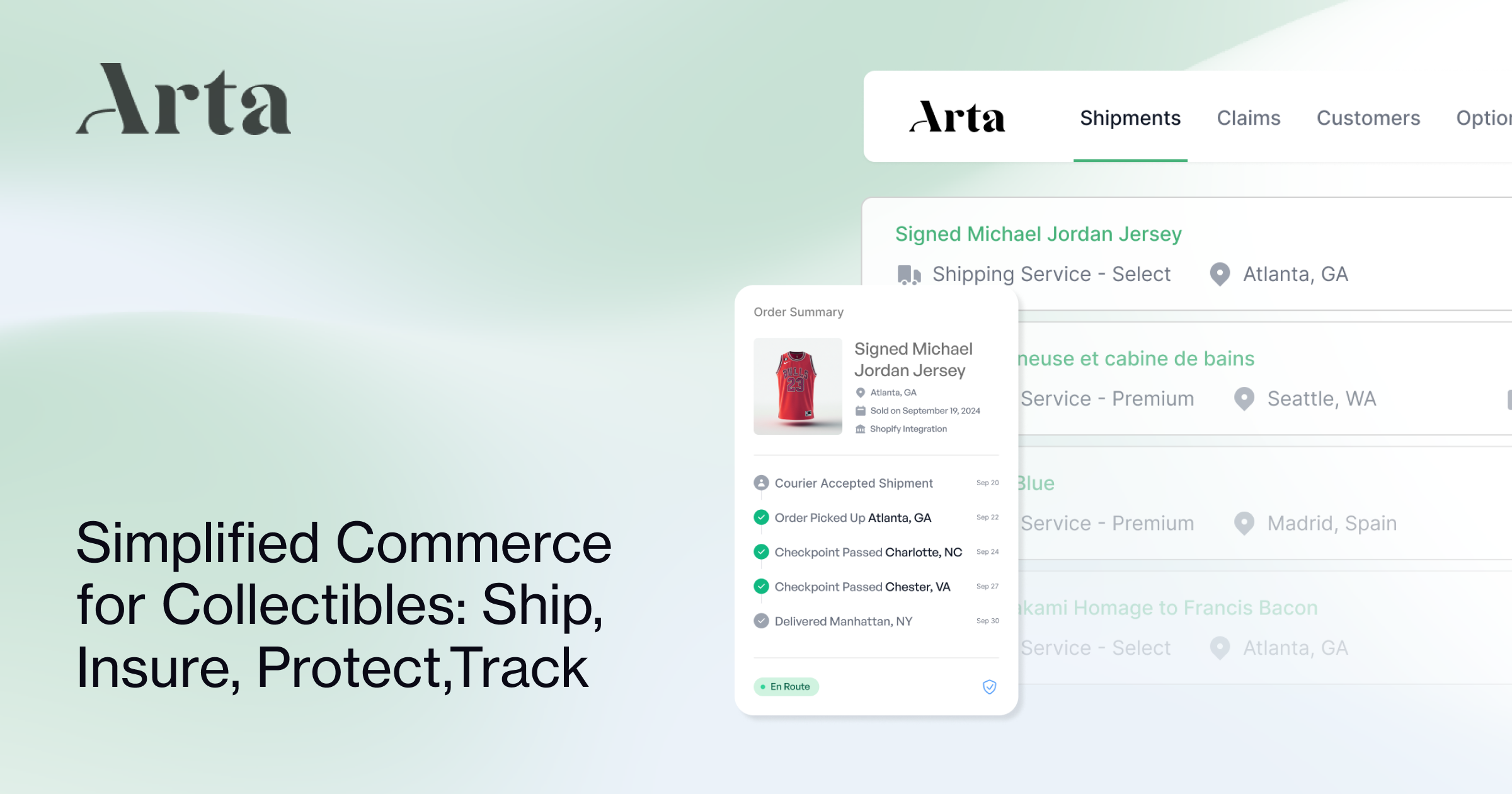
The quiet infrastructure that ships, insures, and tracks the art world's most fragile, most expensive things.
When a collector wins a painting at auction or buys a rare watch online, the sale is the easy part. What happens next - crating a fragile canvas, insuring a six-figure object, clearing customs in another country, and telling the buyer where their purchase is - has long been a manual, phone-and-spreadsheet affair. Arta, a New York company founded in 2015, built software to make that part disappear.
Arta describes itself as commerce technology for the art, luxury, and collectibles ecosystem: "the better way to ship, insure, and track." Through an API, a set of hosted checkout tools, and a Shopify app, it lets merchants, marketplaces, and auction houses generate an instant shipping quote for almost any item - regardless of size, material, or price - and then handle the fulfillment end to end.
The company started narrow. In 2015 it was a simple tool that returned multiple online quotes for US fine-art shipments. A decade later it moves anything that needs extra handling: art and design, furniture, antiques, jewelry, watches, and collectibles, across more than 65 countries.
The pitch is deceptively plain. Take the most operationally painful moment in luxury commerce - the hand-off from checkout to doorstep - and turn it into a line of code. The result is a logistics layer most buyers never see and never think about, which is precisely the point.
Arta's customers are the businesses for whom a damaged shipment is a damaged reputation. That includes auction houses running post-sale automation, online marketplaces that need instant quoting at the point of sale, and individual luxury merchants trying to reach buyers abroad. The company says it works with a large share of the world's luxury and fine-art retailers.
Several of those names are more than customers. David Zwirner and Sotheby's backed Arta as early investors - a rare case of an industry funding the tool built to serve it. In a market that runs on relationships and discretion, that overlap of client and shareholder became its own form of endorsement.
From self-ship and parcel to full white-glove handling, with instant pricing for items regardless of size, material, or price - across 65+ countries.
Collector-grade insurance offered at the point of sale, tailored to fragile and high-value objects rather than generic parcels.
Automated, branded tracking and customer updates that cut down "where is my order" inquiries and keep the buyer informed.
A developer API, hosted checkout tools, and a Shopify app so merchants and marketplaces can automate quoting and fulfillment.
A standard carrier is optimized for volume and uniformity - boxes of known dimensions, moving fast and cheap. High-value goods are the opposite: irregular, fragile, sometimes irreplaceable, and freighted with customs and insurance complexity. Quote them through a generic tool and you get either a wrong number or no number at all.
Arta's difference is that it is purpose-built for that difficulty. Its quoting engine understands the object, not just the parcel; its insurance is written for collectors; its handling tiers stretch all the way to white-glove crews. Where FedEx and UPS offer a label, Arta offers the whole post-purchase experience as a product.
Its closest competitor is Convelio, another tech-enabled art-logistics company. Traditional fine-art shippers - Crozier, Cadogan Tate, Momart, Gander & White - compete on the physical side but not the software. Generic shipping APIs compete on code but not on the specialized care that fragile, high-value cargo demands.
The strategy is a familiar one for infrastructure companies: go narrow first, earn trust in the hardest niche, then widen. Fine art taught Arta how to move the un-moveable; watches, furniture, and jewelry followed the same playbook.
Arta runs a B2B model that blends SaaS with transaction-based logistics: it earns on fulfillment services and on the shipping and embedded insurance that flow through its platform, delivered via API, hosted tools, and its Shopify app. Three customer segments - auction houses, marketplaces, and individual merchants - plug into the same engine.
The 2022 Series A was led by AXA Venture Partners, with a backer list that has included F-Prime Capital and Left Lane Capital. Earlier rounds drew a distinctly art-world crowd: David Zwirner gallery, Sotheby's, artist Rashid Johnson, collectors Poju and Anita Zabludowicz, and tech names like Graph Ventures and Giphy founder Alex Chung.
Adam Fields starts Arta as a tool for getting multiple online quotes on US fine-art shipments.
Backing from David Zwirner, Sotheby's, Rashid Johnson, and tech investors including Alex Chung.
New capital from David Zwirner, Sotheby's, and a consortium of Chinese and European investors.
Shifts from quote aggregator to a full commerce platform with tracking and embedded insurance.
AXA Venture Partners leads a round to expand fulfillment technology and global coverage.
Relaunches around commerce technology for the art, luxury, and collectibles ecosystem.
Adam Fields came to logistics from the art-dealing world - he was previously involved with the online art start-up Artspace - and built Arta on an outsider-insider view: he knew the customer's pain intimately but wasn't bound by the industry's habits.
That vantage shaped the company's founding goal, once described as building "the Expedia of art shipping" - a single, trusted place where the messy logistics of high-value objects become simple and instant. The name Arta itself points backward and forward at once: it comes from an ancient Greek city known as a hub for transportation, and the wordmark's typographic homage to FedEx signals the incumbent it hopes to update.
Arta provides commerce technology that lets the art, luxury, and collectibles market ship, insure, and track high-value items through an API, hosted tools, and a Shopify app.
Auction houses, galleries, marketplaces, and luxury merchants - including Sotheby's, Bonhams, Phillips, David Zwirner, Artsy, and 1stDibs.
Arta was founded in 2015 by Adam Fields, who serves as CEO and came from the online art-dealing world.
Arta has raised roughly $19.5M across multiple rounds, including an $11M Series A in October 2022 led by AXA Venture Partners.
Unlike generic carriers, Arta is purpose-built for fragile, high-value, oversized items - offering instant quotes, embedded insurance, white-glove handling, and branded tracking across 65+ countries.