Munich · Privacy-First Analytics
ARIADNE
Counting crowds without ever taking a picture.
Counting crowds without ever taking a picture.
It is 6:40 a.m. at San Diego International, America's busiest single-runway airport. Roughly nine thousand people are about to move through it at once. Somewhere in the ceiling, a small grey box is counting every one of them - and knows nothing about any of them.
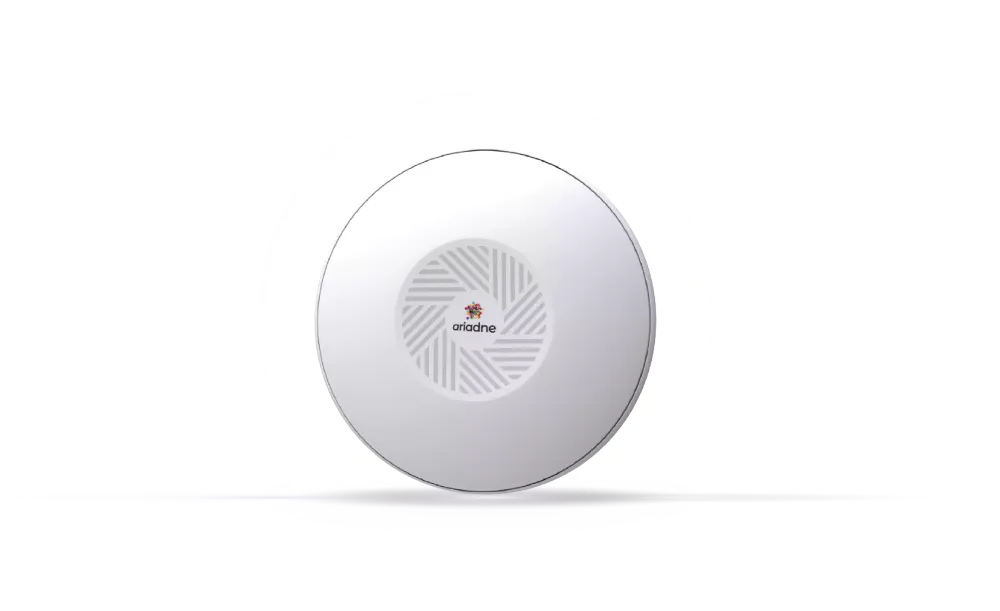
That box is an Ariadne sensor. It does not see faces. It does not log device IDs. It does not keep a single piece of information that could be traced back to a human being. What it produces instead is a live map of movement: where the queues form, how long people linger by Gate 22, which corridor empties first when a flight boards. The airport reads that map and acts on it - opens a TSA lane, restocks a coffee stand, sends a cleaner to a restroom before anyone complains.
Ariadne is the company that built the box, the algorithms behind it, and the slightly heretical idea holding the whole thing together: that you can measure the physical world as precisely as the web measures itself, without surveilling the people in it.
Online, every retailer knows their bounce rate, their dwell time, their conversion funnel. Walk into the same retailer's actual shop and the data goes dark. For decades the only ways to fix that were unappealing: stick cameras on the ceiling and hope nobody reads the privacy policy, or hire someone with a clicker and hope they stay awake.
Cameras counted people by recognising them, which is exactly the thing regulators - and customers - were starting to object to. Europe's GDPR arrived, the EU AI Act loomed, and "we filmed everyone's face to count them" stopped being a sentence you could say in a boardroom. The industry's measurement tools and the public's appetite for being measured were moving in opposite directions.
Ariadne's founders saw a gap shaped like a contradiction: the spaces most desperate for analytics - airports, malls, train stations - were also the ones least able to justify pointing cameras at the public. Someone had to count people without identifying them. The trick was that nobody had made it accurate enough to trust.
Georgios Pipelidis and Nikos Tsiamitros grew up in the same Greek town and met properly years later, in a research lab at the Technical University of Munich. Pipelidis was finishing a PhD in artificial intelligence; the shared obsession was indoor positioning - the unglamorous problem of knowing where something is when GPS gives up at the front door.
Their bet was contrarian. While the industry leaned on cameras, they leaned on the signals every phone already broadcasts - the anonymous radio chatter of GSM, LTE, Wi-Fi and Bluetooth - and on depth sensing that registers a shape, not a face. Process those signals with the right AI and you could locate and count people to within a meter, without ever knowing who they were. Privacy wasn't a feature bolted on at the end. It was the architecture.
PhD in AI from TU Munich. The academic who decided the thesis was worth turning into a company. Endeavor entrepreneur.
The systems builder behind the sensing stack - the part that has to be both accurate and forgetful at the same time.
Born in Veria, schooled in Munich, deployed on three continents. The labyrinth metaphor was, frankly, asking for it.
The platform runs on what Ariadne calls Hybrid Fusion - patented phone-signal sensing paired with Time-of-Flight depth sensing. One method is good at coverage, the other at precision; fused, they hit up to 99% accuracy in optimal conditions and 95%+ in the messy reality of a busy retail floor. Anonymization happens on the device itself, at the edge, before any data leaves the box. No faces. No device IDs. No personally identifiable information. Identifier-free by design, GDPR-native, and ready for the EU AI Act.
Camera-free counting with up to 99% accuracy - the headline product, minus the surveillance.
Sub-meter flow, heatmaps, dwell time and queue length for shops, stations and cities.
App-free wayfinding up to two orders of magnitude more accurate than GPS indoors.
Omni-channel engagement built on anonymized insight, not personal profiles.
Live footfall tells you to cover Saturday's peak and stop over-staffing Wednesday lunch.
The edge hardware doing the anonymizing - small enough to forget it's there. It already forgot you.
A privacy story is easy to tell and hard to sell. What moved Ariadne from clever to credible was operators reporting money, not metaphors. San Diego concessionaires raised revenue 55% once foot traffic was matched to sales. The airport added roughly €4M in annual non-aeronautical revenue. Weko, a German furniture retailer, logged ROI in the first month with a 40% revenue jump.
The customer list reads like a tour of places where crowds are a fact of life: IKEA, MediaMarkt, Deutsche Bahn, Giorgio Armani, Praktiker, Chicago RTA, Glasgow and San Diego airports. The investors followed the same logic - Marathon Venture Capital led both the seed and the Series A, which is a polite way of saying they liked what they saw enough to do it twice.
The name is not an accident. In the myth, Ariadne hands Theseus a thread so he can find his way out of the labyrinth. The company's stated mission is to be that thread for location data - turning anonymous signals into intelligence that helps a business find its way, without ever needing to know who walked the maze.
It's a deliberately narrow promise. Ariadne doesn't want to know you. It wants to know that twelve hundred people just passed Gate 14, that the queue is eight minutes long, that the east wing is dead on Tuesdays. The discipline of measuring behavior while refusing to measure identity is the whole company in one sentence.
Regulation is moving Ariadne's way. The EU AI Act will make face-based counting harder to defend just as cities, retailers and transit agencies want more granular data, not less. A method that was once a principled inconvenience is starting to look like the only version that's allowed to scale. Being early and being compliant are, for once, the same position.
Return to that 6:40 a.m. terminal. A year into an Ariadne deployment, the queues are shorter because lanes open before the crowd builds. The coffee stand restocks ahead of the rush. The restrooms are cleaned on a schedule the foot traffic wrote. Nine thousand strangers move through the building, and the building finally understands them - their movement read in full, their identities never touched.
The grey box in the ceiling still couldn't tell you a single name. That was always the point.