
The woman who noticed the handoffs
Even a tarot reader can have too many windows open. There is the reading, the reflection afterwards, the record to find next time, and the rather earthly business of keeping a practice organised. Mystery may suit the cards. It is a less attractive quality in the filing system.
Bailey approached that problem with an operations background at Daimler, Nike, and Joyly. Anything’s April 24, 2025 profile says she left corporate work in June 2024 and built Aura Vista with a friend using Create. It describes her as a nondeveloper. [1]
That combination makes the story interesting. Operations work asks how separate activities fit together: what starts a process, what information travels with it, and where somebody has to intervene. Applied to a small specialist business, those questions can become a product brief. An attractive screen earns a glance; a well-considered handoff gives someone a reason to continue.
Her unusual advantage was knowing which pieces belonged in the same conversation.
THE WORKFLOW QUESTIONMystery may suit the cards. It is a less attractive quality in the filing system.
From this story
A niche with a paperwork problem
The profile’s diagnosis was fragmentation: readings in one tool, journaling in another, and inadequate support for running a spiritual-services business. [1]
Consider an illustrative reader finishing a session. The cards have been drawn, but the useful record might also include the question, the arrangement, the interpretation, and a later reflection. If those pieces scatter, returning to the session becomes a small investigation. The irritation is ordinary, even when the subject is esoteric.
That suggests a sharper brief than “make a spiritual app.” Which information should stay attached to a reading? What should be easy to retrieve? Does a private journal belong in the same view as material intended for a client? These are design questions that require decisions before they require decoration.
The temptation is to promise everything to everyone who owns a deck. A more useful starting point is one recognisable task, completed without losing its context. Specificity gives an AI builder something concrete to build—and gives its owner something concrete to inspect.
- 01ReadQuestion + spread
- 02ReflectNotes + intentions
- 03ReturnFind the record
A suggested workflow to test, rather than a verified Aura Vista feature sequence.
What was on the table
In April 2025, the story listed AI daily tarot pulls, custom spreads, journals, intentions, energy tracking, reading archives, and visual themes as available. Community features, healer storefronts, courses, and support for additional spiritual practices were planned. [1]
The distinction changes how a prospective buyer should read the proposition. A personal reflection tool and a place to sell services ask different things of a product. One might revolve around a returning individual and a saved record. The other introduces a seller, a customer, an offer, and a transaction. Adding a storefront is a substantial change in the relationship the software manages.
A roadmap can express ambition. It cannot do the work of a feature already in use. When examining any niche app, ask the maker to demonstrate the exact task you need today. Follow it through to its saved result. Then discuss the next release. A promise becomes much easier to evaluate when it has a clearly marked tense.
A ritual.
A record.
A roadmap.
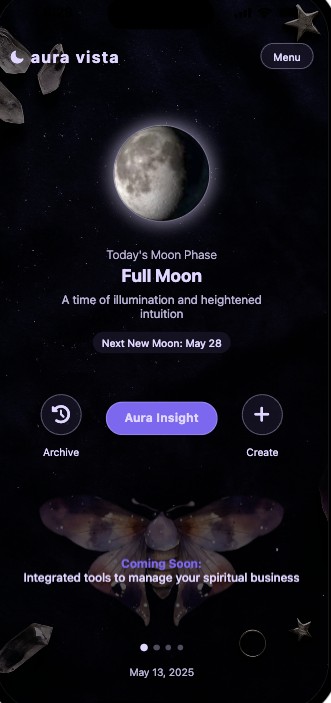
The screenshot reproduced with the source profile includes a “Coming Soon” message for business tools.
Screen displays May 13, 2025; the profile is dated April 24, 2025.The brief is where experience pays
Bailey’s choice of Create connected her systems knowledge to a working product, according to the account. [1] The lesson for another specialist is practical: expertise can help define the behaviour of software even when its owner cannot write the implementation.
A useful brief reads like a sequence. Start a reading. Choose an arrangement. Save the question with the result. Return later and add a reflection. Find the original without reconstructing the session from memory. This is an illustrative specification, rather than a claim that Aura Vista implements each step in that form.
Each verb gives the builder a job. Each transition supplies a test. What happens if the user leaves halfway through? Can two entries have the same title? Where does the saved information appear? Such questions are the working material of an operations specialist.
There is wit in handing the typing to a machine while retaining the judgement. The important decisions still need an owner: what belongs together, what must remain private, and what a completed task actually means.

A working app still has to earn its keep
The historical account described an App Store launch as forthcoming. It supplied no verified paid-customer count or evidence of health outcomes. [1] That leaves the commercial story open.
For a buyer weighing an AI app builder, this is where the next experiment should begin. Invite a small group of intended users to complete a task that matters to them. Watch where they hesitate. Ask what they use today and what switching would cost them in time, attention, or lost records. An enthusiastic compliment is pleasant company; a repeated voluntary return is more useful evidence.
Price deserves its own test. Someone can enjoy a tool without wanting another subscription. A practitioner can admire a beautiful interface while needing a booking or payment function before adopting it for work. These are hypotheses to investigate with users, rather than conclusions to draw from a polished demonstration.
Building creates an object people can respond to. Commercial validation requires learning what they will actually do with it.
Ask for a completed task.
Watch for a voluntary return.
Test willingness to pay.
The next useful instruction
Anything’s current web-app documentation describes support for accounts, stored data, payments, backend actions, and integrations. It also explains previewing and publishing. Those are platform capabilities, not confirmation of Aura Vista’s implementation or release status. [2]
A specialist considering a similar project could begin with a modest instruction: build the smallest complete version of the task that currently wastes the most effort. Define the input, the action, the saved result, and the way someone returns to it. Then try the awkward cases before adding another attractive screen.
For an operations-minded builder, this is familiar territory. A process is only as convincing as the point where a real person uses it. Clear requirements make that point easier to reach; observation reveals whether reaching it was worthwhile.
Aura Vista offers a useful starting thought for anyone carrying a niche in their head. Write down the work in enough detail that another person could follow it. Give the builder that sequence. Put the result in front of the people it is meant to help. The next instruction should come from what happens there.
READ THE SOURCES
- Anything’s original customer profile — April 24, 2025.
- Anything’s web-app capabilities — documentation reviewed October 18, 2026.