She talked her way out of Transylvania, then talked content marketing into telling the truth. Now she has bots doing the talking.
A potential client looked at the AI product Knotch had spent years building and said, flatly, "You're talking about toys and I don't care about toys." Most founders would file that under heckler. Anda Gansca filed it under blueprint.
Within months she had scrapped the rejected product and relaunched her decade-old company around something new: AgentC, a platform that behaves less like a software dashboard and more like a boutique marketing agency - except the staff are AI agents. They interview the client about goals, write content across platforms, analyze the data, and fact-check their own work through a bot named Veritas, with humans kept in the decision loop.
Then she did the thing that makes finance people sweat. She tore up the SaaS subscription. AgentC runs on outcome-based pricing: clients pay when a predefined result shows up - a signup, an engagement metric - and not before. It is a hard way to make money and an honest one, which has always been the Gansca combination.
The bet is not small. Knotch had raised close to $48 million and once carried more than 100 employees. Zillow, Realtor.com, Chime and Zoom signed on as early testers of AgentC. "In moments like these, when it's sort of a dark night of the soul," she said of the reinvention, "we usually get to the light by starting with first-principles thinking."
First-principles thinking is the only kind she has ever used. It is how an 18-year-old in Romania ended up at Stanford, how a non-citizen won the legal right to run an American company, and how content marketing - an industry famous for guessing - got handed a way to measure itself.
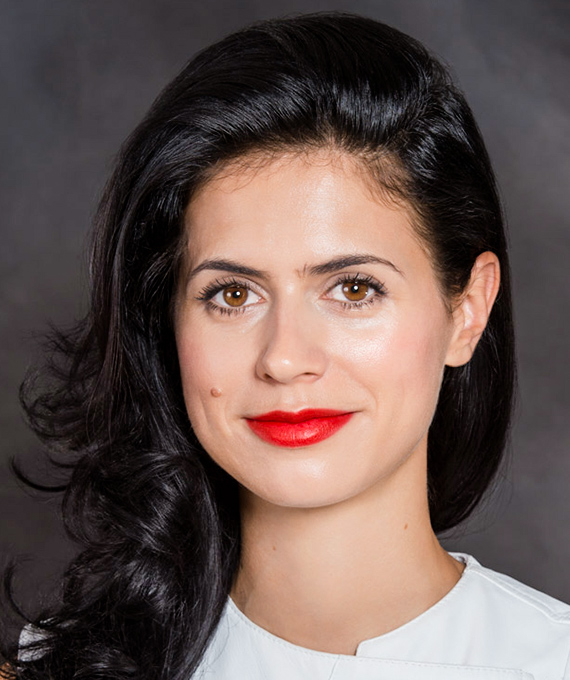
Companies don't fail, rather people give up.
The story turns on a phone call. Gansca was finishing a math-and-computer-science high school in Transylvania and had spent a full year taking English lessons six hours a day to apply to American colleges. She had options. She was leaning toward a school with a strong philosophy program.
Then a Stanford admissions officer named Erinn called her in Romania and said: "You have to come to Stanford because you're an entrepreneur." Gansca had written her essays about youthful projects - a high-school initiative pushing critical thinking, the kind of thing rebellious teenagers in any country dream up. She did not yet know what the word "entrepreneur" meant. She was intrigued enough to say yes.
At Stanford she studied economics and international relations, but the part she loved was econometrics and data analysis - regression lines, the hidden shape of behavior. She graduated with honors. She co-founded the Stanford US-Russia Forum during a semester in Moscow, building a channel for young Russians and Americans to trade ideas. And in a detail that tells you everything about a person who optimizes for substance over ceremony, she missed her own Phi Beta Kappa induction because she thought it was a sorority rush event.
After graduation she spent a year in venture capital, watching how companies get funded. By the end of it she knew she wanted to build one dealing in big data and regression analysis. The harder problem was being allowed to.
Gansca co-founded Knotch in 2012. Being a foreign national trying to run a US startup is its own gauntlet, and she ran it the way she runs everything - head down, all in. To secure an E-2 investor visa she wrote a 150-page business plan, flew back to lobby Romania's embassy in person, and invested her life savings into the company.
The early Knotch was disarmingly human: an app that let people express opinions in color, mapping nuanced emotion onto a spectrum instead of a five-star survey. Those modules pulled roughly 15% click-through and 55% engagement against the 0.1% that standard banner ads limp toward. Brands like Vice Media lined up to beta test. Ross Levinsohn, the former Yahoo and News Corp executive, met her at a 2013 Goldman Sachs conference and became Knotch's first outside director. "The vibe and energy coming off Anda was so positive and so unique," he said. "I would bet on her as many times as she wants to go to the plate."
From there Knotch grew into a content intelligence platform - the system that tells a brand's CMO which content actually moves a business outcome and which just fills a feed. In 2019 the company raised a $20 million Series B for product innovation and international expansion.
Knotch went from a $4M early stage to a $20M Series B, reaching roughly $48M raised across rounds. Figures are approximate, drawn from public reporting.
She mistook her Phi Beta Kappa induction for a sorority rush event - and skipped it.
One year, six hours of English a day. That was the price of the application.
She co-founded a US-Russia student forum from Moscow before she co-founded a company.
Up between 6:00 and 6:30 AM for meditation, exercise and reflection. Every day.
Role models: Coco Chanel and Audrey Hepburn. Substance with a sharp collar.
Her first product asked people to rate things in color, not stars - emotion as a spectrum.
AI agents interview the client, produce content across channels, optimize for the future of search, and analyze results - while humans keep the final call. It is content marketing that finally answers for itself.