Profile / Maker of Things
Alexander Tschopp
He knits whole sweaters out of thin air and a software queue - no cutting, no sewing, no warehouse full of mistakes.
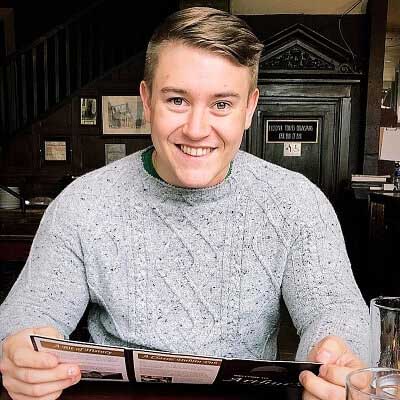
He knits whole sweaters out of thin air and a software queue - no cutting, no sewing, no warehouse full of mistakes.
At a converted manufacturing complex on Brooklyn's waterfront, a row of Japanese machines is doing something the fashion industry mostly forgot how to do here: making a sweater from start to finish, in one piece, only after someone has actually asked for it. That last part is the whole idea. Alexander Tschopp runs the place. He calls his company Tailored Industry, and its pitch fits on a business card - what you want, when you want it, and not one stitch more.
Most clothing is made on a guess. A brand commits to thousands of units six to nine months before a single customer sees them, then spends the season praying the guess was close. Tschopp's machines knit on demand. A brand can order a single garment. It arrives in three to six days. Roughly 30% of the world's 150 billion garments made each year never sell - destroyed, discounted into oblivion, or buried in a warehouse. Tailored Industry is built to make that number look absurd.
The technology underneath is Shima Seiki's WHOLEGARMENT 3D knitting - machines that construct an entire sweater, sleeves and body together, as one seamless object with almost no finishing afterward. Tschopp wrapped them in proprietary software so a brand can place, track, and reorder production the way you'd track a package. He calls the combination manufacturing-as-a-service. Waste falls to about 1% of what conventional methods generate, because nothing gets cut away and nothing gets made on spec.
"At Tailored Industry, we have designed our software platform and business model to combat the largest issue with the apparel supply chain - inventory," Tschopp says. It is a deceptively flat sentence for what is, underneath, an argument that the entire planning calendar of fashion is a liability waiting to be deleted.
Tschopp's interest in business is older than most of his peers' resumes. He was 12 when he read a biography of Andrew Carnegie, the steel baron who turned raw industry into an empire. Something about the machinery of enterprise stuck. By the time he reached Cornell's Charles H. Dyson School of Applied Economics and Management, he wasn't studying business as a subject so much as auditioning for it.
He didn't wait for a diploma. As an undergraduate he founded Collegiate Sun, a company that sold college-branded products - including sunglasses and sweaters - to campus retailers. In its first year it reached 250 retailers. More quietly, Collegiate Sun also operated The American Knitting Company, one of the few full-fashion knitting facilities left on the East Coast. That was Tschopp's first real contact with the machines and the margins of knitwear, and with how brutally hard domestic production had become. The lesson stuck the way the Carnegie book had: not as a grievance, but as a problem worth a decade.
He shut Collegiate Sun down in 2015. Two years later he co-founded Tailored Industry, and pointed all of that hard-won knitwear knowledge at a single question - what would a contract manufacturer look like if you designed it today, from nothing, around the way brands actually need to buy?
"Conventionally, it takes well over six months to design, develop, and mass produce a knitwear collection."Alexander Tschopp - on the timeline he is trying to erase
There is a geography to this story. Brooklyn was once a knitwear capital - roughly 1920 to 1960, the borough hummed with knitting mills. Then, over about 25 years, almost all of it moved offshore. Tschopp set up Tailored Industry inside Industry City, the same waterfront manufacturing district that used to do this work, which is less nostalgia than thesis. He believes products should be made where they're consumed.
"The idea is to really have the products made where they're going to be locally consumed," he says. Local production isn't a marketing line for him; it's the mechanism that makes a three-day turnaround physically possible. You cannot ship a single made-to-order sweater across an ocean and call it on demand.
The ambition runs past one factory. Tschopp has talked about turning the Brooklyn operation into a model factory and replicating it across the country - a network of small, software-driven plants sitting close to the customers they serve. Early on, the Brooklyn floor ran around 10 Shima Seiki machines and produced something like 1,000 to 2,000 units a month, already straining against more demand than it could absorb. The constraint was never customers. It was capacity.
The client list reads like a quiet endorsement from people who know production: Ministry of Supply, American Trench, Allen Edmonds, and a pilot run for Gap Inc.'s Hill City men's active brand. Mostly contemporary labels and boutiques - the kind of brands for whom a wrong inventory bet is not a rounding error but an existential one.
His machines knit a whole sweater - body and sleeves - as a single seamless piece. No cutting. No sewing the parts together.
"Minimum order quantity: zero" isn't a slogan. The factory can profitably make exactly one garment.
The business plan grew out of a number: roughly 30% of the ~150 billion garments made each year are never sold.
He chose Industry City on purpose - the same Brooklyn waterfront that was a knitwear hub from 1920 to 1960.
The spark was a biography of Andrew Carnegie, read at age 12. The fascination with how industry works never wore off.
"We want a new Brooklyn location to be a model factory and replicate it in other parts of the country."The next chapter - a network of small plants close to the people they serve