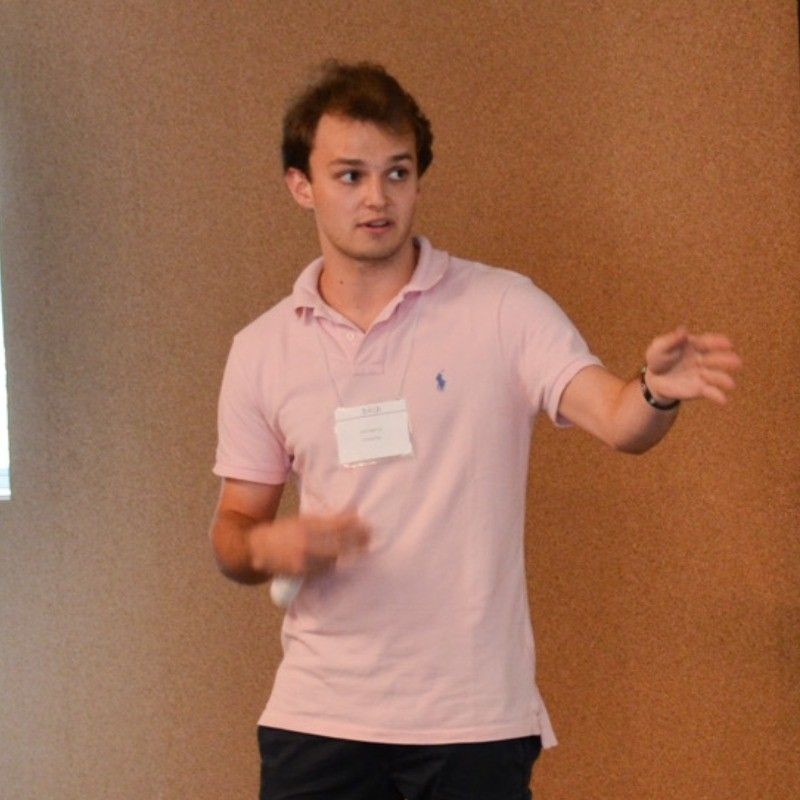
The builder behind the interviewer
There is a company in San Francisco where an AI named Alex interviews people who are applying for jobs. It runs the conversation live, over video, and asks a real follow-up question based on what you just said. The company used to be called Apriora. Now it is also called Alex, because the product ate the name. John Rytel is the person who builds the part that has to actually work.
He is the co-founder and CTO. His business card says CTO; his own company says something blunter. In the founder description, Rytel is the one who “just builds.” That is not a slogan dreamed up for a pitch deck. It is the load-bearing job at a company whose entire promise is that a piece of software can do, at three in the morning, what a recruiter does at three in the afternoon - and do it for a thousand candidates at once without the quality sliding.
Alex conducts live video interviews across the formats hiring teams actually run: technical screens, phone screens, system design, coding rounds, behavioral questions. It uses either a company's preset questions or ones it recommends from the job description, then improvises follow-ups in real time. The reported numbers are the kind a CTO loses sleep over: more than 90% of interviews get finished, candidates rate the experience an average of 4.5 out of 5, and the system flags potential cheating with its own fairness detection. One-click ATS integration. Always on. No slot ever full. Every one of those bullet points is, underneath, an engineering problem with Rytel's fingerprints on it.
Brown, Warsaw, and the long way around
Rytel studied computer science and applied mathematics at Brown University. That is where he crossed paths with Aaron Wang, who had done quant finance and a turn at Facebook AI before studying CS, applied math, and economics at the same school. Two technical people, the same campus, overlapping obsessions. The kind of pairing that tends to end in a company.
But the resume before the resume is the interesting part. Rytel did not come up through the usual conveyor belt of brand-name Bay Area internships. He came up through the American School of Warsaw. He wrote full-stack code for Zwolnieni z Teorii, a Polish education nonprofit. He engineered software at the African Development University. He did a software stint at Crowley. The throughline is not prestige - it is a habit of shipping working systems in places where there is no famous logo to hide behind. You learn a particular kind of discipline building software that has to run somewhere unglamorous and far away. That discipline is exactly what an AI interviewer needs.
The $5,000 problem
The premise Rytel and Wang started with in 2023 was almost rude in its simplicity. Hiring is slow and expensive. Companies spend north of $5,000 per hire, and most of that is human time - recruiters and hiring managers running the same first-round interview over and over. The average interview process drags on for about a month. Somewhere in that math is an enormous amount of repeated, automatable conversation.
The trap, of course, is that “automate the interview” usually means “make the candidate feel like they are talking to a vending machine.” The whole bet of Alex is that you can have the throughput of automation without that cold, processed feeling - that an AI can be conversational, can listen, can ask the smart follow-up, and can leave the person on the other end feeling like the half hour was worth their time. The 4.5-out-of-5 rating is the scoreboard for whether that bet is paying off. The engineering to keep it there is Rytel's beat.
From a seed check to a Series A
The trajectory has been fast. The company went through Y Combinator in the Winter 2024 batch. It raised a seed round of roughly $2.8M led by 1984 Ventures. Then came a Series A of about $17M led by Peak XV Partners - the firm formerly known as Sequoia Capital India & SEA. Stack it up and the company has pulled in somewhere around $20M to build out a single, audacious idea: an AI that can sit across the table from any candidate, anywhere, anytime.
Somewhere in that stretch, Apriora rebranded to Alex. It is a small detail that says a lot. Most companies guard the distinction between the brand and the product. Here, the product was so central that it simply absorbed the company. The interviewer became the whole identity. And the interviewer is the thing Rytel keeps standing up.
What a CTO actually owns here
It is easy to wave at “an AI that interviews people” and move on. It is harder to sit with what that demands. A live conversation cannot lag. The follow-up question has to be relevant, not generic, and it has to arrive in the rhythm of a real exchange. The fairness detection has to catch someone gaming the system without falsely accusing an honest, nervous applicant. The whole thing has to plug into a company's existing applicant-tracking system in one click, scale to thousands of simultaneous interviews, and hold its 90%-plus completion rate while it does. That is the surface Rytel works on. Not a demo - a system that real people, on the worst-possible-timing day of their job search, depend on to be fair and to work.
There is something quietly fitting about the fact that the company is on a profile called Alex, and its CTO is the human who keeps Alex running. Rytel does not appear to be chasing the spotlight. He is the half of the team described, plainly, as the one who builds. In an industry overrun with people narrating the future, that is its own kind of statement: less talking about the machine, more making the machine talk.
Two founders, one job each
Every good founding team splits the problem in half along a line nobody draws on paper. At Alex, the line is clean. Aaron Wang carries the parts of the story that come from quant finance and Facebook AI - the instinct for where a market is moving, the comfort with models and money. Rytel carries the build. The pairing works because both halves came out of the same place, the same Brown classrooms, the same shared vocabulary of computer science and applied mathematics. They are not translating across disciplines. They are finishing each other's sentences in the same one.
That matters more than it sounds. A lot of AI startups are a non-technical founder hiring a technical one, then hoping the wiring holds under pressure. Alex is a company where both people can read the same code and argue about the same architecture. When the CTO says something cannot be done by Friday, the other founder knows exactly what he means. There is no layer of guesswork in the middle. For a product whose failure mode is “an awkward, broken interview during the most stressful week of someone's year,” that tight coupling is not a luxury. It is the safety margin.
The hard part is the conversation
It is worth being concrete about what is actually difficult here, because “AI interviewer” is the kind of phrase that flattens a mountain of engineering into three syllables. A scripted survey is easy. A real interview is not. A real interview listens to an answer, notices the thread worth pulling, and pulls it - all inside the half-second before a silence turns uncomfortable. It does that over video, where latency is the enemy and a hiccup reads as the machine being “dumb.” It does it while staying fair, which means treating a confident answer and a nervous-but-correct answer on their merits rather than their delivery.
Then you have to do all of that thousands of times at once, on a Tuesday when a company posts a job and a flood of applicants arrive within the hour. The system cannot get slower as it gets busier. The completion rate cannot dip when the load spikes. And the fairness detection that flags possible cheating has to be precise in both directions - catching the person reading answers off a second screen without smearing the honest applicant who simply paused to think. These are the constraints that turn a clever demo into a company. They are also, more or less, the CTO's daily to-do list.
Why now, and why this
The timing is not an accident. The leap in conversational AI made an interviewer like Alex newly plausible right around when Rytel and Wang started building in 2023, and Y Combinator's Winter 2024 batch put them in the room exactly as the rest of the industry was waking up to the same opportunity. The seed from 1984 Ventures and the Series A from Peak XV Partners are bets that this particular team can hold a lead in a space that is about to get crowded. The moat, if there is one, is not a single clever feature. It is the accumulated reliability of a system that keeps working while competitors are still demoing - the unglamorous, compounding advantage that lands squarely on the technical co-founder's shoulders.
It is a fitting destination for someone whose earlier work ran through Warsaw classrooms, a Polish education nonprofit, and a university in Africa. None of those stops handed him a famous logo. All of them taught the same lesson: software is judged by whether it works for the person in front of it, not by who built it. Rytel now applies that lesson at a scale of thousands - to people he will never meet, on the day they are most hoping the thing on the other side of the screen treats them fairly. He stays mostly out of the frame. The interviewer he built does the talking.