telematics
(43)
The App That Failed - and the API That Learned to Drive
Two brothers tried to make an app talk to a car. The app went nowhere. The obstacle became Smartcar - a translation layer now sitting between mobility businesses and more than 40 automakers.
Zonar’s big idea: make the driver get out and look
A wooden prototype became a fleet-management business by making vehicle inspections harder to fudge. Now Zonar wants to run the rest of the school-bus day, too.
Lightfoot wants to pay you to ease off the accelerator
The British fleet-tech company turns smoother driving into a prize-winning habit. Behind the dashboard lights is a serious wager: fuel savings last longer when the driver gets something too.
Zego put insurance on the clock. Now it wants to watch you drive.
Zego won delivery drivers with cover that clocks on when they do. After an expensive retreat from fleet insurance, it is betting on phone data, safer driving and a much bigger audience.
WEX Europe sells a better way to stop for fuel
Behind the Esso Card is a business built on buying fuel, extending credit and making fleet paperwork behave. Its real test is whether the right filling station is on the driver’s route.
Toyota’s Cars Produce a Torrent of Data. This London Team Makes It Useful.
Toyota Connected Europe sits behind the app, the fleet dashboard and the data pipe - turning signals from connected cars into services people can understand and Toyota can operate.

Powerfleet Bought Its Way to 3 Million Subscribers. Now It Has to Make Them Speak One Language
After two major deals, Powerfleet has the customers, devices and reach of a telematics heavyweight. Its bet is that device-agnostic software can turn forklifts, trucks and cold-chain sensors into one coherent operating system - before integration debt catches up.

The $50,000 Crash Problem: How SambaSafety Built a 6.5 Million-Driver Early-Warning System
Annual driving-record checks are a photograph of a moving target. SambaSafety turned that blind spot into a subscription business - then bought the training and telematics pieces needed to do something about the alerts.
PrePass Sells Truckers a Green Light - and Turns Five Minutes Into a Fleet Strategy
For more than 30 years, PrePass has sold fleets something gloriously unromantic: fewer stops. The trick is turning a green light at the scale house into lower fuel burn, cleaner toll books and a reason for drivers to stay.
Urgently Put the Tow Truck on a Map - Then Learned the Map Wasn't the Business
The app made a miserable roadside ritual feel trackable. The harder lesson was that software can optimize a tow, but it cannot wish away trucks, weather, thin margins or customer concentration.
The 30-Hour Spreadsheet That Built a Climate Startup
Trucking is the biggest carbon line item in almost every supply chain - and until recently, most carriers reported it by hand. Celine King built software to do it in seconds, and sold it to an industry that hates change.

The Startup That Read 400,000 Truck Crashes So Your Fleet Doesn't Become the Next One
Idelic turned a trucking company's in-house safety tool into a machine-learning platform that predicts crashes before they happen. In April 2026, Descartes bought it for up to $40 million.
When Heavy Machines Break, Elevāt Makes Them Talk Back
The Seattle startup wires up off-highway equipment - tractors, cranes, fire trucks - and hands technicians an AI that reads the machine's mind before anyone opens the panel.
The Tire Company That Wants to Sell Fewer Tires
Bridgestone Americas built a continent-sized business around the part of a car most people notice only when it fails. Now it is turning that overlooked circle of rubber into a service network, a data stream and a test of whether mobility can become less wasteful.
Vontier
The company you have never heard of runs the fuel pumps, tool trucks and traffic lights you pass every day - and it is quietly betting all of them on the messy middle of the energy transition.
Solera Holdings, LLC.
Solera sits behind the moments when a car is claimed, repaired, sold, tracked, or returned to the road. Its advantage is not one famous app, but a deep reservoir of vehicle data wired into the daily work of insurers, shops, dealers, and fleets.
Allstate
Allstate began as insurance by mail from a Sears catalog. Ninety-five years later, it is rebuilding the Good Hands around apps, driving data and a distribution network designed to meet customers wherever they shop.
Clupp
Clupp is a Mexico City insurtech offering pay-per-kilometer insurance for cars, motorcycles, bicycles, scooters, and gadgets. Its app prices policies on how much and how well you drive, rewarding low-mileage and low-risk customers with lower premiums. Founded in 2021 and backed by Y Combinator (W22), Clupp partners with established carriers and reinsurers to cover claims, and has expanded into B2B SaaS tools for brokers and insurance products tied to startup financing.
Terminal
Terminal is a universal API for telematics data in commercial trucking and fleet management. It connects to hundreds of telematics service providers - GPS, safety events, fault codes, dash-cam media, driver hours - and delivers that data in one normalized feed, so insurers, fleet software, logistics firms and fintechs can build products without wiring up hundreds of one-off integrations. Often called 'the Plaid of trucking,' the Toronto company was founded in 2023, went through Y Combinator's S23 batch, and has raised $26M to date.

McEasy
McEasy is an Indonesian IoT-and-SaaS company that helps logistics, transportation and supply-chain operators digitize their fleets. Founded in Surabaya in 2017 and now headquartered in Jakarta, it combines GPS/telematics hardware with a cloud platform for fleet management, a transportation management system (TMS), AI dashcams, fuel and driver management, and analytics. More than 1,500 companies - including JNE, DAMRI, Cleo and Pertamina - use McEasy to cut operational costs, improve delivery efficiency and bring visibility to fleets that were previously run on pen and paper.
Overdrive IOT Pte Ltd
Overdrive IOT is a Singapore-headquartered industrial IoT company that connects and monitors physical assets - vehicles, equipment, facilities and people - in real time on a single cloud platform. Founded in 2015 by Aston Chia and Zen Chin, it uses a mix of sensors, connectivity technologies and mesh networking to automate data sensing, then turns that data into tracking, alerting and command-centre visualisation for clients across aviation, logistics, construction and public services in Asia. Customers include Changi Airport, Sentosa, NTU, FedEx and Singapore's Ministry of Manpower. The company raised a US$2.9M Series A from Tin Men Capital.
Saferoad Information Technology LTD.
Saferoad Information Technology is a Saudi telematics and IoT company based in Al Khobar that builds both the hardware and the software behind vehicle tracking and fleet management. Founded by Mohannad Alhaj in 2009, it positions itself as the Kingdom's first and only full-stack telematics provider - designing its own GPS trackers, dash cams and sensors while running an AI-driven cloud platform for fleet monitoring, driver-behavior scoring, cold-chain compliance, car sharing and school-bus safety. Its stated mission is to reduce road fatalities and improve driving behavior across Saudi Arabia, serving corporate and government clients including Saudi Aramco, Saudi Post, SAPTCO and the Transport General Authority.
W-Locate Pte Ltd
W-Locate is a Singapore-based location technology company that blends machine-to-machine (M2M) telematics, big data, cloud computing and location intelligence. Its two flagship platforms - FIND (Fleet Intelligent Dynamics), a cloud fleet-management system, and XimLoc, a patent-pending SIM-based positioning technology that locates any SIM device indoors or outdoors without relying solely on GPS - serve enterprises, mobile operators and governments across Asia. Founded in 2010 by Stevie Ooi, the company has raised roughly US$2M+ from TNF Ventures and RHB-OSK, and works with partners such as Tata Communications to deliver location services for construction, logistics, waste management and smart-city use cases.
EdgeTensor
EdgeTensor is a Dallas, Texas-based deep-tech company building Gen AI-powered video telematics and fleet-management software that runs at the edge and in the cloud. Founded in 2017 by computer-vision researchers Rajesh Narasimha and Soumitry Ray, the company makes AI affordable and scalable on low-cost cameras and embedded chips, turning raw dashcam and in-cabin video into structured safety, compliance and risk insights. Its hardware- and sensor-agnostic platform serves fleets, telematics service providers, automotive Tier-1s/OEMs and insurers who want driver-safety analytics without being locked to a single device vendor.
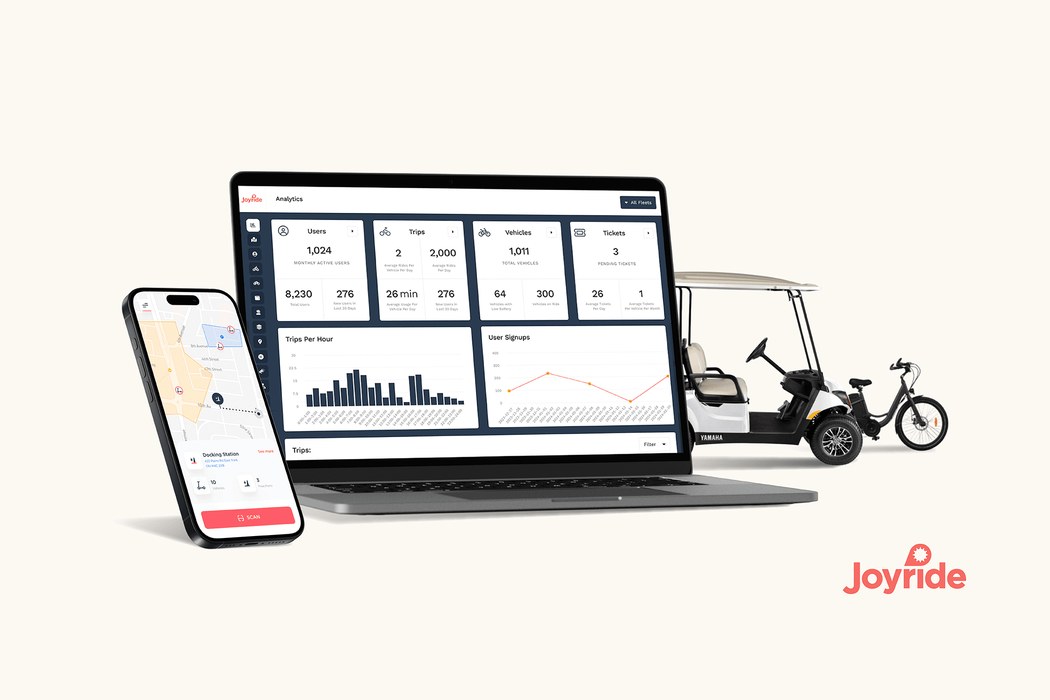
Joyride
Joyride is a Toronto-based mobility software company that gives operators, cities, dealers and OEMs a white-label platform to launch and run shared and rental fleets of e-bikes, e-scooters, golf carts, low-speed vehicles and other lightweight vehicles. Its hardware-agnostic system turns vehicles into connected, keyless and trackable assets, pairing branded rider apps with a fleet-management dashboard, IoT connectivity, payments and increasingly AI-driven operations tools. Founded in 2014 and backed by Yamaha Motor, Joyride powers fleets across 250+ markets on five continents.
Sfara
Sfara is a Hoboken, New Jersey-based mobility-safety software company that turns an ordinary smartphone into a crash-detection and emergency-response platform - no dedicated hardware required. Using patented on-device AI, its SDK detects vehicle collisions at any speed (including its 'ZeroMotion' capability for stationary vehicles) while a multi-layered suppression framework filters out false positives. Sfara sells a GDPR-compliant SaaS platform to insurance carriers, automotive OEMs, fleets, and mobile network operators, aiming to accelerate first-notification-of-loss (FNOL), speed emergency response, and modernize telematics.

LEEO
LEEO is a commercial auto insurance managing general agent (MGA) that uses telematics, agentic AI, and data science to underwrite, price, and manage risk for fleets. Formerly known as Fairmatic, the company rebranded and relaunched on December 15, 2025 under CEO Jeffrey Chen. It serves brokers and fleet operators - focusing on segments like non-emergency medical transport, light business auto, and last-mile delivery - with fast AI-driven quoting and binding, actionable safety insights, and a telematics-based claims process that can detect crashes and auto-fill incident reports. LEEO is backed by Battery Ventures, Foundation Capital, and Aquiline Technology Growth.
Standard Fleet
Standard Fleet is a San Francisco-based software company building a hardware-free fleet management platform for the connected-vehicle era. It plugs directly into a vehicle's own cloud API to deliver telematics, digital keys, automated payments and EV management across 30+ automakers - no dongles or aftermarket devices required. Started as a consumer app for Tesla owners, it now connects roughly 100,000 EVs for rental, rideshare, leasing, insurance, corporate and government fleets, and was the first third-party app authorized on Tesla's fleet platform.

VOOM Insurance
VOOM Insurance is an insurtech company building usage-based, telematics-driven insurance for underserved mobility segments - motorcycles, drones, e-bikes, light aircraft and gig drivers. Founded in 2016 by Tomer Kashi and Ori Blumenthal, VOOM launched the world's first pay-per-mile motorcycle insurance and, through its SkyWatch division, became the leading digital drone insurance product in North America. The company charges customers based on actual usage rather than flat annual premiums, aiming to make coverage fairer for people whose vehicles sit idle for much of the year.

Monarch
Monarch is a San Francisco based reseller and deployment partner for cloud-managed physical security and connected-operations technology. As an authorized Verkada reseller and Samsara channel partner, it designs and installs AI-powered camera systems, access control, environmental sensors, and fleet dash-cam and GPS telematics for schools, hospitals, warehouses, construction sites, and multi-site enterprises. The pitch is enterprise-grade security without the NVR/DVR complexity - hardware that updates over the air and is managed from a single cloud dashboard.