The most consequential sentence in a clinical record may be the one nobody thought to structure. It can sit inside a physician’s note, surrounded by abbreviations and the ordinary clutter of a working day. It does not line up politely in a spreadsheet. It does not volunteer itself to the researcher. It waits.
Venky Soundararajan has arranged much of his career around that wait. As co-founder and chief scientific officer of nference, he works on the ungainly problem of making biomedical knowledge computable: papers, laboratory results, images, genomic information and years of narrative records that were created to care for a person, not to please an algorithm. His companies have given this problem three different forms. nference works across clinical data. Anumana focuses on the signals inside electrocardiograms. Pramana, now part of Evident, brought pathology slides into the digital fold.
The common idea is almost suspiciously tidy. The evidence exists; the connections do not. Soundararajan’s job is to persuade machines to find them, institutions to permit the search, and scientists to decide whether the pattern means anything. Artificial intelligence supplies the headline. Trust, data plumbing and disciplined doubt do most of the heavy lifting.
nference
Clinical notes, labs, imaging, genomics and longitudinal histories become research-ready evidence.
Anumana
AI reads electrophysiology signals for patterns that may be difficult to see in routine interpretation.
Pramana
Robotics and software digitize pathology slides so physical specimens can enter computational workflows.
Before the record, the protein
Soundararajan did not begin with hospital paperwork. He studied electronics and communication engineering at IIT Guwahati, graduating in 2005, then moved to MIT for a doctorate in biological engineering. The switch looks dramatic only if engineering is mistaken for a collection of subjects instead of a habit of mind. Circuits became proteins; signals became biological interactions. The persistent question was how relationships inside a complicated system could reveal what its isolated parts concealed.
One paper from 2014 makes the continuity unusually visible. Soundararajan and his collaborators studied connectivity inside cancer-related protein structures, borrowing inspiration from the logic of Google’s PageRank. A residue far from a drug’s binding site could still matter because networks have their own geography. Influence is not always seated where the action appears to be.
That is a useful prehistory for nference. The company’s later canvas was vastly larger, but its intellectual instinct was familiar: connect enough fragments and an otherwise quiet signal may become legible. Soundararajan also completed a genetics research fellowship at Harvard Medical School. By then he had inhabited electronics, computation, biology and medicine - an interdisciplinary itinerary that resembles a committee meeting, except that one person had to attend every session.
“Clinical data is extraordinarily rich, but the signals that matter are fragmented across notes, laboratory results, images, genomics and years of patient history.”Venky Soundararajan, 2026
The partner was part of the invention
In 2013, Soundararajan and Murali Aravamudan formed the idea that became nference. Neural networks were advancing quickly, while biomedical information was expanding in every direction. Their proposed platform would synthesize, triangulate and visualize that unruly material. It sounded persuasive in a diagram. The practical obstacle was finding an institution willing to do the work with them.
Soundararajan later called the search for the right enterprise partners the most arduous part of nference’s early journey. The wording matters. Hospitals are not merely owners of large datasets. They are custodians of records created inside relationships of care, hemmed in by legal duties and justified suspicion. A clever model without institutional trust is a race car without a road: impressive, loud and going nowhere.
The long partnership with Mayo Clinic became nference’s road. The work included automated de-identification and machine-assisted curation of electronic records, allowing research on longitudinal evidence while protecting patient identities. In 2017 the partners also launched Qrativ, a joint venture intended to combine computational knowledge synthesis with clinical expertise for drug discovery. Soundararajan served as a co-founder and chief scientific officer.
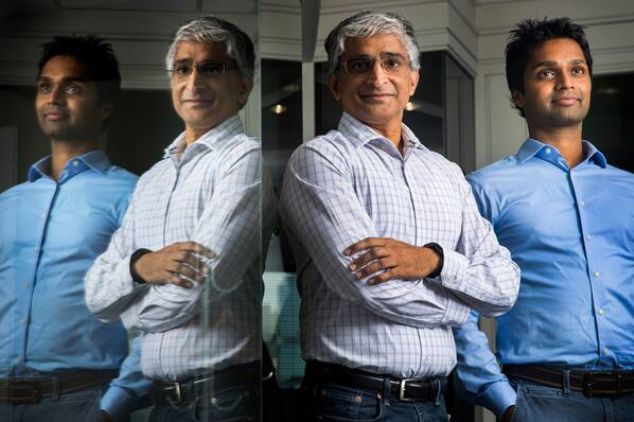
His advice to aspiring entrepreneurs follows directly from that experience: find the right partners and keep investing in the team’s success. There is little cult-of-the-founder theater in the prescription. The institution, the scientists, the engineers and the clinical collaborators are not scenery around an idea. They are how the idea becomes real.
When the archive answered quickly
The pandemic turned the value of connected clinical evidence into an immediate public question. nference researchers worked across biomedical literature, molecular information and de-identified real-world records. Their studies examined early symptom patterns, viral biology, variants and vaccine performance. The work also exposed a paradox of research at speed: urgent evidence is most valuable precisely when everyone is most tempted to overstate it.
Soundararajan has told one story that captures the velocity. After his team posted a real-world comparison of two mRNA vaccines, messages from the CDC and NIH arrived within six hours. Over the next day came calls from scientists and interview requests. Within a week, two independent health systems had validated the data and the findings appeared in a White House briefing. For a scientist, this is the equivalent of dropping a pebble into a pond and discovering that the pond has a press office.
The anecdote is thrilling, but the more durable point is restraint. In a 2026 interview about retrospective evidence, Soundararajan addressed bias, mechanism and the higher bar required before an observed association should alter prescribing. Real-world data is powerful because it records what happened outside the neat boundaries of a trial. It is treacherous for the same reason. People do not arrive randomly assigned, with every confounding variable tied up in a bow.
His public language now often carries both acceleration and caveat. AI can curate vast clinical narratives; physicians still validate. Observational work can generate a sharp hypothesis; it does not magically become causation because the sample size has acquired commas. The scientist’s responsibility is not only to reveal the signal but to draw a bright line around what it has yet to prove.
A company becomes a constellation
Anumana and Pramana made nference’s underlying thesis easier to see. An ECG is not prose, and a pathology slide is not a laboratory value, yet each contains more information than a conventional workflow may extract. Anumana was established with Mayo Clinic to develop AI from electrophysiology signals. Pramana built technology to scan and manage pathology at scale. The ventures were less a departure from nference than an expansion of its grammar.
Soundararajan’s official biography credits him with more than 50 scientific papers and patents. The subjects range from influenza and cancer proteins to genome editing, electronic records and clinical outcomes. Breadth can become a polite word for distraction, but here the connecting line is unusually firm: biological information is plentiful, distributed and often trapped in the wrong form.
By 2026, that approach had expanded into new federated programs and institutional collaborations. nference announced a Metabolism Agentic Intelligence Atlas drawing from de-identified care patterns across more than 30 million patients. In September, the company and Rush University System for Health announced a long-term collaboration for a secure, Rush-hosted analytics platform. The architecture reflects the lesson of the Mayo years: bring computation to the institution’s data environment rather than treating sensitive information as luggage to be casually moved.
The valuable signal is often not absent. It is stranded - in a note, a waveform, a slide, or a system that cannot speak to its neighbor.
The difficult art of making fragments agree
Soundararajan describes his ultimate mission as teaching machines to read and comprehend every form of biological data and clinical knowledge. “Comprehend” is the dangerous word, the one philosophers and software salespeople could argue over until the lights go out. In his working version, comprehension has a practical test. Can the system connect evidence well enough to produce a useful, testable question for a scientist or clinician?
That test keeps the ambition grounded. A clinical note was written by a person about a person. An ECG is the trace of a living electrical system. A pathology slide is tissue, not pixels merely waiting for an impressive model. Turning these into computation should increase their meaning, not flatten it.
The career that began with networks inside proteins now spans networks between hospitals, companies, researchers and data types. Soundararajan has not solved the archive, which is fortunate because archives resent finality. He has built an increasingly elaborate way to ask it questions. Somewhere in the disorder, another consequential sentence is still waiting. The machine may find it first. The human work begins the moment it does.