The first version of Secureframe was not software. It was a collection of Excel sheets, guides and auditor recommendations that Shrav Mehta passed to founders who were trying to understand SOC 2. This was generous, useful and plainly unsustainable. Then he asked the important question: if he built a product to automate the ordeal, would anyone use it? People said yes, as people often do. One of them did something rarer. A month later, the founder called back and asked where the product was. Mehta quit his job that week.
The quick read
- What it does: connects to cloud and business systems, gathers evidence, monitors controls and prepares teams for audits.
- Who buys it: startups chasing enterprise deals, regulated companies, larger security teams and defense contractors.
- What it costs: the public Fundamentals plan starts at $7,000 a year; audits and deeper services can add to the bill.
- Why it is different: expert guidance, common-control mapping, trust workflows and a growing federal-compliance specialty sit in one platform.
- Where it stops: software can preserve proof and expose gaps. It cannot create executive ownership or perform the independent audit.
A buyer asks the awkward question
Mehta had met the problem at Lob, the direct-mail software company. Enterprise customers would arrive with sensitive data, exhaustive security reviews and questionnaires that could run to a thousand lines. A young company might have perfectly sensible engineering and still be unable to prove it in the language procurement understood. The sale stopped until the proof appeared.
That distinction matters. Secureframe is described as compliance software, but the urgent event is often commercial. A prospect wants a SOC 2 report before signing. A hospital customer asks about HIPAA. A card-processing partner wants PCI DSS. A federal contract introduces CMMC or FedRAMP. The security team sees controls; the founder sees a deal waiting in legal's inbox.
“One person called me back a month later asking where the product was. I quit my job that week.”Shrav Mehta, founder and CEO
By the time Secureframe had an MVP, more than 40 companies were waiting. Mehta and co-founder Natasja Nielsen began with SOC 2 and ISO 27001 because the first customers needed both. Customer requests pulled the roadmap toward HIPAA and PCI DSS, then into privacy, risk, vendor management, trust centers, AI governance and custom frameworks. The founder did not discover that everyone adored compliance. He discovered that enough people urgently disliked doing it by hand.

The list beneath the list
A framework looks forbidding until you reduce it to work. Employees need background checks and confidentiality agreements. Cloud logs must be enabled. Data must be encrypted. Access must be reviewed. Incidents need a plan. The old method scattered those facts across calendars, email and shared drives. What failed first was usually continuity: somebody forgot one check, a screenshot went stale, an employee changed roles, or the evidence vanished into the wrong folder.
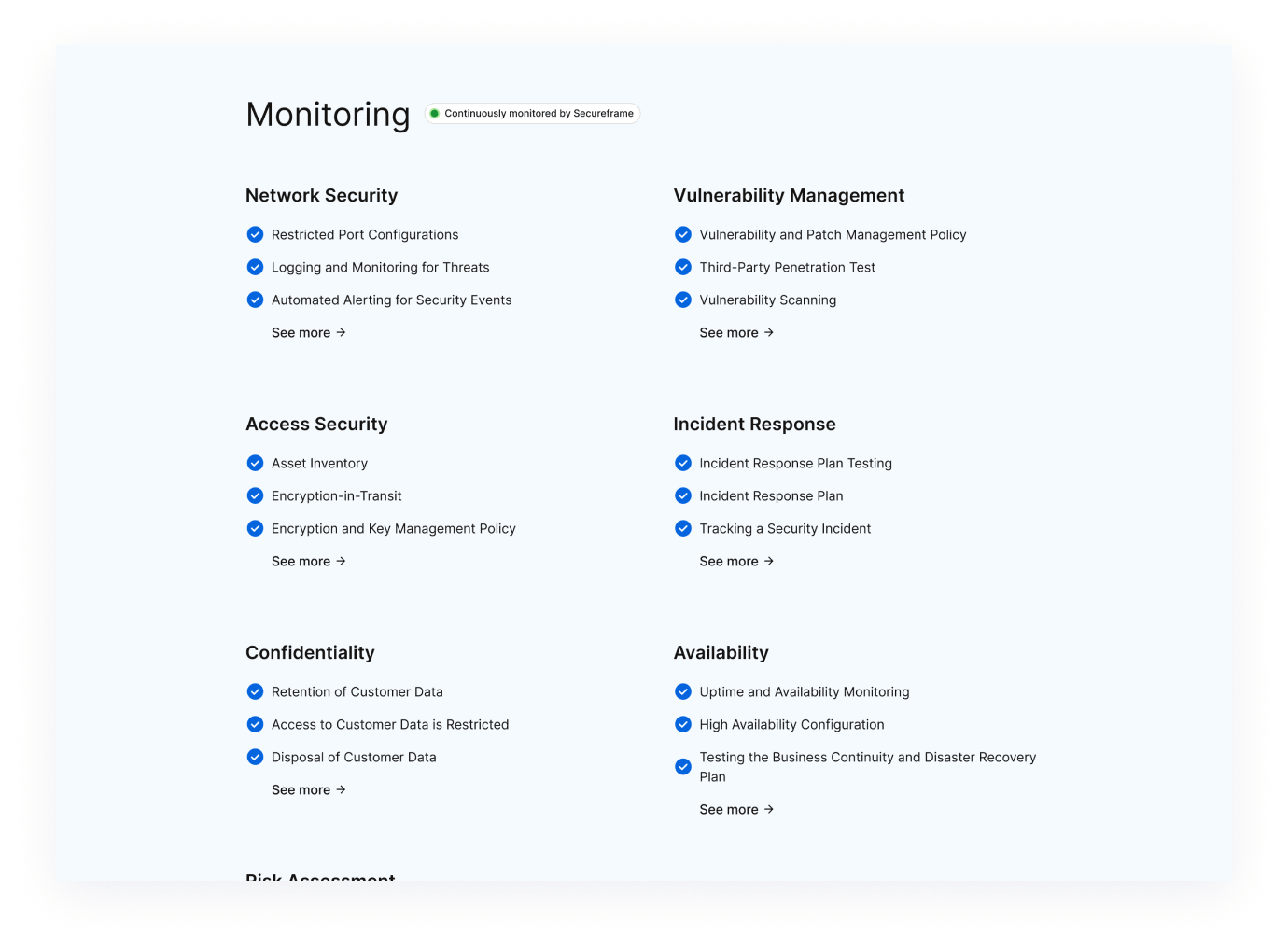
Secureframe connects to systems such as AWS, Azure, Google Cloud, GitHub, identity providers, HR tools and device managers. It tests configurations, collects evidence and flags exceptions. The useful trick is the common control. One background-check process may support several frameworks; one encryption control may satisfy several auditors. Do the work once, map it many times, and keep watching for drift.
The platform now has three obvious faces. Comply is the operating room: controls, tests, policies, risks, personnel, vendors, training and audits. Trust is the shop window: a trust center, knowledge base and questionnaire automation for answering the next buyer without beginning again. Defense is the specialist wing: CMMC scoping, secure cloud provisioning, System Security Plans, Plans of Action and Milestones, live scoring and assessment preparation.
The money is in the pause
Secureframe is recurring B2B software because compliance recurs. Certifications must be maintained, evidence refreshed and controls monitored as employees, vendors and infrastructure change. The Fundamentals package begins at $7,000 a year and includes infrastructure monitoring, evidence collection, policy and risk management, custom controls and a trust center. Complete adds deeper risk, vendor, access-review and questionnaire features. Defense is quote-based.
The subscription is not the entire price of becoming compliant. An independent auditor still has to perform the formal audit, technical gaps may require engineering work, and sophisticated programs may need consultants or penetration tests. This is where marketing arithmetic can become a little too charming. Automation cuts the scavenger hunt; it does not repeal the standard.
Still, the comparison is not software versus zero. It is software versus staff hours, consultants, duplicated evidence, missed controls and the opportunity cost of a delayed contract. Echo IQ, a health-technology customer, said it reached SOC 2 and HIPAA in six months and saved $120,000 in consulting and staffing costs. Manufacturing Consulting Concepts reported more than 500 hours saved on NIST 800-171 and CMMC work. They are customer case studies, not universal promises, but they reveal what buyers put in the denominator.
Secureframe offers continuity, integrations, ownership and an audit trail. The spreadsheet remains cheaper until its omissions become expensive.
The platform makes repeatable work scalable. Specialists remain valuable for scoping, interpretation, remediation and unusual environments.
The core category overlaps heavily. Secureframe leans on guided expertise, multi-framework work, trust workflows and federal depth.
This is the strongest competitor until a customer, regulator or contract makes proof of security unavoidable.
From startup badge to defense paperwork
The company's expansion follows a revealing sequence. It began where urgency was easy to see: small software companies needed a recognizable badge to sell upmarket. It then moved into the machinery around that badge - customer questionnaires, vendor reviews, risk registers and policy management. AI features arrived to draft policies, suggest questionnaire answers, map controls and propose remediation. In 2024, Secureframe added NIST AI RMF and ISO 42001 support, allowing the compliance system to govern the very technology assisting it.
The next move was toward Washington. Secureframe Federal launched in 2025 for CMMC 2.0 and FedRAMP 20x. The company completed its own CMMC Level 2 assessment and participated in the FedRAMP 20x pilots, later announcing a Moderate-level milestone in June 2026. Secureframe Defense followed with a more opinionated package for organizations handling controlled government information. In August 2026, a hosted MCP server let compatible AI assistants work with permission-aware compliance data. The path runs from collecting screenshots to letting agents query the live record.
SOC 2 and ISO 27001 automation, built around early customer demand.
HIPAA, PCI DSS and broader GRC capabilities join the platform; funding reaches $79 million.
AI-assisted policies, risk, remediation and questionnaires expand the workflow.
Federal and Defense products, access reviews, FedRAMP progress and a hosted MCP server.
Where the shortcut ends
Secureframe works best when a company has a reasonably modern technology stack, a clear framework target and somebody accountable for the program. It works especially well when revenue supplies a deadline. The integrations can then collect facts that already exist, the platform can organize the gap list, and experts can help translate the standard.
It is a poorer fit when the environment is mostly bespoke, offline or operational technology; when leadership expects a badge without changing weak practices; or when nobody owns remediation. A failed encryption test is useful information, not an automatic fix. AI-drafted policies still have to describe the business honestly. Questionnaire suggestions need review. Federal work can require specialized infrastructure, assessors and exact scoping. The software can make accountability visible. It cannot manufacture accountability.
What another company can copy
- Wait for behavior, not compliments. The callback asking for a product was stronger evidence than a dozen friendly yeses.
- Attach the product to a costly deadline. Enterprise procurement gave compliance automation urgency and a budget.
- Find the common control. Reuse work across standards instead of treating every framework as a new project.
- Automate proof before prose. Live evidence and tests are harder to fake and easier to maintain than polished policy documents.
- Keep experts beside the machine. Repetition scales in software; interpretation and judgment do not disappear.
Secureframe's cleverest move was to notice that compliance is not purchased for the pleasure of compliance. It is purchased because somebody else - a buyer, an auditor, an agency - needs to believe you. The company turned that need into a system of record and then kept following the evidence outward. The certificate may be the visible prize. The less visible prize is that next year, when the awkward question returns, the answer is already waiting.