There is a peculiar indignity in modern advertising. A company can know what you browsed, where you live, what the weather is doing and whether a blue sofa remains in stock. Then, after assembling this orchestra of information, it serves you a generic rectangle. The targeting is a telescope; the creative is a Post-it note. Innervate exists in the embarrassing distance between the two.
The company started in 2014 as RevJet. Founders Mitchell Weisman and Serge Ioffe had spent years at LifeStreet Media, where they learned that the media market had lavished engineering on bidding, targeting and pricing. Far less attention went to the final object delivered to a person: the image, wording, offer and arrangement of the ad. RevJet built an “Ad Experience Platform” to manage, test and improve those objects.

The first failure was not inspiration. It was plumbing.
A large campaign can involve designers, media buyers, analysts, lawyers, product feeds, customer-data platforms, ad servers and regional teams. One image must become many sizes. One offer must obey inventory, geography and compliance rules. Every variation must be approved, trafficked and measured. The first thing to fail is usually the manual test: too many meetings, too much coding, too few experiments and results that arrive after the question has gone stale.
LendingTree described precisely that trap. Every test demanded brainstorming, legal approval, production, coding, careful execution and another round of meetings to distribute the result. It spent two years evaluating dynamic-creative platforms. The change of mind came when automation offered control as well as speed. In one later experiment, an ad showing personalized monthly payments produced a reported 66 percent lift. The platform could also retire losing variants once the evidence was strong enough. A bad ad stopped being a political dispute and became a number with an off switch.
“Our goal is to find winners faster and find losers faster, as well.”LendingTree customer case study
Four shirts, one answer
The cleanest Innervate story belongs to OTTO, the German ecommerce company. OTTO had more than 5,000 creatives in market and wanted to expand programmatic advertising without expanding its staff. Earlier tools could swap products, but a marketing manager could not easily reshape the creative itself. OTTO wanted a system that fit its stack, offered self-service building and reporting, and could support experimentation.
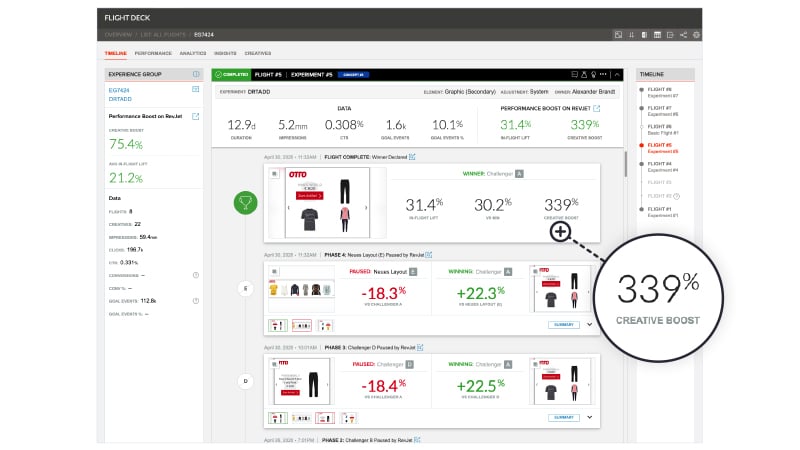
It did not begin with a transformation program. A small core team ran a proof of concept. With online training and documentation, it stood up a campaign with new creative concepts in 35 business days. In one test, ads showing different numbers and types of products competed. Four clothing products won, producing a reported 339 percent creative boost. The lesson is not that four shirts possess mystical commercial power. It is that the machinery allowed a retailer to ask the question cheaply, answer it cleanly and remember the result.
Nordstrom supplied the same lesson at a different speed. It connected a product feed and compared a single-product scrolling ad with a multi-product carousel. In less than a day, the carousel generated 71.5 percent more shopping-bag adds at 95 percent confidence. Speed matters because it changes the questions a team is willing to ask. When an answer takes a quarter, curiosity becomes expensive. When it takes a day, curiosity becomes a habit.
RevJet outgrew its own name
By 2023, the company’s problem had widened. Ads were only one surface. The same content logic applied to email, websites, landing pages, social posts, video, audio, in-app messages, retail media and in-store screens. RevJet relaunched as Innervate, a reference to the nerves that activate muscles. The metaphor is conspicuous but accurate: the product does not aspire to be every muscle. It wants to carry instructions among them.
The current Dynamic Content Orchestration Platform sits above systems a customer already owns. Its Orora operating layer, AppXchange and connector library link data, assets, workflows and delivery tools. Innervate says the catalog includes more than 60 apps and 100 connectors. Creative teams can make templates and variants; operations teams can build approvals and trafficking flows; analysts can compare performance across channels; decisioning tools can change images, copy, offers and calls to action using audience or real-time signals.
This distinguishes Innervate from a pure ad builder, a customer-data platform or a generative AI tool. Celtra and Flashtalking approach parts of the dynamic-creative problem; Adobe, Optimizely, Bloomreach and Braze cover adjacent territory; an enterprise can also assemble its own stack. Innervate’s wager is that the valuable product is the connective layer and its persistent memory. It calls that memory “forever memory,” which is grand language for a sensible idea: do not let an experiment disappear when an employee or agency does.
The bill, and the bargain
Innervate sells enterprise software rather than a self-serve subscription with a cheerful $49 button. Customers purchase an annual Innervate Pass for access, then pay network-usage fees for active subscriptions. Dollar pricing is negotiated. Its published standard terms include a curious provision: during the first ten days of each month, a customer may reduce the previous month’s network-usage fees. This “Forever Happiness Guarantee” is partly branding, partly risk control, and unusually concrete for enterprise software.
The company raised a $21 million Series A led by Nautic Partners in 2018, bringing disclosed funding at the time to $30 million. That money was earmarked for product, engineering, AI, machine learning, personalization and international expansion. The business now serves large teams in retail, ecommerce, financial services, telecommunications, travel and direct response. Public customer references include OTTO, Nordstrom, LendingTree, Core Digital Media, Bridgestone, Allstate, Zalando and Yahoo.
The part worth stealing
The most transferable idea here does not require buying Innervate. Choose one workflow in which manual coordination is expensive. Name the failure in measurable terms: launch time, production hours, conversion rate, approval delay. Give a small cross-functional team enough authority to run a proof of concept. Compare variants against a control. Agree in advance on statistical confidence and what happens to a loser. Then preserve the finding somewhere the next campaign can use it.
This approach works because it makes technology answer a bounded question. It also explains what changed customers’ minds. OTTO did not standardize on a platform because “orchestration” sounded modern. It watched a small team launch, measured a winner and saw a route to scale without more staff. LendingTree did not seek more dashboards. It wanted shorter test cycles and control over assets. Nordstrom wanted its tools to fit together. In every case, the persuasion arrived as operational evidence.
Conditions for a useful deployment
- Enough content volume and variation to justify an orchestration layer.
- Usable product, customer and performance data with clear permissions.
- Conversion events that can be measured, not merely admired.
- Teams willing to standardize approvals, naming and campaign workflows.
Without those conditions, orchestration can become another expensive layer over disordered data. A small company running a handful of static campaigns probably needs discipline more than software. A large company whose legal team will not accept automated variants may produce thousands of possibilities that never leave review. And AI generation, however fashionable, can worsen the blockage by creating assets faster than humans can govern them.
That is why Innervate’s least glamorous features may be its most important: connectors, approvals, trafficking, measurement and institutional memory. The creative still matters. But in enterprises, the difference between an idea and an impression is a long chain of ordinary work. Innervate has built its company around making that chain less ordinary.